

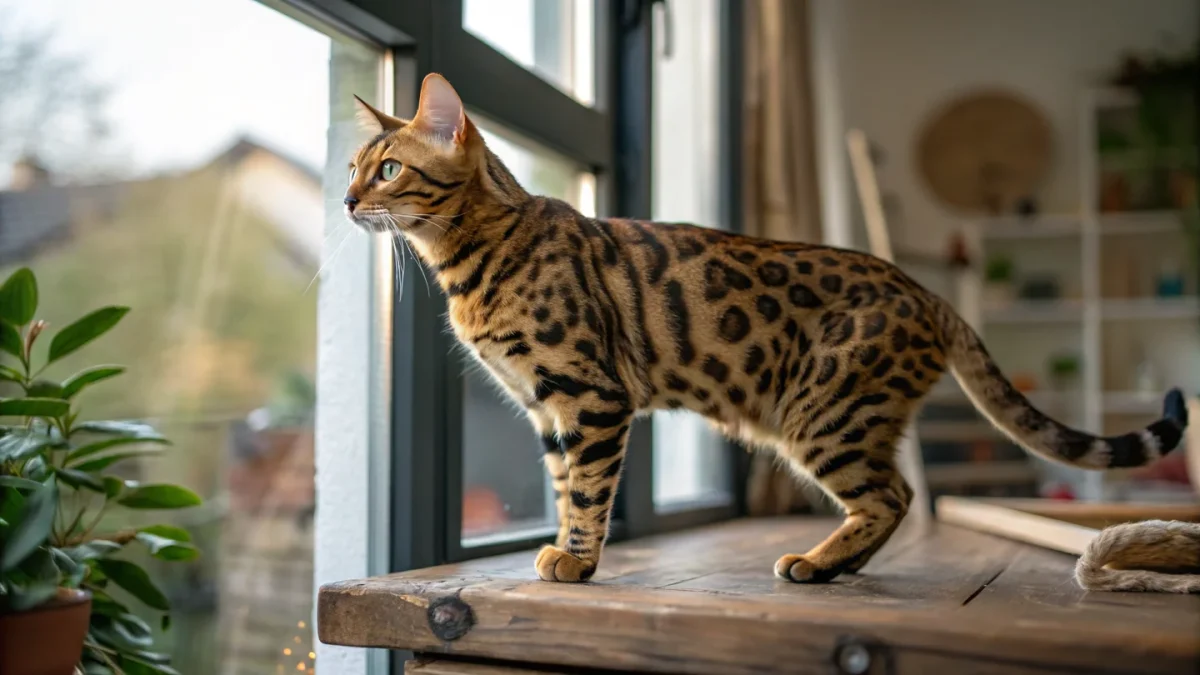
The question worth asking before acquiring a Bengal is not "do I like how they look?" The answer to that is almost always yes — the coat is extraordinary. The question worth asking is whether your daily life actually accommodates what this breed requires.
The Bengal ends up in rescue situations more often than most cat breeds, and the overwhelming pattern is the same: people who fell in love with the appearance didn't anticipate the activity level, the enrichment needs, or the sustained engagement commitment. None of these are unreasonable demands. They just aren't what most domestic cat ownership involves, and the mismatch causes problems.
What the Bengal Actually Requires Day to Day
For full detail on the breed, read the complete Bengal breed guide. For decision purposes, the picture distills to a few core requirements.
Daily interactive play. Two substantive sessions per day, 20–30 minutes each. Not launching a ball occasionally and seeing if the cat bats it. Sustained, prey-drive-engaging sessions with interactive toys. This is a minimum for mental health, not a luxury.
Vertical space. Tall cat trees, wall-mounted shelves, or other climbing infrastructure. Bengals are physically large and heavy relative to the average domestic cat — budget cat trees won't hold them. This is a real equipment investment.
Company during absence. A Bengal alone all day without a companion animal is a Bengal channeling its intelligence into whatever your home offers. The outcomes are not usually what you'd want. A second active cat, or an owner who works from home, or a very enriched environment — some combination of these is necessary.
A secure household. Bengals investigate everything, can open certain types of cabinet latches, and have access to heights most cats can't reach. Households with breakables in high places need to consider this. Households with small animals in cages — birds, rodents, fish — need to consider this very seriously.
What You Get in Return
Against those real requirements: a cat unlike most others.
The coat genuinely stops people. The glitter effect in direct light is something that doesn't lose its visual impact with familiarity. The rosettes and spots are so clearly wild-derived that living with a Bengal carries a persistent sense of mild improbability.
Bengal temperament in depth reveals a personality that is engaging in ways that sedentary cat breeds aren't. Bengals interact with their environment actively, learn their owners' patterns, respond reliably to training, and deliver a level of behavioral complexity that keeps the relationship interesting over fifteen-plus years. This is not a cat you stop noticing.
The athleticism is impressive. A well-conditioned Bengal navigating an enriched environment — making precise leaps, engaging with puzzle toys with focused persistence — is genuinely worth watching.
Before You Decide
Your current life situation:
- How many hours a day are you away from home? If 8+, is there another animal companion?
- Do you have small animals already (birds, fish, rodents) that share the space?
- Do you have children? Their age and temperament with cats matters.
- Do you have the physical space for adequate vertical enrichment?
What you want from a cat:
- Do you want active daily engagement, or a more ambient companion?
- Are you prepared to structure daily play sessions indefinitely?
- Do you want a cat that is visually spectacular and behaviorally interesting?
Practical questions:
- Can you verify the generation (SBT) of the Bengal you're considering?
- Is a Bengal legal to own where you live? Laws vary.
- Are you prepared for the typical Bengal lifespan of 12–16 years?
The Right Owner for a Bengal
The Bengal thrives with an active owner who has the time, space, and interest to match the cat's energy. People with home offices who work surrounded by a cat exploring the environment find the Bengal's constant low-level activity a compelling background. People with active households — children, dogs, other cats — often find Bengals integrate well because there's always something interesting happening.
What the Bengal genuinely struggles with is benign neglect. Not cruelty — just the low-key absence of engagement that works fine with many breeds and fails catastrophically with this one.
The cat that results from a well-matched placement is something special. Confident, athletic, visually remarkable, genuinely interactive. For the person it suits, there's no breed quite like it. If you're working through a broader decision about which high-energy breed might suit you, how to choose a cat breed provides a structured way to map your lifestyle to breed traits.