

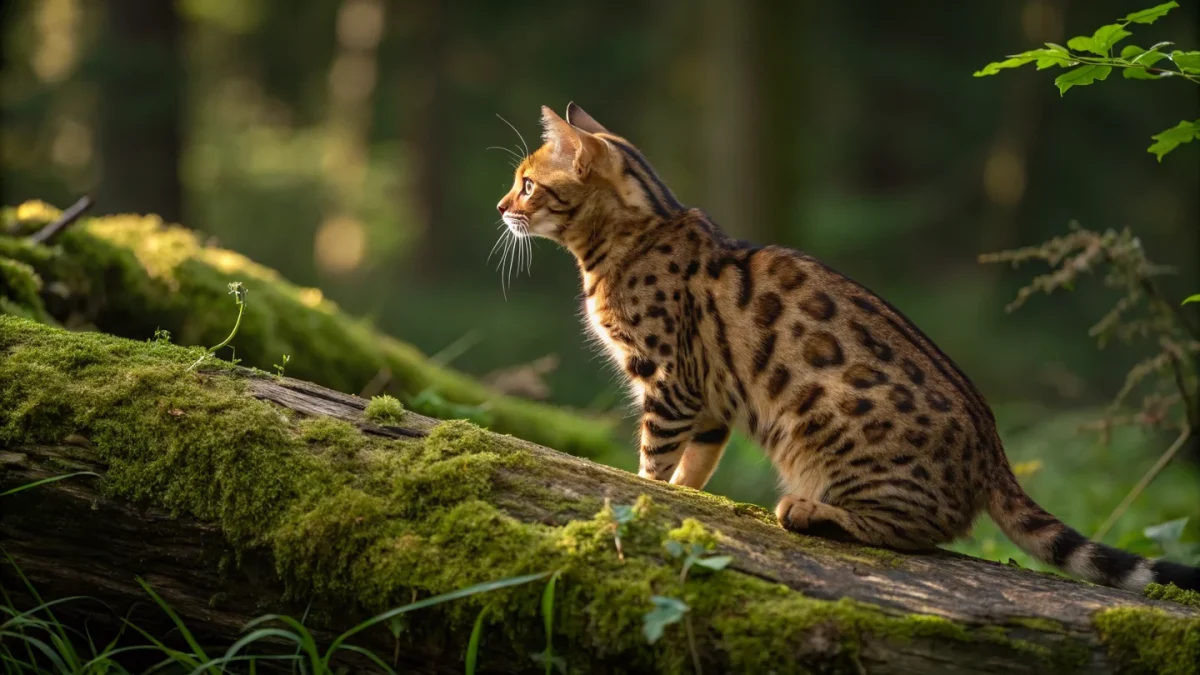
I've been to enough cat shows to stop being surprised by breed enthusiasm. Siamese people are devoted. Maine Coon people are a whole thing — I have a breeder friend who can talk about her cats for three hours without repeating herself. But the Bengal contingent at shows is something different. The first time I stopped at a Bengal ring at a national specialty, it was because someone walking past me said, quietly and entirely to themselves, "they look illegal." That's the right reaction. That coat — the rosettes, the glitter, the horizontal flow that tracks across the flanks like a wild cat's — doesn't look like selective breeding. It looks like something escaped.
The history behind that coat is stranger and more deliberate than most people know. The Bengal breed traces to one woman with a geneticist's mind and, by her own account, a dream of creating a domestic cat that looked like it lived in a forest. Jean Mill came remarkably close.
Mill's original intent had nothing to do with disease research and everything to do with the fur trade. By her own account, she wanted to give people a housecat that looked like a wild leopard cat so the real ones would stop getting shot for pelts and their cubs stop getting sold into the exotic pet trade. She later gave the F1 hybrid female back to the leopard cat father — standard practice for wild-domestic hybrids in early hybrid work — and the project was set aside when her first marriage ended.
That might have been the end of it. It wasn't.
The Reconnection and the Research Program
In the early 1980s, Mill — by then remarried and living in California — learned about a research program run by Dr. Willard Centerwall at the University of California, Davis. Centerwall had been conducting ALC-domestic crosses to study whether wild cat resistance to feline leukemia could be introduced into domestic cat populations. The research had produced a number of hybrid females, but the project was winding down, and Centerwall needed to place the cats.
Mill acquired eight of these F1 hybrid females from Centerwall's program. She also independently acquired ALC males from wildlife dealers to breed to domestic cats. From these foundations, she began building what would become the Bengal breed in earnest.
The name "Bengal" came from the Asian leopard cat's taxonomic name — Prionailurus bengalensis — rather than from any geographic connection to the Bengal region specifically.
The Founding of the Bengal Breed
Mill's work in the 1980s was not without complications. F1 and F2 hybrids were difficult to work with — the males were sterile, a common feature of early hybrid generations. Breeding required backcrossing F1 females to domestic males repeatedly to achieve male fertility, which didn't stabilize until the F4 generation in most lines.
The goal throughout was specific: a domestic cat with a wild-type spotted coat pattern. Mill described the desired outcome as a cat that looked like it had come from the jungle but had the temperament of a housecat. This required selecting for temperament in each generation alongside coat pattern — eliminating the wildest individuals from breeding programs and emphasizing individuals that showed manageable, social behavior.
Other breeders joined the work in the 1980s. Gordon Bussell and Elizabeth Cunnane in the United States contributed to expanding the early gene pool. Some lines incorporated other domestic breeds to address the fertility issue and expand the gene pool — domestic shorthairs, Egyptian Mau (which contributed some of the spotted pattern genetics that appear in certain Bengal lines), and Abyssinian all turn up in early Bengal pedigrees.
Registry Recognition
Bengal generations and the SBT threshold explains the generation system that governs Bengal classification. Registry recognition tracked closely with the establishment of the SBT (studbook tradition) designation.
The International Cat Association (TICA) gave the Bengal breed experimental status in 1983 and advanced it to championship status in 1991, when sufficient SBT generations existed to document domestic breeding stability.
Some of the major traditional cat registries were slower to recognize the breed, citing concerns about wild ancestry and the hybrid origins. Recognition processes varied significantly by organization and country, and not all registries have accepted the Bengal even in the decades since TICA championship status.
From Experimental Hybrid to Popular Breed
The trajectory from Jean Mill's 1963 experiment to the Bengal's current status as TICA's most-registered breed is one of the more remarkable stories in modern domestic cat breeding.
What Mill created — and what several decades of subsequent breeders refined — was a genuinely new category of domestic cat: a hybrid that had been domesticated generation by generation, with wild appearance preserved while wild behavior was systematically reduced. This required patience, because the generation threshold at which male fertility and domestic temperament stabilized took years to reach.
The coat pattern that emerged from the process — particularly the rosetted marking system that developed as breeders selected for ever-greater similarity to leopard and ocelot markings — exceeded what anyone could have reliably predicted from the founding cross. Domestic cats with full multi-toned rosettes had never existed before the Bengal program. The aesthetic achievement was genuinely novel.
The Controversy That Followed
The Bengal's popularity inevitably attracted breeding practices that bore little resemblance to Mill's careful generational work. As demand increased, some breeders cut corners on generation documentation, sold F1-F3 hybrids as appropriate pets, and prioritized appearance over temperament.
This contributed to the Bengal's early rescue problem — cats purchased as pets that were actually early-generation hybrids with temperaments incompatible with normal household life. The welfare consequences for those animals were significant, and the regulatory response in various jurisdictions — where F1-F3 Bengals began to be classified as exotic animals requiring permits — reflected legitimate concerns about misrepresentation in the breeding market.
The modern Bengal breed in its SBT form is a domestic animal — genuinely, not nominally. The wild ancestry explains the coat and some behavioral tendencies, but it is four or more generations removed from daily reality. The domestication that Jean Mill set out to achieve in the 1960s, and completed in the 1980s-90s, produced an animal that stands independently of its hybrid history.
That history is worth knowing, though. It explains why the Bengal looks the way it does, why the generation labeling matters, and why a breed whose founding is less than seventy years old can already have a complicated and instructive story.