

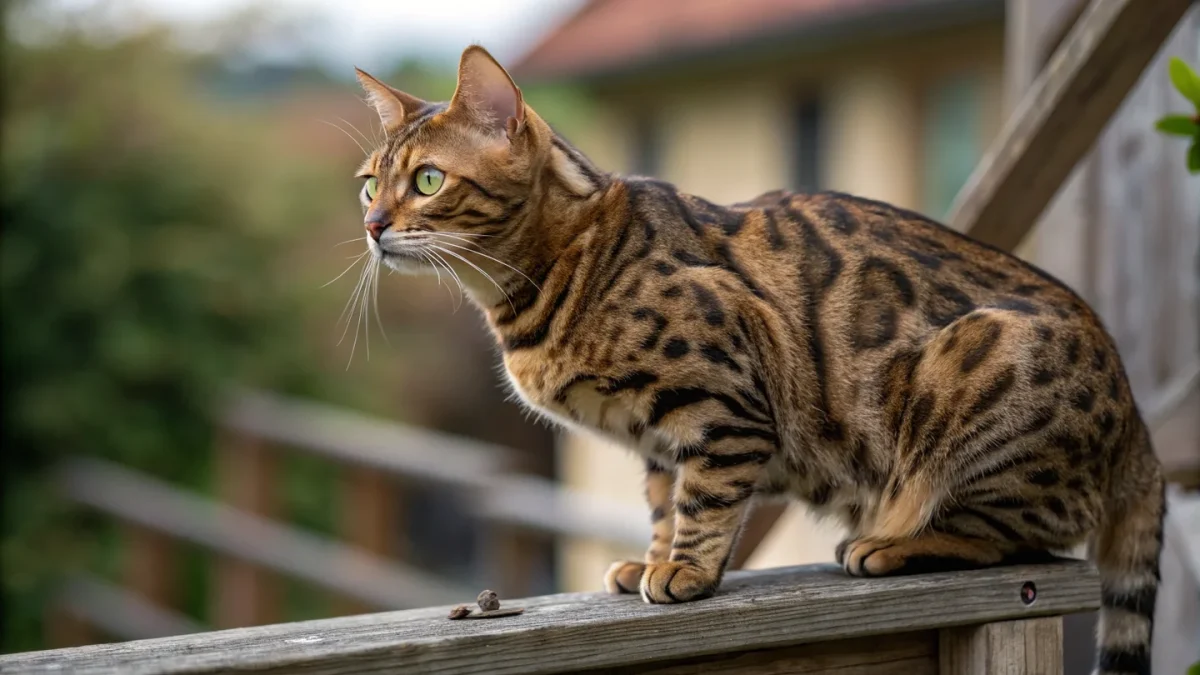
Bengals attract more misinformation than most domestic breeds, which makes sense given their unusual origin. A domestic cat with leopard rosettes that descends from a wild ancestor is inherently provocative — it invites speculation, projection, and the kind of dramatic claims that spread easily.
Some of the misconceptions inflate what Bengals are (dangerous, uncontrollable, essentially wild). Some deflate them (low-maintenance, easy to handle, naturally gentle). Most fall somewhere in between. Here are the six I hear most consistently, and what's actually true.
1. "Bengals Are Aggressive Because of Their Wild Blood"
This is the most persistent misconception and the one that causes the most unnecessary fear.
SBT Bengals — the four-or-more-generation domestic Bengals that responsible breeders sell as pets — are not aggressive animals. They are high-energy, prey-drive-motivated, demanding of stimulation, and capable of vigorous play. None of those qualities are aggression.
The distinction matters. An aggressive animal attacks without provocation or because it perceives threats in normal situations. A high-drive, understimulated Bengal that uses its owner's hands as play prey is demonstrating a management problem, not inherent dangerousness.
Early-generation Bengals (F1-F3) do carry behaviors that are genuinely challenging and potentially dangerous in household contexts — that's why they're not appropriate pets for most people. But the confusion of early-generation hybrid behavior with SBT Bengal behavior is like attributing wolf pack behavior to a Golden Retriever because dogs and wolves share ancestry.
2. "Bengals Are Hypoallergenic"
This claim circulates widely among breeders and online communities, and it is not supported by evidence.
No cat breed is hypoallergenic. The primary allergen in cat allergies is the Fel d 1 protein, produced primarily in the salivary glands and deposited on the coat during grooming. All cats produce Fel d 1. All cats groom. The Bengal breed is not an exception.
The Bengal's short, dense coat may mean that less loose hair distributes throughout a home compared to longhaired breeds, which may reduce indirect allergen spread to some degree. This is a real but modest effect. It is not the same as being hypoallergenic, and it provides no guarantee that an allergic person will tolerate a Bengal.
People with significant cat allergies should spend time with a specific Bengal before acquiring one, not rely on breed claims.
3. "The Glitter Coat Requires Special Grooming Products"
It doesn't. The glitter effect in Bengal coats is structural — it's produced by cells within individual hair shafts that refract light. It is genetic and inherent to the hair itself.
No product enhances it, no product damages it with normal use, and no special maintenance routine is required to preserve it. Regular brushing, nail trimming, and basic grooming are all the coat needs. Anyone selling "Bengal coat enhancers" is selling something the breed doesn't require.
4. "All Bengals Are the Same — Wild-Derived Cats with Wild Behavior"
Bengal temperament varies significantly between early-generation hybrids and SBT Bengals — and between individual SBT Bengals.
The generation system exists precisely because the temperament range from F1 to F4+ is so wide as to describe fundamentally different animals. An F1 Bengal with 50% ALC ancestry is not the same as an F7 SBT Bengal. Collapsing both into "Bengal" and attributing the same behavior to both is the source of considerable confusion.
Among SBT Bengals themselves, individual variation is substantial. Socialization history, specific breeding lines, and individual personality all affect how manageable any given Bengal is. The breed generalization holds (active, intelligent, prey-driven, demanding of engagement), but within that generalization is a wide range of individuals.
5. "Bengals Shed Minimally So They're Easy to Live With"
The coat claim is approximately accurate — Bengals shed less conspicuously than many double-coated breeds because their tight, flat coat retains loose hair rather than distributing it widely. In a comparative sense, Bengal owners often note less hair on furniture than they expected.
What this misconception misses is that "easier to live with" doesn't follow automatically from lower shedding. Bengal maintenance is not primarily about the coat. It's about the energy level, the enrichment requirements, the stimulation needs — the daily commitment that the coat has nothing to do with.
Someone who adopts a Bengal expecting an easy-care pet because "they don't shed much" will be surprised by the part of Bengal ownership that actually requires effort.
6. "Bengals Are Good for People Who've Never Had a Cat Before"
Bengals are not beginner cats. That's not a judgment on their character — it's an acknowledgment that their particular combination of traits (high activity, strong prey drive, intelligence, need for structured enrichment) is most successfully navigated by owners who understand cat behavior and have realistic expectations.
A first-time cat owner who gets a Bengal often loves the cat intensely, struggles with management, and attributes the struggle to the cat being "difficult" or "too wild." The same cat with an owner experienced in high-drive cats would present far fewer problems.
If someone has their heart set on a Bengal as their first cat, the honest advice is to do serious research, commit to the enrichment infrastructure before acquisition, and potentially spend time around Bengals through breeders or cat-sitting before committing. Not because Bengals are unmanageable — they're not — but because the transition to Bengal ownership goes better with preparation.