

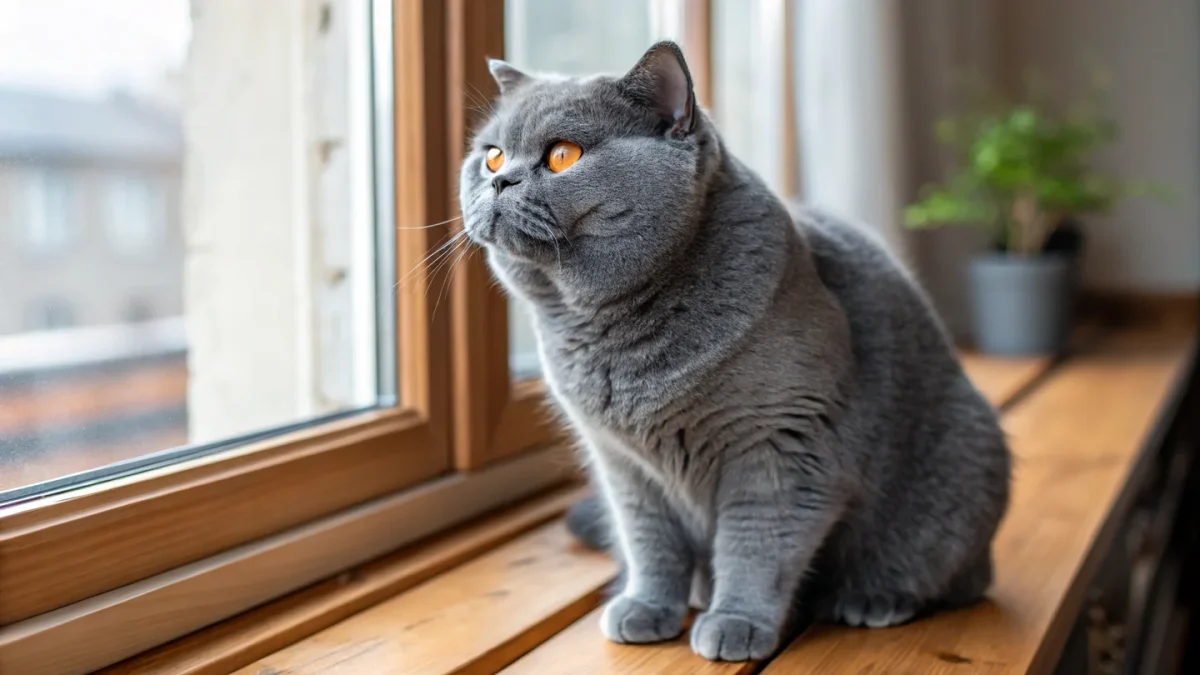
The British Shorthair gets dismissed fairly often by people who aren't familiar with the breed — "oh, that's just a fat gray cat" is a comment that would make any serious British Shorthair fancier visibly wince. The misconceptions that cluster around this breed tend to underestimate it in every direction: the structural roundness gets called obesity, the self-contained personality gets called aloofness, the calm gets called laziness.
All of these readings are wrong, and all of them matter for understanding what this breed actually offers. For the complete picture, see the complete British Shorthair breed guide and British Shorthair temperament.
"They're Just Fat Cats"
The British Shorthair's round, cobby appearance is structural. The broad skull, full cheeks, wide chest, short legs, and dense plush coat that stands away from the body — these are the breed standards, developed over decades of intentional selection. A British Shorthair at an ideal weight has a specific silhouette that reads as round.
An overweight British Shorthair looks different. The structured roundness loses its quality — the waist disappears, the movement changes, and when you run your hands along the sides, you can't feel the ribcage definition that should be there. The fat-cat version and the healthy-breed-type version are distinguishable once you know what you're looking at.
That said, British Shorthairs are prone to weight gain. Their low-to-moderate activity level and tendency toward food motivation is a combination that doesn't self-regulate well without portion control — one breed nutrition resource puts their predisposition to weight gain at roughly 25% higher than mixed-breed cats. The round silhouette shouldn't be maintained by overfeeding — it should be maintained by the cat's actual bone and muscle structure.
"They're Unfriendly"
British Shorthairs are private. They're not cold. The distinction matters.
An unfriendly cat avoids people, shows aggression when approached, and doesn't seek contact at all. A British Shorthair in a household it trusts will come find you when it wants company, sit beside you with evident contentment, slow-blink at you from across the room, and show genuine pleasure when you scratch behind its ears in the right spot.
What it won't do is perform affection on your schedule, rush to greet every guest, or climb uninvited into your lap. The British Shorthair's affection is real; it's just offered on the cat's terms rather than yours. For the owner who respects that distinction, the breed is genuinely warm. For the owner who interprets "doesn't come when called" as "doesn't care about me," the relationship will feel less satisfying than it deserves to be.
"They're Lazy"
British Shorthairs are calm adults. British Shorthair kittens are regular kittens. Adult British Shorthairs have a lower activity level than many breeds — but "lower than average" is not "zero."
They play. They investigate. They follow household activity with watchful interest. An adult British Shorthair will notice a new object in the room within minutes and assess it thoroughly before deciding it's acceptable. They respond to feather toys with genuine engagement. They can be found at odd hours doing cat things that involved significantly more energy than their resting state would suggest.
The calm reads as lazy because the breed doesn't perform its activity loudly or dramatically. But the mental engagement is present. A British Shorthair is not a decorative object that happens to breathe.
"They're So Independent They Need No Attention"
This one causes real harm to real cats. The British Shorthair's tolerance for routine alone time and its non-demanding personality lead some owners to extend "can tolerate normal working hours" into "fine being alone indefinitely."
They're not. Extended isolation — consistently being alone for 12+ hours, day after day, week after week — affects British Shorthairs visibly: increased sleep, reduced engagement, less initiative. They don't express this the way a more anxious breed would, with vocalization or destructive behavior. They express it quietly, which is easier to miss.
Regular human presence, social interaction at their own pace, and consistent routine — these things matter for the breed even if the breed doesn't make a dramatic case for them.
"The Coat Is No Work at All"
Weekly brushing is genuinely low maintenance compared to any longhaired breed. But "low maintenance" isn't "no maintenance." British Shorthairs shed, and they shed more than their short coat suggests during seasonal transitions. Weekly brushing under normal conditions, 2-3 times weekly during shedding season, is the real requirement. This is simple and not time-consuming — but it's also not zero.
The breed's grooming advantage over, say, a Persian is real and significant. It's just worth calibrating expectations correctly: low maintenance for a purebred cat, not invisible.