

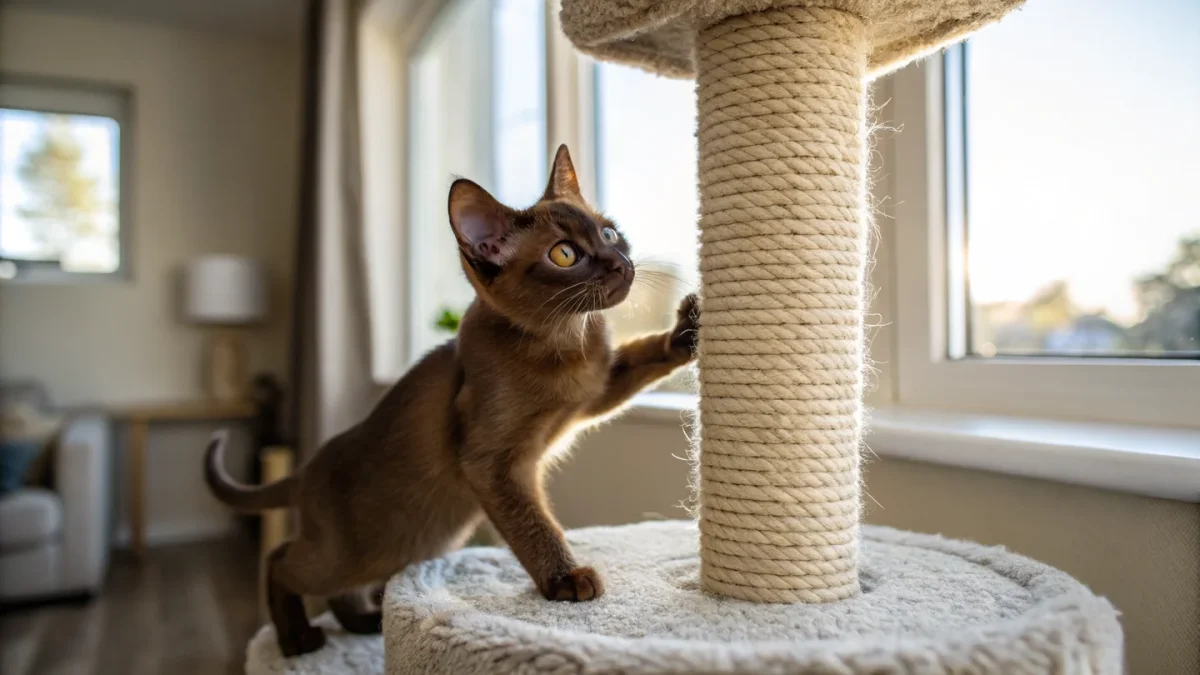
If you've had cats before but never a Burmese, prepare for the discovery that you've been living with cats that were merely tolerating you. The Burmese kitten makes the contrast immediate and obvious.
This is not an exaggeration for effect. The Burmese kitten's social drive — the same drive that makes the adult breed one of the most people-attached cats in existence — is operational from the first days at home. The kitten that has decided you are its person will follow you, climb you, sleep on you, and require your participation in its games with cheerful, persistent insistence.
First-time Burmese owners who came in expecting a relatively independent kitten are sometimes genuinely surprised.
The First Week
The Burmese kitten typically adapts to its new home faster than many breeds. The social drive that will define the adult personality means the kitten is oriented toward connection rather than hiding, toward exploration rather than retreat.
The first day or two may include some adjustment caution — this is a new environment and any kitten has a settling-in period. But most Burmese kittens are investigating the available space and approaching their new people within 24 hours.
Set up the initial environment with the basics: litter box, food, water, warm bedding, and a few safe toys. Don't overwhelm the first space with the entire house. Let the kitten establish its bearings in a manageable area and expand access gradually over the first week.
Energy Management: This Is an Athletic Kitten
The Burmese kitten has high energy and channels it through play with the full commitment of a young, highly motivated cat. This is not problematic — it is appropriate kitten behavior, amplified by the Burmese's characteristic drive.
Provide appropriate outlets:
- Wand toys for interactive sessions (several times per day is not excessive in the early months)
- A sturdy cat tree for climbing and launching
- Puzzle feeders that engage the kitten's intelligence and slow down eating
- Safe solo toys for the times you can't be actively involved
A kitten that doesn't have appropriate outlets for its energy will find inappropriate ones. The Burmese kitten is resourceful.
Sleep: More Than You Might Expect
Despite the energy, kittens sleep a lot — typically 16 to 18 hours per day. The Burmese kitten's active periods are intense, but they are punctuated by substantial sleep. It will choose to sleep on or near you whenever possible. This is the adult velcro behavior beginning early.
Provide warm, comfortable sleeping options in multiple locations, with at least one near where you typically sit or sleep. The kitten will use these — and also use you.
Starting Good Habits Early
The Burmese's low-maintenance grooming routine is genuine, but the habits worth building early are handling-related. A kitten that is regularly and gently handled — paws touched, ears checked, mouth briefly examined — grows into an adult that accepts these interactions without resistance.
This matters practically for:
- Nail trimming (every two to three weeks for life)
- Ear cleaning (periodic)
- Veterinary examinations
- Any health monitoring that requires handling
Gentle, positive, brief, and consistent: those four characteristics describe the effective approach to kitten handling habituation.
The Social Need: Already Present
The complete Burmese breed guide discusses the breed's social requirements for adult cats. Those requirements begin in kittenhood. A Burmese kitten left alone for long periods will vocalize, will seek stimulation in undesirable ways, and will develop the anxiety patterns that are harder to address in the adult.
If you're away from home regularly for long hours, establishing a companion relationship — either another cat acquired at the same time or shortly after — addresses this from the start rather than as a retrofit. Two Burmese kittens from the same litter or close in age will provide each other with social stimulation and play that a single kitten can't provide for itself.
The intensity of the Burmese kitten phase moderates somewhat as the cat reaches adulthood. The adult is still the velcro cat — still follows, still attaches, still needs your engagement. But the kitten's energy combined with the breed's social drive is the most full-on expression of the Burmese personality. First-time owners who know what's coming and embrace it have an easier time than those who are surprised by it.