

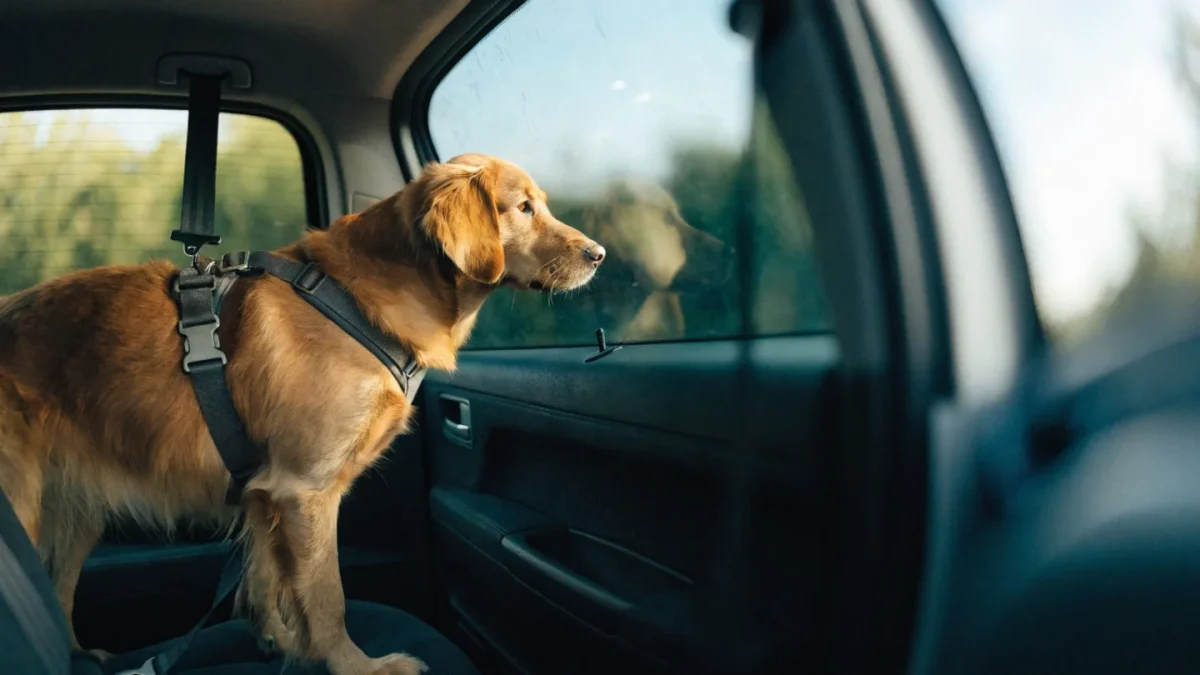
The car safety aisle at any pet store is full of products that look responsible and perform… less responsibly. A harness that says "crash-tested" on the box might have been tested by the manufacturer on a crash dummy that looks nothing like your dog's situation. Or crash-tested at speeds that don't reflect highway driving.
I went through a few different options for Benny before landing on something I actually trust. Here's what I learned, and what the research actually shows about pet car safety.
Why This Matters More Than You Think
An unrestrained 50-pound dog becomes a projectile in a sudden stop at 35 mph. The force involved is significant—hundreds of pounds of force depending on the dog's weight and the collision speed. That's dangerous for the dog and for human passengers.
Beyond collision risk: unrestrained pets are a distraction. A dog moving around the cabin, nudging your arm, or climbing between seats creates the kind of attention split that causes accidents before any collision even happens.
And beyond both of those: in many states, driving with an unrestrained pet is technically against the law, though enforcement varies.
The Options, Evaluated Honestly
Crash-Tested Harnesses (The Best In-Seat Option)
A harness that attaches to the seatbelt system can restrain your dog in a crash—but only if it's actually been third-party crash tested, not just internally tested by the manufacturer.
The Center for Pet Safety has done independent crash testing on pet restraints and published results. The findings: most products on the market performed poorly at highway speeds. A small number—including harnesses from brands that have been tested at CPS standards—held up.
Look for harnesses with documented third-party crash test results, not just "tested" claims. The harness should fit your dog's specific weight class, attach to the vehicle's seatbelt anchor, and fit snugly enough that the dog can't wiggle out.
What this looks like in practice: your dog sits in the back seat, harness on, clipped to the seatbelt via a short adapter. They can shift position somewhat but can't reach the front seats, can't stick their head out windows, and are substantially protected in a crash.
Benny isn't thrilled about this arrangement, but he's adapted. He still stares out the window. He just does it while buckled.
Secured Crates (The Strongest Protection)
For dogs who don't do well in harnesses, or for cats and small animals, a hard crate secured to the cargo area of an SUV provides strong crash protection—arguably stronger than a harness for larger dogs, because the crate itself absorbs force rather than the dog's body.
The operative word is secured. A crate just placed in the cargo area without being strapped down can become its own projectile. Cargo straps or crate-specific anchoring systems are not optional.
Crates should:
- Be the right size (dog can stand, turn, lie down)
- Be made of sturdy material—plastic travel crates are fine for containment, not ideal for crash protection; dedicated crash-tested dog car crates exist and are worth considering for frequent travelers
- Be secured against movement in all directions
This is the setup I'd use for cats on road trips. A hard crate, buckled down in the cargo area. It doubles as their "safe space" if you set it up right with familiar bedding.
Boosters and Car Seats (Small Dogs and Cats)
Small-dog and cat "car seats" are essentially raised, padded platforms that let the animal look out the window. They usually attach to the seat with a strap and clip the animal via harness.
Honestly? The crash protection on most of these products is not impressive. They're primarily comfort products for small animals, not safety products. If you use one, pair it with a well-fitting harness and keep speeds moderate.
The main real benefit: for very small dogs, keeping them elevated (rather than on the seat where they could fall off) and secured (rather than loose) is genuinely safer than nothing. But don't count on these surviving a highway collision.
Cargo Barriers and Dividers (Minimum Protection)
A cargo barrier separates the back of an SUV from the passenger area. For large dogs, it keeps them contained and out of the front seat. It provides zero crash protection—in a collision, the dog hits the barrier, and the barrier may or may not hold.
Better than nothing for preventing distraction-related accidents. Not adequate as a crash safety measure.
I'd use a barrier only in addition to other restraints, not instead of them.
What Doesn't Work
Letting the dog ride unrestrained in the back seat: This is what most people do. I did it before I knew better. It's the least safe option.
Tying a leash to a seatbelt: People try this. A leash is not a restraint system. In a crash, the jerk on the collar or leash can cause spinal injury. This is worse than no restraint in some scenarios.
Leaving the dog in the front passenger seat: Airbag deployment in the front passenger seat at highway speed is extremely dangerous for dogs.
What to Actually Do Based on Your Pet
Large dog (50+ lbs): Crash-tested harness on the back seat, or a secured hard crate in cargo. These are the two options worth using.
Medium dog (20-50 lbs): Crash-tested harness on the back seat. Crate in cargo works too if your dog accepts it.
Small dog under 20 lbs: Crash-tested harness on the back seat, or a properly secured small crate. Car seats can work if the dog is genuinely tiny and the harness connection is snug.
Cat: Hard crate secured in back seat or cargo area. No exceptions. A cat loose in a car is a hazard.
Puppy: Crate in the back seat or cargo area. Puppies shouldn't be loose in cars—they're unpredictable and training them to accept a crate early makes all future car travel easier.
Getting Your Pet to Accept Car Restraints
Some dogs and cats resist harnesses, crates, and any other new constraint. This is normal and solvable with gradual introduction—put the harness on during short trips first, reward calm behavior, build duration slowly. See the road trips with pets guide for more on building car comfort generally.
The road trip packing list for pet owners covers what else to have ready for safe and comfortable road travel.
FAQ: Car Safety for Pets
Is a crash-tested pet harness really that different from a regular harness?
Yes. Most pet harnesses on the market have not been tested at highway crash speeds by independent organizations. Those that have been third-party tested show meaningful differences in performance. This is worth researching before you buy.
How do I know if a harness is actually crash-tested vs. just marketed that way?
Look for certification from independent testing organizations (the Center for Pet Safety has published test results), not just the manufacturer's "tested" claims. Genuine crash-tested products will reference the specific test standard and organization.
Can my cat travel in a soft carrier in the car?
A soft carrier is better than no carrier but less protective than a hard crate. If you use a soft carrier, secure it to the seat with a seatbelt. For road trips, a hard crate in the cargo area with familiar bedding is safer and more comfortable for longer travel.
My dog gets anxious in the crate but not loose in the car. What should I do?
Start crate desensitization at home before road trips—feed meals in the crate, reward time in the crate, build positive associations. Short trips with the crate before longer ones help. For genuinely crate-resistant dogs, a well-fitted crash-tested harness is the better choice over leaving them loose.
Are pet seatbelt laws actually enforced?
Inconsistently, and laws vary by state. New Jersey, for example, has specific rules. Most states don't have specific laws but could cite distracted driving. Don't rely on lack of enforcement as a safety strategy.