

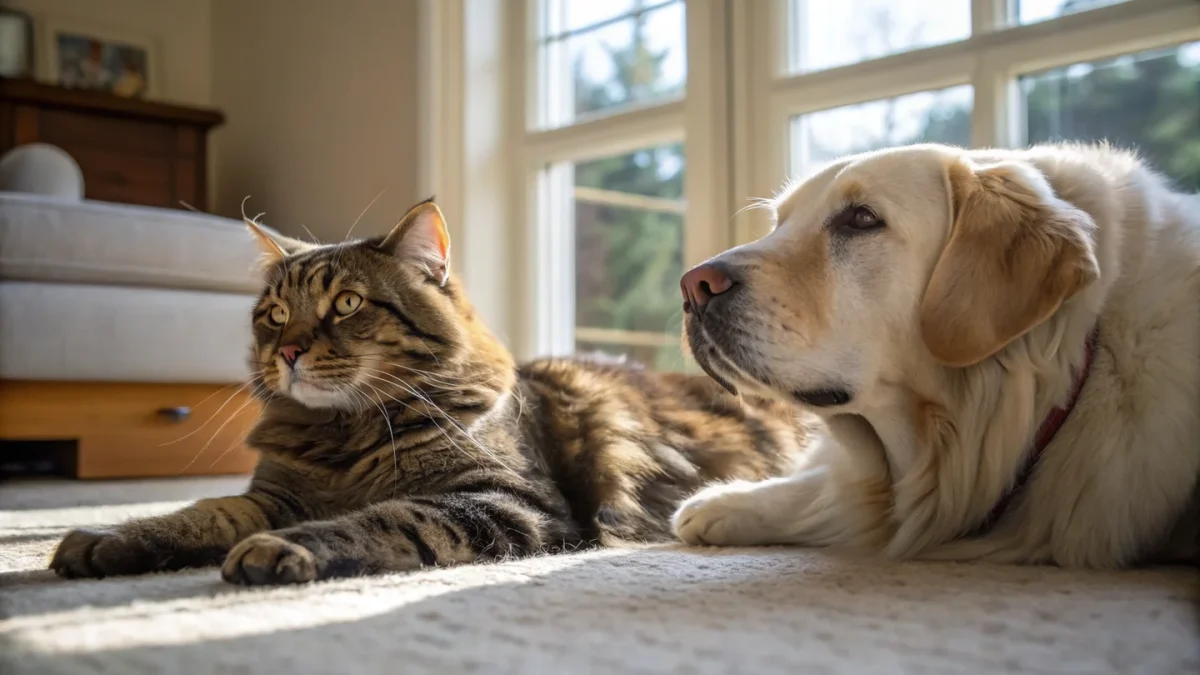
The question isn't which cat will "like" dogs — cats rarely like anything on initial introduction. The question is which cat will adapt to a dog's presence without prolonged stress, will establish workable boundaries through normal social signaling, and will eventually reach a stable coexistence. The difference between breeds in this regard is real.
For the overall selection framework, the cat breed selection guide covers all variables.
What Predicts Good Cat-Dog Coexistence?
Cat-side factors:
- Confidence: Cats who approach new things with curiosity rather than fear set boundaries more effectively and recover from startling faster
- Low reactivity: Cats who don't escalate easily manage dog exuberance better
- Previous positive experience with dogs or other animals: Socialization history matters more than breed in some cases
Dog-side factors (equally important):
- Prey drive: A high prey-drive dog introduced to a fearfully fleeing cat is the most dangerous scenario regardless of the cat's breed
- Previous positive cat experience: Dogs who have lived with cats are significantly easier to introduce to cats
- Training: A dog that responds to "leave it" reliably is a dog that can share a home with a cat
1. Abyssinian
Confidence and curiosity define the Abyssinian's approach to new things, including dogs. The Abyssinian breed profile covers the breed's ancient domestic roots and why that history produces such confident social behavior. They don't panic and flee — they assess, establish their position, and coexist on terms they find acceptable. They're athletic enough to remove themselves when needed without that removal looking like prey fleeing.
2. Maine Coon
Maine Coons are documented frequently as coexisting well with dogs — their large size, confidence, and adaptable personality all contribute. They're not easily intimidated by dog size or exuberance, and they establish clear limits with a calm authority that most dogs respect. Their history as working farm cats, often sharing environments with dogs, may contribute. The Maine Coon breed profile covers the breed's origins as a working cat of the American Northeast and what that heritage means for the adult personality.
3. Ragdoll
The Ragdoll's low defensive aggression is an advantage in cat-dog introductions. They don't scratch or hiss reflexively; they're more likely to simply move away from unwanted interaction. This avoidance behavior reduces escalation risk. They're not the most adaptable breed in terms of energy matching, but the low reactivity is a genuine asset.
4. Siberian
Siberians are bold and curious, which translates to relatively confident dog introductions. They're not particularly fearful and tend to hold their ground rather than flee, which reduces prey-chase triggers in many dogs.
5. Tonkinese
Playful, social, and adaptable — Tonkinese often integrate well in multi-pet households, including with dogs. Their social drive is broad enough to potentially include a sociable dog as part of their household community.
6. Bengal
This one requires a caveat. Bengals are confident and bold — assets in cat-dog relationships. But their own high prey drive can create problems in households with small dogs. The confidence that helps with dog introductions can become territorial aggression in the wrong pairing. Best with calm, cat-experienced dogs.
Breeds to Introduce Carefully
Russian Blue: Initial shyness with novelty makes the introduction period more stressful for the cat. With a calm, cat-experienced dog and a slow introduction, it's manageable — but a boisterous, unfamiliar dog in the house is hard on a Russian Blue.
Persian: Sensitive and not built for the kind of chase-retreat dynamic that dog introductions sometimes involve. Possible in the right household with the right dog; not an easy match.
Scottish Fold: The joint condition makes them more vulnerable to physical interaction during adjustment periods.
The Most Important Factor
The introduction process matters more than breed for most multi-pet households. A slow, controlled introduction — with the cat having escape routes and high places to retreat to, the dog restrained during initial meetings, and positive associations built over days and weeks — dramatically improves outcomes across all breed combinations.
Never do a "just let them work it out" introduction. It doesn't work, it's not fair to either animal, and it sets the relationship back by creating fear associations that take months to undo.