

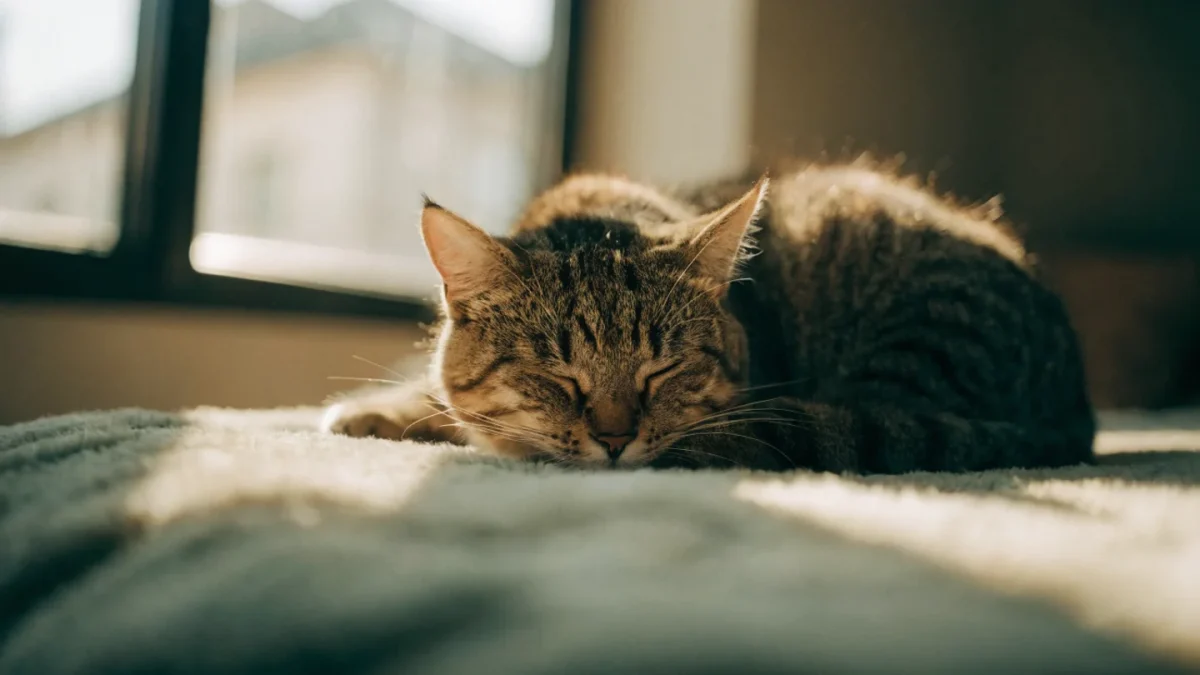
Here's what's actually going on when your cat spends three-quarters of the day in a heap on the sofa: they're not lazy. They're not depressed. They're not even bored, necessarily. They're doing exactly what millions of years of evolution designed them to do. The foundation for all of this is in why cats come alive at night.
Cats sleep between 12 and 16 hours a day on average, and some — particularly kittens and older cats — push that to 20 hours without anything being wrong. The first time I clocked my cat Miso's sleep one Saturday, I counted nearly 18 hours. She looked completely comatose by 4pm. She was fine. She was, in fact, thriving.
Why Cats Sleep So Much
The short answer is energy management. Cats are crepuscular hunters — meaning they're most active at dawn and dusk — and their bodies are built around short, explosive bursts of effort followed by long recovery periods. Hunting (even imaginary prey, like a feather wand or a dust bunny) burns serious energy relative to body weight. Sleep is how they reload.
Unlike grazing animals that can refuel constantly, cats evolved as ambush predators. Their digestive and metabolic systems are optimized for feast-rest-repeat cycles rather than continuous low-level activity. That long afternoon nap isn't laziness. It's preparation.
The technical breakdown looks something like this: cats cycle between light sleep (dozing) and deeper slow-wave sleep, with short phases of REM sleep mixed in. During light sleep — what looks like a cat flopped on the couch but one ear is swiveling at every sound — they're still partly alert. They'll be up in a second if something interesting happens. Deep sleep is rarer and shorter in cats than in humans, which is part of why they seem to wake so effortlessly and immediately.
How Sleep Needs Change by Age
This is where people get surprised, because "12-16 hours" is genuinely just a midpoint.
Kittens are the record-holders. Young kittens, especially in their first few weeks, can sleep up to 20 hours a day. Sleep is when growth hormone releases, and they're doing an enormous amount of growing. If you've raised a kitten, you know the drill: frantic zoomies, then collapsed like someone pulled a plug, then frantic zoomies again. That's their biological rhythm.
Adult cats (roughly 1-7 years, though it varies by individual) settle into the 12-16 hour range. You'll notice some cats trend toward the lower end if they're more active or live in stimulating environments, and others naturally sleep more. Both ends of that range are fine.
Senior cats — typically from around 10-11 years onward — often sleep more than they did in their middle years. Joints ache, energy levels drop, the drive to patrol and explore mellows. Honestly, a senior cat sleeping 18 hours a day is usually just an older cat being comfortable, not a warning sign on its own.
The Difference Between Normal Sleep and Something Worth Watching
Look — more sleep is usually just more sleep. But there are patterns worth knowing.
A sudden increase in sleep, combined with other changes (not eating well, hiding more, changes in litter box habits, seeming uncomfortable when touched), can be worth mentioning to a vet. "Sleeping a lot" alone rarely tells you much. It's sleeping a lot plus something else that shifts the picture.
Conversely, a cat sleeping less than usual — restless, pacing at night, vocalizing more — can also signal something. That shift away from their personal baseline matters more than any number.
The real question isn't "is my cat sleeping the right number of hours?" It's "is this different from what's normal for this specific cat?" You know your cat's rhythms better than any general guideline does.
What Cats Are Actually Doing When They Sleep
Most cat owners have watched a sleeping cat twitch, chirp softly, or make tiny paddling motions with their paws. That's REM sleep — the active dreaming phase. Cats do dream — research has backed this up since the 1960s, when neurologist Michel Jouvet performed lesion studies on cats that caused them to physically act out behaviors during REM sleep: stalking, pouncing, and reacting to what appeared to be imaginary prey. The muscle movements tell the story.
What's interesting is how lightly cats hold even deep sleep. A slight noise, a shift in light, a smell — cats can go from apparently comatose to fully alert in a fraction of a second. That hair-trigger wakefulness isn't a flaw in their sleep; it's a feature of being a small-ish predator that's also prey for larger ones. They evolved to rest deeply while staying ready to move.
Miso has this thing where she looks completely unconscious, completely flat, but the moment I start heading toward her food cabinet — not touching anything, just walking that direction — her eyes open and she's sitting up. Every time. The body is asleep. The threat-detection system never fully clocks off.
Sleep Locations and What They Signal
Where your cat chooses to sleep matters as much as how long. Cats don't sleep just anywhere — they sleep where they feel secure.
A cat that sleeps in exposed spots (middle of the floor, open couch) is a confident cat. One that consistently tucks into enclosed spaces — under the bed, behind furniture, inside boxes — may be seeking extra security, which can be personality or can reflect some underlying stress in the environment. Neither is bad by default, but if a cat that used to sleep on your lap suddenly starts hiding to sleep, that's worth noticing.
Sleeping near or on you is a significant compliment in cat terms. They're choosing to be vulnerable near you, which means they trust you. Cats don't do that casually.
Enrichment, Activity, and How They Affect Sleep Quality
Honestly, activity level and sleep quality are linked more than most people realize. A cat that gets regular interactive play — real play with wand toys or similar, not just a pile of toys left on the floor — often sleeps more soundly and is calmer when awake. The hunting cycle (stalk, chase, pounce, catch) that play mimics leads to a natural wind-down afterward, especially if followed by a small meal.
Cats that are chronically bored or understimulated can develop odd sleep patterns: restless at night, more sleepy and flat during the day, unpredictable bursts of energy at inconvenient hours. It can look like too much sleep, but it's actually disrupted sleep — a different problem.
A cat that plays hard and then sleeps hard is a healthy cat. That's the rhythm they're built for.
Frequently Asked Questions
Is it normal for a cat to sleep 20 hours a day?
For kittens and senior cats, yes — 20 hours is within the normal range. For a healthy adult cat in the middle of life, 20 hours consistently would be on the high end. If it's a recent change from their usual pattern, and especially if combined with changes in appetite or behavior, it's worth a vet visit. If they've always been a champion sleeper and everything else seems fine, they're probably just a deeply committed napper.
Do cats sleep more in winter?
Many cats do sleep more during winter months, particularly if they have access to warm sunny spots that shift with the season, or if they're tracking shorter daylight hours. Cats are somewhat responsive to light cycles. It's not dramatic like a full hibernation response, but a slightly sleepier winter cat is pretty common and generally not concerning.
Why does my cat sleep all day and then go wild at night?
This is crepuscular behavior at its most inconvenient. Cats are naturally most active at dawn and dusk, so if they're sleeping through the day, they're often ready to run at 3am. Regular interactive play sessions in the evening — particularly before your own bedtime — can help shift some of that energy earlier and lead to a calmer night for both of you.
Should I let my cat sleep in my bed?
That's genuinely a personal call, and there's no single right answer. Cats in beds are a beloved institution in plenty of households. The practical considerations are whether their sleep patterns disrupt yours (some cats are very still; others are not), whether anyone in the house has allergies, and whether you're comfortable with the arrangement. If it works for everyone, there's nothing inherently wrong with it.
Can a cat sleep too little?
Technically yes, though it's much rarer than people sleeping too little. A cat that seems unusually restless, vocalizes at night, or can't seem to settle might be uncomfortable — physically or from stress in their environment. Persistent sleep disruption in a cat is worth investigating, since cats that feel safe and comfortable almost always sleep well.