

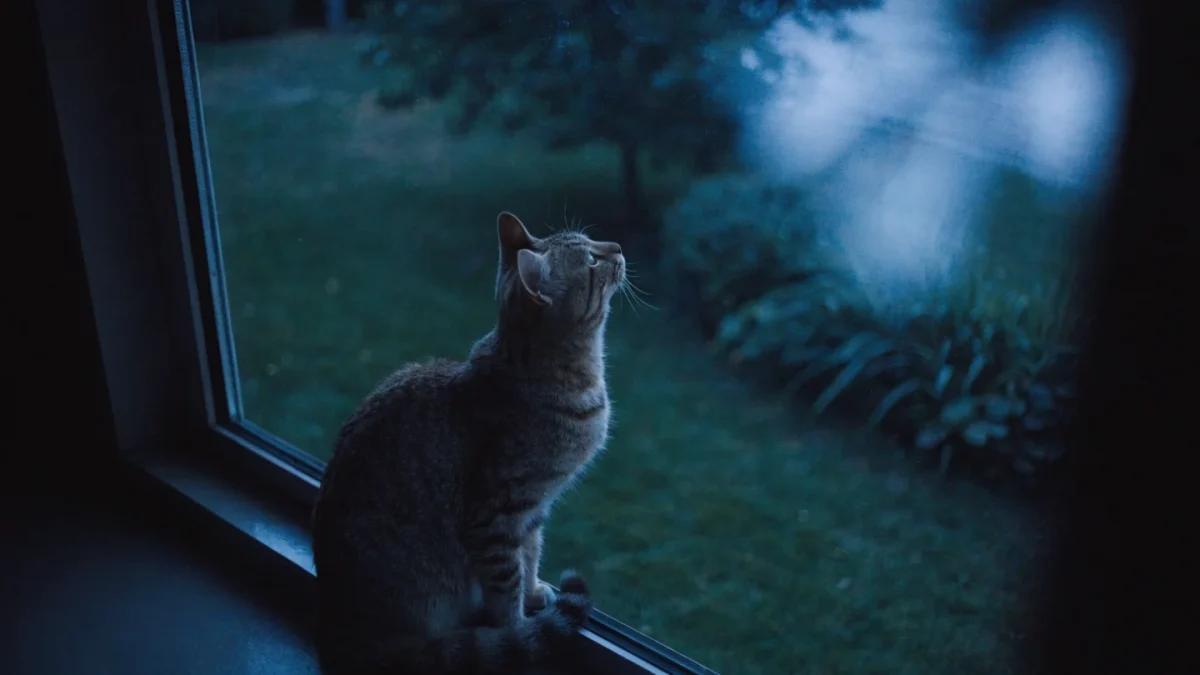
Here's what's actually going on when your cat decides 2 a.m. is the perfect time to sprint down the hallway, knock a glass off the nightstand, and then stare at you like you're the problem.
Cats are not nocturnal. I know — it really feels like they are — but that's not quite right. They're crepuscular, meaning their instinct is to hunt at dawn and dusk. The issue is that indoor cats with nothing to do during the day have a surplus of pent-up energy, and they discharge it whenever they feel like it. Which, unfortunately, is often the exact moment you try to fall asleep.
My cat Mochi did this for six solid months after I adopted her. I tried everything in the wrong order: shutting her out of the bedroom (she cried), keeping her in (she sat on my face), and at one point buying a calming plug-in that did absolutely nothing. What finally worked was understanding why it was happening — and then addressing that, not the symptom.
The good news: this is almost always fixable. It takes about two to three weeks of consistency, but you can shift your cat's peak activity window to align much better with yours.
Why Cats Get the Nighttime Zoomies
Before the solutions make sense, the biology needs to make sense.
In the wild, a cat's day runs on an energy cycle tied to prey behavior. Small rodents and birds are most active at dawn and dusk — so cats evolved to match that schedule. They rest in between, conserving energy. They hunt, they eat, they groom, they sleep. Then they do it again.
Indoor cats have the same biological programming, but without the actual hunting. They sleep all day because there's nothing to hunt. They wake up at the same times their ancestors would have — often right around when you're winding down for the evening. And because they've been napping for ten hours, they are ready to go.
The zoomies you witness aren't random chaos. They're the physical release of a predatory sequence that had nowhere to go. Sprint, pounce, bat, stalk — your cat is going through the motions of a hunt whether or not there's actual prey involved. Understanding how the hunting sequence works in cats explains a lot about why simply ignoring the behavior doesn't make it go away. The drive is real. It needs an outlet.
A few other factors can intensify nighttime activity:
Age. Kittens have enormous energy reserves and almost no impulse control. They are, by nature, chaos. Young adult cats (one to three years) are often the worst offenders — fully developed prey drive, still figuring out household rhythms.
Boredom during the day. An under-stimulated cat will bank energy all day and spend it all night. This is probably the biggest factor for cats kept in small apartments without much environmental variety.
Routine disruption. A cat whose human recently changed work schedules, moved, or introduced a new pet may shift their activity patterns in response.
Attention-seeking that worked. Cats learn fast. If waking you up at 3 a.m. has ever resulted in you getting up to feed them, play with them, or even yell at them — they know it works. Negative attention is still attention.
The Step-by-Step Plan for Cat Active at Night Solutions
This is the approach that actually works. It has a few moving parts, and all of them matter.
Step 1: Stop Reinforcing the Behavior
I know this one hurts at 3 a.m., but it's non-negotiable. The moment you respond to nighttime attention-seeking — even once — you reset the clock. Cats are not spiteful; they're excellent at cause and effect.
If your cat is meowing outside the door, scratching, or yowling: don't open the door. Don't yell. Don't even get up. This is genuinely hard for the first few days and then it gets easier as the cat starts to realize that performance no longer produces results.
If your cat is IN the room with you and being disruptive, the same principle applies. You're not punishing them. You're just removing yourself as a source of reward. Roll over. Put a pillow over your head. Do not engage.
The tricky part is that behavior almost always gets worse before it gets better — this is called an "extinction burst." Your cat is not escalating out of spite. They're trying harder because something that used to work suddenly isn't. Hold the line.
Step 2: Fix Daytime Enrichment
A cat that is genuinely tired at bedtime does not rampage at 2 a.m. The problem is usually that your cat has spent the entire day sleeping on the sofa, totally unchallenged.
Daytime enrichment doesn't mean you need to entertain your cat all day. It means you need to give them things to do that engage their prey drive on their own schedule.
Puzzle feeders. Feeding some or all of a cat's daily food ration through a puzzle feeder means they have to work for it — stalk it, bat it, figure it out. This is mentally tiring in a way that sitting next to a full bowl simply isn't. You can make very simple DIY versions with cardboard tubes or egg cartons if you want to try before committing to anything.
Window access. A window perch in a spot with actual outdoor activity — bird feeders, a garden, foot traffic — gives a cat hours of passive stimulation. They watch, they chatter, they stalk the glass. It costs almost nothing.
Rotating toys. Toys left out all the time become invisible. Cats stop seeing them. Rotate a few in and out every few days to restore novelty. Items with different textures, sounds, and movements matter more than expensive ones.
Vertical space. Cat trees, shelves, and high perches aren't just about preference — climbing and surveying territory satisfies behavioral needs. A cat who can climb and look down at things gets a kind of environmental stimulation that floor-level cats don't have.
None of these require you to be present. That's the point.
Step 3: Schedule a Pre-Bed Play Session
This is the single most impactful intervention and it's also the one people skip because it feels arbitrary. Don't skip it.
Thirty to forty minutes before you want to go to sleep, initiate an active play session with your cat using a wand toy or something that moves the way prey moves — erratic, ground-level, with pauses. Go hard. The goal is genuine exertion: pupils dilating, tail flicking, the full predatory focus. This is your cat completing the hunting sequence it's been building toward all day.
Read your cat during the session. You're looking for heavy breathing, lying down mid-play, or losing interest after genuine effort. That's the signal. Reading your cat's body language helps here — there's a difference between a cat who's tired and a cat who's bored and disengaged.
The session should end with the cat catching the toy. This matters more than it sounds. The hunting sequence — stalk, chase, pounce, catch — needs to complete. If it doesn't, the cat stays aroused. Let them catch the toy, let them bunny-kick it for a moment, and then end the session.
Step 4: Feed After Play, Not Before
Immediately after the play session, give your cat their last meal of the day. This is the behavioral key that ties everything together.
After a hunt, a cat eats. After eating, a cat grooms. After grooming, a cat sleeps. This is the natural sequence their whole biology is built around. When you recreate it — play (hunt), then food (eat) — you trigger the rest of the sequence automatically. The grooming and sleep follow.
This is also why free-feeding cats often have worse nighttime behavior. If food is always available, there's no post-meal collapse, no "hunt complete" signal. The whole cycle stays unsatisfied.
A timed feeder can help if you can't be home to feed at a consistent pre-bed time. Set it to dispense the last meal about fifteen to twenty minutes after your play session ends. The cat plays with you, wanders off to groom, hears the feeder click, eats, and settles.
Step 5: Create a Good Sleep Environment for the Cat
You want your cat to have compelling reasons to stay calm and settled during the night — not just an absence of stimulation.
A comfortable, elevated sleeping spot near where you sleep (but not necessarily on you, if that's been the problem) gives cats the combination of security and warmth they prefer. Cats sleep better when they feel enclosed — a cat cave or covered bed appeals to the same instinct as a den.
Blackout curtains in rooms where street lights or early sunrise would otherwise trigger a 4 a.m. "it's dawn, hunt time" response can make a meaningful difference, especially in summer months.
Some cats also respond well to background sound — a fan, quiet ambient audio — that provides sensory consistency through the night. This is not universal, but worth trying if your cat seems startled by night sounds.
Step 6: Be Patient for Two to Three Weeks
Behavior change in cats doesn't happen overnight. The adjustment period is typically ten to twenty-one days when the routine is genuinely consistent.
The real question most people hit is: what if I'm doing everything right and it's still not working?
First, check for exceptions. Any night where someone in the house gave the cat attention during the disruption resets progress. Kids are often the wildcard here — one sleepy five-year-old who lets the cat in at 2 a.m. undoes a week of work.
Second, consider whether there's an underlying stressor. A cat that's recently started waking at unusual times after a period of being settled might be responding to something environmental — a new pet, construction noise, a scent they can smell through the walls. That's a different problem from a bored indoor cat with too much energy.
Honestly, if the routine is airtight and it's still not improving after three weeks, a vet conversation is worth having. Not because something is necessarily wrong, but because hyperthyroidism and a handful of other conditions can genuinely cause increased nighttime restlessness in cats — and it's more common than most people realize in cats over ten years old, with the average diagnosis coming around age twelve (Cornell University College of Veterinary Medicine).
When the Problem Is Actually a Kitten
Kittens deserve their own mention because the approach above works — but the timeline is different, and your expectations need adjusting.
A kitten under one year old has essentially no natural sleep regulation. They sleep hard, play hard, and have almost no in-between. The nighttime energy surges are intense and frequent. The play-before-bed routine still helps, and enrichment still matters, but you are also just waiting for them to grow up a little.
What I found with my second cat, a kitten named Fig, was that adopting her with Mochi already in the house was the actual solution. Two cats entertain each other. They tear around at 3 a.m. together and then collapse in a heap. If you're considering a second cat anyway, the companionship benefit for nighttime behavior is real — though introduce them properly, because throwing two cats together without a slow introduction usually creates a different set of problems.
What Doesn't Work (And Why)
A few things that come up constantly but have poor track records:
Punishing the behavior. Spray bottles, loud noises, any aversive response — these don't teach cats to sleep. They teach cats to be wary of you specifically, and to be disruptive when you're not around to enforce anything.
Locking the cat out permanently without any other changes. This reduces disruption to your sleep but does nothing to address the underlying energy surplus. Your cat will learn to be disruptive outside the door instead.
Tiring them out right before bed with no feeding. The play session matters, but if it ends without food, the cycle doesn't complete. Half the routine is better than nothing, but you'll see faster results with the full play-then-feed sequence.
Waiting for the cat to "calm down with age" when they're young adults. Cats do mellow somewhat between ages three and five, but if the behavior is established and reinforced, it won't just go away on its own.
FAQ
My cat has been fine for years and suddenly started waking me up — what changed?
A sudden change in a settled cat's nighttime behavior is worth noticing. Check for environmental changes first: new neighbors, new sounds, another pet they've become aware of, changes in your own schedule. If nothing obvious has changed, and the cat seems otherwise different — eating more, losing weight, more vocal generally — a vet check is the right call. Sudden behavioral changes in adult cats can sometimes have physical causes.
Will a second cat make the nighttime problem better or worse?
Usually better, but only if the introduction goes well. Two cats that are genuinely bonded will often wear each other out and collapse together. Two cats that merely tolerate each other may have separate energy peaks that tag-team through the night. Slow, careful introductions matter for this reason among many others.
Is it okay to let my cat sleep in my bedroom?
That's entirely a personal call. Many people sleep fine with their cats in the room; others find it disruptive regardless of the cat's behavior. If you enjoy having your cat nearby, the solutions above should make it workable. If you'd rather have the room to yourself, that's valid — just make sure the cat has a genuinely comfortable alternative and you're consistent about not letting them back in.
My cat wakes up at exactly the same time every night — is that normal?
Yes. Cats have precise internal clocks and are very sensitive to environmental cues — the quality of light, sounds, temperature shifts. If they've learned that something happens at a particular time (dawn light, a neighbor leaving for work, a feeder clicking), they'll wake to it reliably. Eliminating the cue or adjusting the feeder time is usually the fix.
How long until I see results with the play-then-feed routine?
Most people notice improvement within a week, with significant change by two to three weeks. The key is consistency every single night, not most nights. If you're hitting a plateau, the usual culprit is an inconsistency somewhere — a night where someone fed the cat earlier, or where the play session was cut short.