

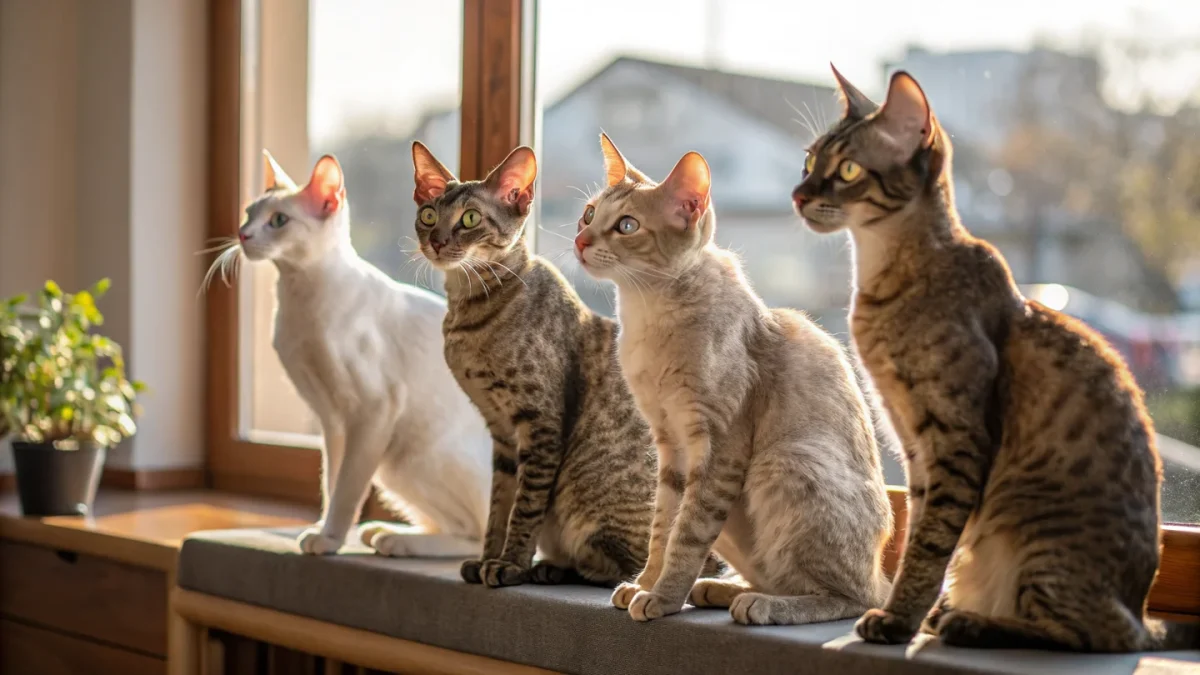
The first known curly-coated cat in documented modern history appeared in a Cornish barn in 1950. Within a decade, a second mutation surfaced independently in nearby Devon. Decades later, similar mutations appeared in the United States in completely unrelated cats. Nature, it seems, keeps discovering this particular genetic trick.
What is remarkable about the rex mutations in cats is that each discovery represents a completely independent genetic event. Cross any two of these curly breeds together and the kittens have straight coats — proof that each mutation is on a different gene. For the full Cornish Rex breed profile, that article covers the history and temperament in detail.
For broader context on coat types and breed classification, the cat breed categories guide is useful background.
Cornish Rex — Tight Waves, Velvet Touch
The Cornish Rex mutation (re gene) affects the hair shaft in a way that eliminates the outer guard hairs and most of the awn hairs, leaving primarily the soft, crimped down coat. The result is tight, uniform waves that feel remarkably like velvet or warm suede.
The reduced coat means less insulation — Cornish Rex feel the cold and seek warmth actively. The coat also produces oil more visibly than coated breeds because the normal oil-distribution mechanism of the outer coat is absent. Periodic bathing is necessary.
Personality: highly active, intensely social, kitten-like throughout life.
Devon Rex — Soft Curls, Pixie Face
The Devon Rex mutation (re^d gene) is different from the Cornish Rex mutation and sits on a different chromosome. Crossing Cornish and Devon Rex produces straight-coated kittens. The Devon Rex breed profile covers the full genetics, care requirements, and personality in detail. The Devon coat tends to be softer and shorter than the Cornish, with looser curls and a texture that varies more across individuals.
The Devon Rex face is its other defining characteristic — a distinctly pixie-like appearance with enormous eyes and satellite-dish ears set wide on a compressed muzzle. The personality shares the Cornish Rex's high social drive and persistent playfulness, with perhaps slightly more mischief.
Selkirk Rex — Fluffy Curls, Dominant Mutation
The Selkirk Rex is genetically distinct in one important way: the Selkirk mutation is dominant, not recessive. A cat with only one copy of the Selkirk mutation has a curly coat — unlike the Cornish and Devon, which require two copies for the curly phenotype to express.
The breed originated in Montana, USA in 1987 and was developed through crosses with Persian, British Shorthair, and Exotic Shorthair — which explains the Selkirk's notably heavier, rounder build compared to the slender Rex breeds. The coat is full and plush with loose, flowing curls, quite different from the tight waves of the Cornish or Devon.
The Selkirk comes in both shorthaired and longhaired varieties. The longhaired Selkirk has particularly dramatic curls.
Personality: calm, patient, and affectionate — the Persian influence is evident in temperament.
LaPerm — Ringlets, North American Origin
The LaPerm appeared on a cherry orchard in The Dalles, Oregon in 1982 — again, a spontaneous mutation in farm cats. The LaPerm mutation produces springy ringlets (in longhaired individuals) or tighter curls (in shorthaired individuals), a texture different from all three of the breeds above.
The LaPerm mutation is dominant, like the Selkirk Rex. One copy produces the curly coat.
LaPerms are active, social, and people-oriented. They're rarer outside of North America and Australia, making them genuinely difficult to find as pets in many parts of the world.
Care Considerations for Rex Breeds
All curly-coated breeds share some common care considerations related to their modified coats:
- Reduced guard hairs: The Cornish and Devon Rex in particular have reduced insulation and are cold-sensitive
- Oil management: Without the full outer coat to distribute oils, periodic bathing is needed for Cornish and Devon Rex
- Grooming approach: Brushes can disrupt the curl pattern — handling with hands rather than aggressive brushing maintains the wave structure better
- Individual variation: The tightness and consistency of the curl varies by individual within each breed