

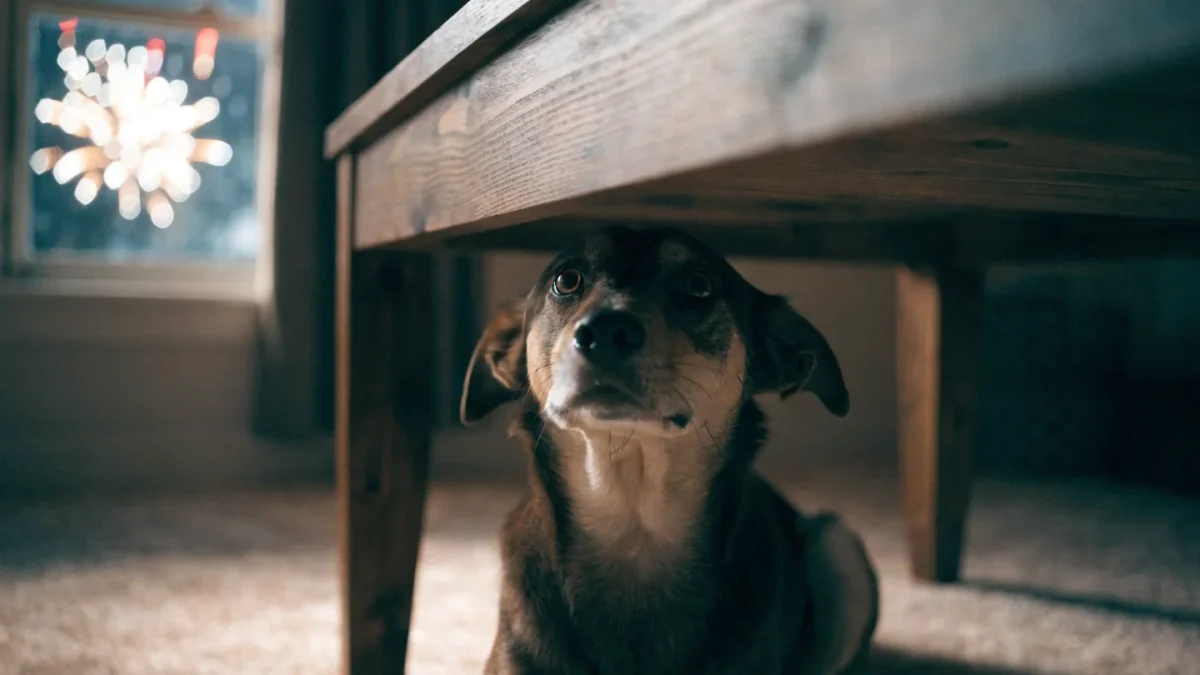
The family had a 4-year-old Border Collie named Chase. Every Fourth of July, Chase spent the evening panting, pacing, drooling, and trying to climb behind the toilet. By morning he'd usually scratched through the bathroom door in an attempt to escape, urinated on himself, and was exhausted and trembling.
His owners had tried thunder shirts for two years. They'd tried calming treats. They'd put him in the basement, then in the car. They'd tried sitting with him and reassuring him. Nothing meaningfully helped.
When they finally came to me, I prescribed trazodone plus a low-dose of a short-acting anti-anxiety medication for the two days around the holiday. Chase slept through most of the Fourth. He was calm, he didn't injure himself, and his owners were stunned that something had actually worked.
I tell this story because noise phobia in dogs is widely managed with inadequate interventions for years before people think to ask a vet. And it's genuinely treatable.
What's Happening in a Noise-Phobic Dog
Noise phobia isn't "being scared" in a normal sense. It's a conditioned fear response that involves the autonomic nervous system — which is why logical interventions like "showing the dog the fireworks aren't dangerous" or "just comforting them" don't work.
The physiological response to a triggering noise includes cortisol and adrenaline release, increased heart rate, panting (the dog literally can't help it — panting is driven by sympathetic nervous system activation), and the overwhelming impulse to escape. A dog in full noise phobia panic cannot be talked down from that state with reassurance or treats. The cognitive, thinking part of their brain is essentially offline.
This is important to understand because it shifts the frame. You're not managing a behavioral issue or a training failure. You're managing an autonomic fear response in an animal who cannot reason their way out of it.
And it tends to get worse over time without treatment. Noise phobia is one of the conditions that sensitizes with repeated exposure — every fireworks event makes the next one worse.
Signs of Noise Phobia
Mild:
- Excessive panting
- Pacing, restlessness
- Seeking owner contact more than usual
- Reduced appetite
- Whimpering or vocalizing
Moderate:
- Trembling
- Hiding (under beds, behind toilets, in closets)
- Drooling
- Dilated pupils
- Attempting to squeeze into small spaces
Severe:
- Destructive behavior — scratching through doors, breaking through windows, injuring themselves trying to escape
- Self-urination or defecation
- Extreme vocalization
- Full panic — unresponsive to owner, may bite when cornered
Severe noise phobia is an animal welfare issue. A dog injuring itself trying to escape perceived danger is suffering. It's not a personality quirk.
Environmental Management: The Foundation
Before medication, before supplements, before thunder shirts — the environment matters.
A safe den. Most noise-phobic dogs will seek a small, enclosed space. A crate (if already used as a safe space), a closet, under a bed, in an interior bathroom. Provide access to this space and make it comfortable. Add familiar-smelling bedding. Ideally, this space has been introduced as a positive place well before fireworks season, not introduced for the first time during a panic.
Interior rooms. Outside-facing windows make fireworks louder and more visually stimulating. An interior room or basement reduces both noise and the flash of fireworks light.
White noise or music. Something at significant volume in the dog's space — a white noise machine, fan, TV, or music — masks some of the sudden acoustic impact of fireworks. Sudden, unpredictable loud sounds are more triggering than sustained background noise.
Your presence. You can stay with your dog. Comforting a phobic dog does not "reinforce" the fear — this is an outdated behavioral model that's been updated by better understanding of fear physiology. Being present and calm helps somewhat, not because it solves the problem, but because your dog is less alone.
Keep the dog inside. This is non-negotiable on fireworks nights. Dogs who escape during fireworks typically run hard and far. More dogs go missing around the Fourth of July than any other time of year.
Supplements and Non-Prescription Options
I'll be honest: the evidence base for most calming supplements is modest. That doesn't mean they don't help at all. They mean they're not the answer for dogs with moderate to severe noise phobia, though they may take the edge off for milder cases.
Melatonin — Some evidence for mild anxiolytic effect in dogs. Low-risk, worth trying for mild anxiety. Does not help dogs in full panic mode.
Composure/Zylkene (alpha-casozepine) — Casein-derived supplements; mild calming effect in some dogs. No significant evidence for serious noise phobia.
CBD — Trendy, but the evidence in veterinary medicine is limited. Some dogs respond; many don't. Quality control issues with CBD products are real.
Adaptil/DAP (Dog Appeasing Pheromone) — Synthetic version of a pheromone produced by nursing mothers. Some evidence for mild anxiety reduction. Not effective for moderate-severe noise phobia on its own.
Thunder shirts — Compression wraps that apply gentle, constant pressure, theoretically mimicking a calming embrace. Help some dogs in the mild-moderate range. Not transformative for severe phobia.
These tools are appropriate starting points and add-ons. For moderate to severe noise phobia, they need veterinary intervention to make a real difference.
Veterinary Options
Trazodone — A serotonin antagonist/reuptake inhibitor that's become the primary first-line medication for situational anxiety in dogs. Significantly reduces anxiety response. Can be used as needed for specific events. Works best when given 1-2 hours before anticipated stressor.
Sileo (dexmedetomidine oromucosal gel) — The only FDA-approved treatment specifically for noise aversion in dogs. Applied to the gum, absorbed quickly, provides reliable sedation and anxiety reduction. Prescription only.
Alprazolam (Xanax) — Short-acting benzodiazepine. Used in combination with trazodone in moderate to severe cases. Must be used carefully — some dogs become more disinhibited or agitated with benzos alone.
Gabapentin — Increasingly used for anxiety; also provides some muscle relaxation which helps with the physical manifestation of anxiety.
Acepromazine — An older sedative I'll mention mainly to note what it isn't. "Ace" causes physical sedation but does NOT reduce anxiety. A dog who's dosed with acepromazine may appear calm but is internally just as panicked and is unable to move to express it. This is considered inappropriate for noise phobia management.
The right medication depends on the severity, your dog's health status, and what's worked or not worked before. This is a conversation with your vet — ideally several weeks before the fireworks event you're preparing for, not the day before.
Desensitization: The Long Game
Medication manages the acute event. Systematic desensitization can, over time, actually reduce the underlying phobia.
The principle: expose the dog to very quiet recordings of fireworks at a level so low it produces no anxiety response, pair that with positive experiences (treats, play), and very gradually increase the volume over weeks to months. Never progress to the next level until the dog is completely relaxed at the current level.
This takes months. It requires a systematic protocol. It works, but it requires commitment, and it can't be done in the week before the Fourth of July. It's a winter project for a summer improvement.
FAQ
My dog has been scared of fireworks for years. Is it too late to help them?
No. Noise phobia that has been present for years can still be treated with veterinary medication and behavior modification. It may take longer than a brand-new case, but treatment can genuinely help at any age.
Isn't comforting a scared dog just reinforcing the fear?
No. Fear is not a trained behavior that's reinforced by comfort. Providing comfort and safety to a frightened dog doesn't make them more fearful — it makes them slightly less alone during a difficult experience. You don't make a human more anxious by reassuring them. The same logic applies.
Should I take my dog to the fireworks show?
Unless your dog has demonstrated completely comfortable behavior around fireworks at close range, no. Even dogs who seem fine at distance can be overwhelmed at close range. The noise, crowds, and heat at a fireworks show are stressful for most dogs.
My dog sleeps through fireworks on quiet years. This year was bad. Why?
Noise phobia can develop at any age and can change in severity year to year. Aging, underlying anxiety, and sensitization from previous exposures all contribute. A dog who was fine at 2 years old may develop phobia at 6. Take each year fresh.
How far in advance should I talk to my vet about medication?
At least 3-4 weeks before the event you're preparing for. Your vet may want to try one medication first to assess response before finalizing the protocol, and some medications work better with advance dosing. Don't call the afternoon before the Fourth.