

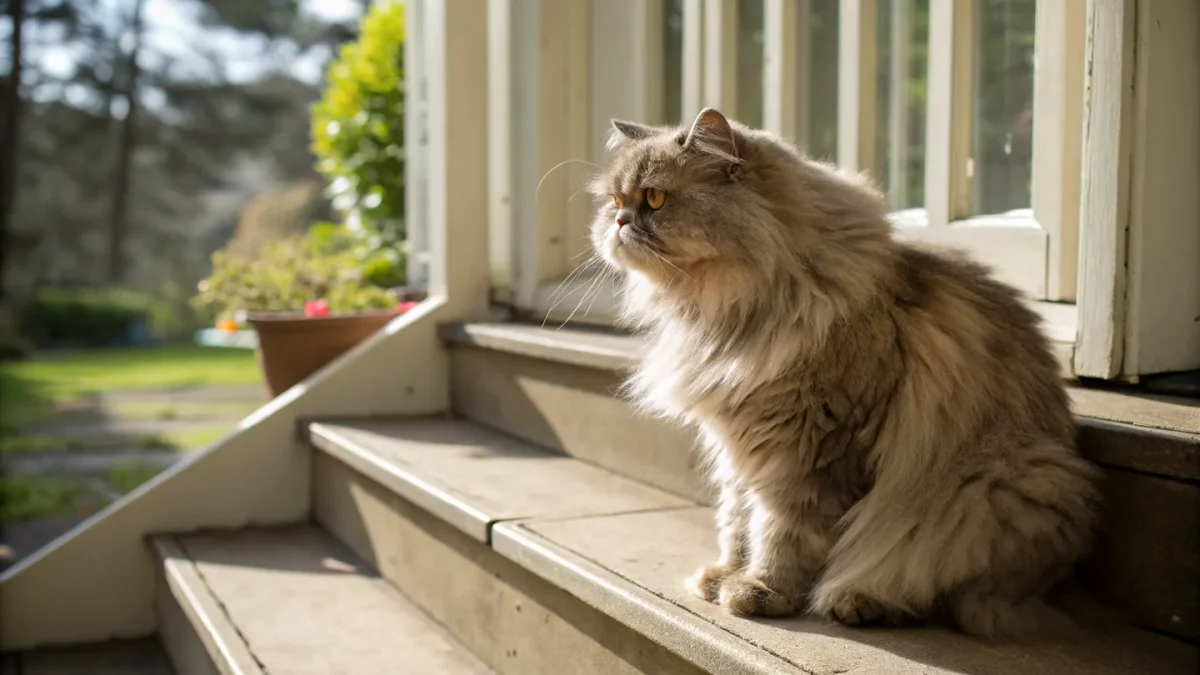
The Persian cat of the 1890s looked noticeably different from the Persian of the 1990s. The nose was positioned lower on the face, clearly visible from the front and the side. The muzzle had some length. The eyes, while large, didn't protrude. A 19th-century Persian placed next to a contemporary show Persian would look like a different cat.
The transformation happened through selective breeding over the course of roughly a century, accelerating significantly in the mid-20th century when American show breeders began favoring progressively flatter facial profiles. The result is the extreme brachycephalic (short-skulled) type that's become the default image when most people think "Persian cat." For the full breed context, see the complete Persian cat breed guide.
What Brachycephaly Is
Brachycephaly — from the Greek for "short skull" — describes a skull structure in which the facial bones are compressed, shortening the muzzle and rotating the features upward on the skull. The nose ends up at or above the level of the eyes. The jaw is shortened without a corresponding reduction in the number of teeth, producing dental crowding. The eye sockets are shallower.
In cats, brachycephaly affects more systems than the face:
Respiratory: The shortened nasal passages restrict airflow. A study published in PLOS ONE examining flat-faced and non-flat-faced cats found that brachycephalic breed-types including Persians are significantly more likely to have respiratory difficulties and substantial breathing noise compared to other breed-types. Stenotic nares (abnormally narrow nostrils) are documented in a substantial proportion of extreme flat-face individuals, and approximately 20% of brachycephalic cats examined in one study had abnormally positioned nasal turbinates causing additional airway occlusion.
Ocular: The nasolacrimal duct — the channel that drains tears from the eye into the nasal cavity — is impinged by the compressed facial structure. A CT dacryocystography study published in Veterinary Ophthalmology (2022) documented how the duct in severely brachycephalic Persian cats must take a tortuous downward path, meaning tears must flow against gravity to drain normally — a physical impossibility that explains why constant tear overflow is the rule rather than the exception. In some cats this is mainly cosmetic; in others the overflow causes skin irritation and recurrent skin fold infections.
Dental: Teeth are present in normal numbers despite the shortened jaw, producing crowding and misalignment. A study examining 50 brachycephalic Persian and Exotic Shorthair cats, published in the Journal of the American Veterinary Medical Association (2018), found dental crowding in 56% and malocclusion in 72%, with periodontal disease present in 88% of the study population. This predisposes affected cats to tooth resorption and progressive periodontal disease throughout life.
Neurological: In very extreme cases, skull compression can affect brain development. A 2017 study by Schmidt et al. published in the Journal of Veterinary Internal Medicine examined Persian cats across brachycephaly grades and found that the mean ventricle-to-brain ratio in extreme (peke-face) Persian cats was significantly higher than in less-affected individuals — a finding consistent with internal hydrocephalus. Severely affected kittens in that research showed neurological signs including ataxia, head tremors, and abnormal breathing patterns.
Traditional vs Extreme: What to Look For
Traditional Persian (also called doll-face):
- Visible muzzle from the front and side
- Nostrils positioned at or below eye level
- Eyes prominent but not protruding
- Less pronounced facial folding
- Breathing audible: no
- Constant eye overflow: rare or mild
- Dental crowding: mild if present
Extreme flat-face Persian (ultra-type, peke-face):
- No visible muzzle; face flat from the side
- Nostrils at or above eye level
- Eyes very prominent, sometimes asymmetrical
- Facial skin folds around nose
- Breathing audible: often
- Constant eye overflow: common
- Dental crowding: frequent
The visual difference is significant once you know what you're looking at. In photographs, traditional Persians are sometimes mistaken for other breeds (Ragdolls, Turkish Angoras) by people used to seeing only extreme flat-face individuals.
Why the Extreme Type Became Dominant in Show Circles
Cat show standards set the ideal. When show organizations in the mid-20th century began rewarding extreme facial flatness as an aesthetic ideal — rounder faces, higher noses — breeders who wanted to win shows bred toward those features. The same ratchet-effect that produced the flat-face Bulldog in dogs produced the flat-face Persian in cats.
There's ongoing welfare discussion around this in cat fancy communities, similar to discussions about brachycephalic dogs. Some organizations have moved to explicitly moderate their standards away from extreme facial types.
The Genetics
Brachycephaly in domestic cats involves multiple genes. A 2016 study on selection signatures in the Persian breed identified CHL1 and CNTN6 — both known to influence face shape in humans — as positional candidate genes for the brachycephalic phenotype in cats, though the full genetic architecture remains under investigation. The trait is clearly heritable: brachycephalic parents consistently produce brachycephalic offspring, and the phenotype has been progressively intensified through deliberate selection over several breeding generations.
Reversing the extreme type requires selecting for moderate facial structure over generations — which is happening in some breeding programs, more slowly than the welfare case would suggest is ideal.
Making an Informed Choice
If you're acquiring a Persian from a breeder, asking about facial structure directly is entirely appropriate. A breeder who's working toward traditional facial structure will usually say so explicitly — it's a point of philosophy and some pride in those circles.
The practical question: a traditional-faced Persian will have fewer chronic health issues, lower lifetime veterinary costs related to the face, and will breathe, eat, and drain tears normally. A flat-faced Persian is more visually dramatic in the way the contemporary standard describes, but carries those health costs as the tradeoff.
Both types share the Persian coat, temperament, and grooming requirements. The face is the variable, and its consequences are real.