

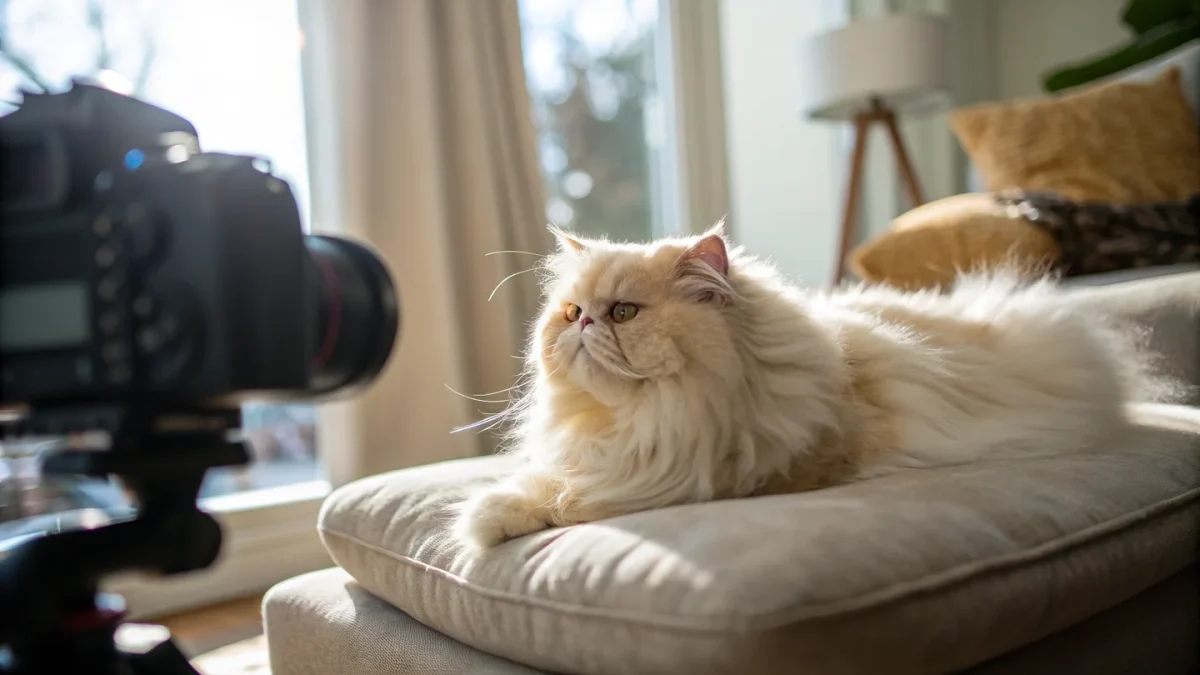
Persians are among the most beautiful domestic cats, and that beauty drives a lot of acquisitions that turn out to be a poor match. Not because Persians are difficult in a behavioral sense — they're genuinely not — but because the daily grooming requirement is underestimated by nearly everyone who hasn't owned one before.
This is the honest assessment. For the full breed profile, see the complete Persian cat breed guide. For a deeper look at their personality, see Persian cat temperament.
The Grooming Question Comes First
Every Persian ownership conversation has to start here, because it's the single most common reason Persian adoptions fail. Daily combing. Not weekly. Not when the coat looks tangled. Every day.
Persian fur has a woolly undercoat that felts within days of neglected grooming. The result is mats — tight, uncomfortable attachments to the living coat that cause skin irritation and, when severe, require professional removal. A neglected Persian coat goes from "needs attention" to "requires professional intervention" faster than owners who haven't experienced it expect.
Ask yourself honestly: is there a 10-15 minute grooming session that I can commit to every single day, indefinitely? Is that something I'll sustain when the initial novelty wears off? When work is busy? When I'm tired?
If the answer is yes — and especially if the answer is "I might actually enjoy that routine" — you're a candidate for Persian ownership. If the answer is "probably most days," you are not yet ready for a Persian. Not because you're a bad person, but because "probably most days" will produce a cat in chronic discomfort.
Your Household Profile
Good match:
- Quieter household, predictable routine
- Frequently or consistently home (work from home, retired, part-time)
- Adults or families with older children who understand gentle interaction
- Someone who finds calm, elegant companionship more appealing than interactive play-driven energy
Poor match:
- Very busy household with constantly rotating guests and unpredictable noise
- Frequently traveling without reliable, daily-grooming-competent pet care
- Young children who will pursue the cat with rough handling
- Someone wanting an active, engaging, "dog-like" companion
The sensitivity of the Persian temperament matters here: these cats settle into routines and don't adapt well to constant disruption. They're not fragile, but they register change. A Persian in an unstable household will spend time hiding and show reduced appetite — not a cat thriving in its environment.
The Flat Face Factor
If you're considering a Persian from a breeder, you'll encounter the choice between extreme flat-face (ultra-type or peke-face) and traditional (doll-face) Persians. This is a more significant decision than it might appear.
Extreme flat-face Persians have the most dramatically round faces with noses essentially level with the eyes. This causes measurable health consequences: brachycephalic research documents restricted nasal passages causing audible breathing in many extreme individuals, constant eye overflow caused by the nasolacrimal duct's inability to drain tears normally against gravity (confirmed by CT imaging studies), dental crowding and malocclusion in 72% of brachycephalic Persians in one JAVMA study, and skin fold infections in the compressed facial folds.
Traditional Persians have a moderate facial structure — visible muzzle, normally positioned nostrils, less pronounced eye protrusion. They have the same coat, the same temperament, and the same basic needs. They have significantly fewer chronic health issues.
This is worth stating plainly: if you're acquiring a Persian, a traditional-faced individual is the more humane choice and will typically have a lower lifetime veterinary cost.
Costs and Ongoing Commitment
Persians are not inexpensive cats to own well. The grooming requirements mean either a genuine daily time commitment or periodic professional grooming costs. The health predispositions — particularly in flat-face individuals — mean higher veterinary expense.
Annual dental care is particularly important due to the shortened jaw's effect on tooth alignment. Regular veterinary checkups should include eye examination for drainage issues.
None of this is prohibitive. It's worth knowing before the decision rather than after.
Who Does Best With a Persian
The households that consistently report genuine happiness with a Persian share a few characteristics: they're home a reasonable amount, they're calm people who appreciate a calm animal, and they entered ownership with clear eyes about the grooming commitment.
People in quiet, stable living situations — retirees, work-from-home professionals, single adults with consistent routines — are disproportionately well-represented among satisfied Persian owners. The breed's temperament and lifestyle needs align well with those settings.
Families work when the children are old enough to interact respectfully and the household has the stability Persians need. Very young-child households are genuinely challenging for this breed — not because the Persian will cause harm, but because the Persian won't be comfortable, and an uncomfortable Persian is not living its best life.
The Exotic Shorthair Alternative
The Exotic Shorthair deserves mention in any Persian discussion. Developed by crossing Persians with American Shorthairs, the Exotic Shorthair has essentially identical temperament to the Persian — same calm, same self-contained affection, same apartment-suitability — but a short, plush coat that requires only weekly brushing rather than daily combing.
If everything about the Persian appeals to you except the grooming, the Exotic Shorthair is a direct alternative worth serious consideration. The primary things you'd be giving up are the signature coat's visual drama — which is also what requires the daily maintenance. And if you're weighing several breeds against each other, the framework in how to choose a cat breed helps translate personality traits into practical household compatibility.