

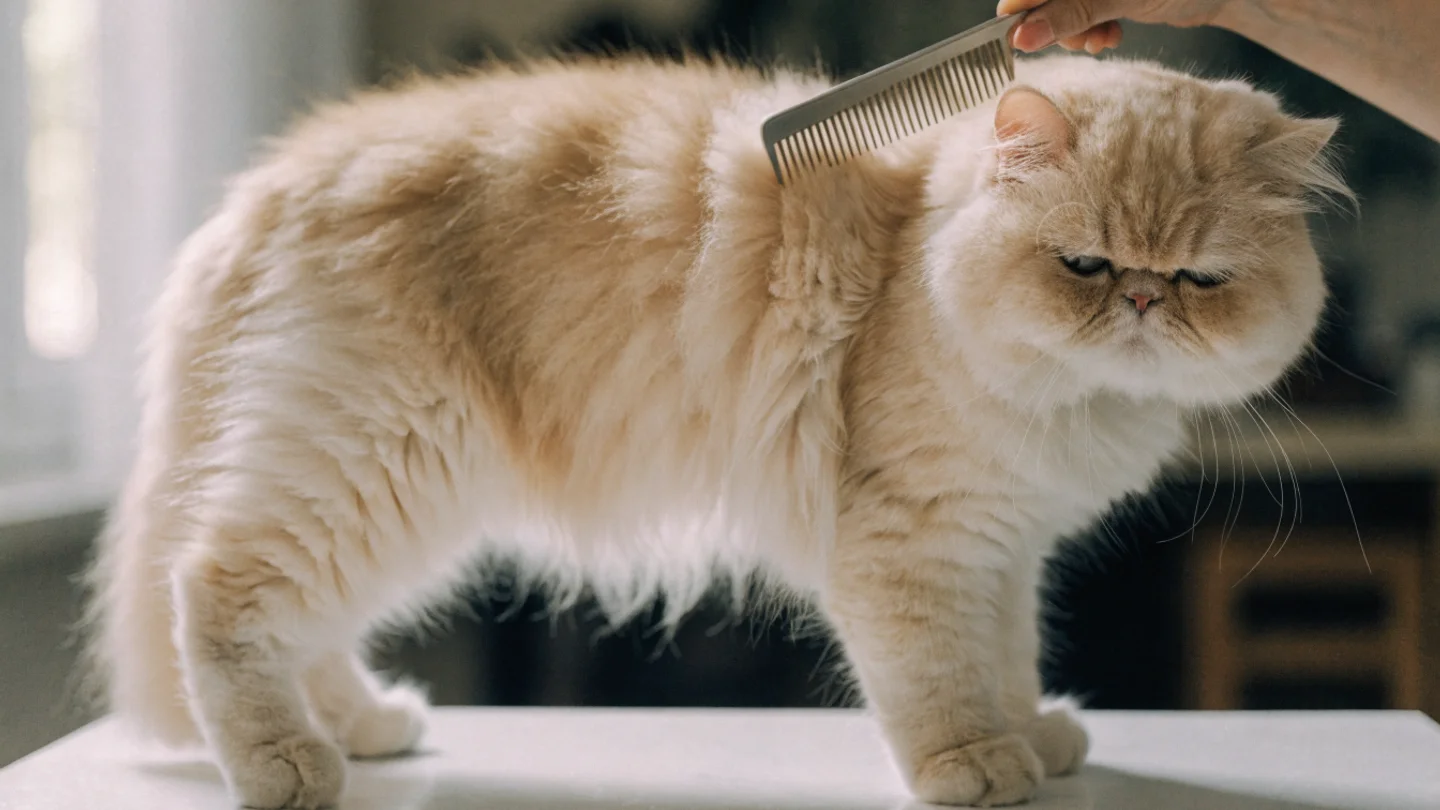
Persian cat grooming is the most significant practical commitment of owning the breed, and it's worth understanding exactly what that means before acquiring the cat rather than after. For many people it becomes a genuinely pleasant part of their routine — a daily few minutes of quiet bonding time. For others, it's an honest mismatch that causes both owner and cat ongoing frustration.
For the full breed overview and whether a Persian is right for your lifestyle, see the complete Persian cat breed guide and whether a Persian cat is right for you.
What the Persian Coat Is
Persian fur is long (up to 5-6 inches), dense, and has a substantial woolly undercoat beneath the guard hairs. This differs fundamentally from the silky, relatively minimal undercoat of a Maine Coon or Ragdoll. The woolly texture felts readily — given warmth, moisture, and compression, the undercoat fibers interlock and form mats that are physically attached to the living coat rather than just tangles in the outer layer.
Mats develop fastest in the areas where there's friction: armpits, the belly, between the hind legs, and around the collar zone. On flat-faced Persians, the fur around the face also requires special attention because it sits near the permanently damp area around the eyes.
Daily Grooming: The Sequence
Step 1: Check and address problem areas first.
Before doing anything else, check the mat-prone zones. Run your fingers through the armpit fur on both sides, the belly, and the area behind the ears. If anything resists your fingers, address it before proceeding to the rest of the coat — a mat pulled through while you're doing a general comb is more painful than one addressed deliberately.
For a just-forming tangle, a wide-toothed comb can often work through it if you hold the mat base firmly between two fingers to prevent skin pulling. For a fully formed mat, use a mat splitter or dematting comb to break it into smaller sections before combing.
Step 2: Comb the body systematically.
Use a wide-toothed metal comb (often called a Greyhound comb). Work in sections, starting at the back legs and moving forward. Use short, deliberate strokes that reach the full coat depth rather than just skimming the surface.
Work against the coat growth direction for the first pass to reach the undercoat, then smooth with the coat direction.
Step 3: Comb the ruff, tail, and chest.
The ruff (neck collar fur) tends to tangle around itself. Comb it in sections, from the collar outward. The chest fur between the front legs is also prone to tangling. The tail can be combed gently from base to tip.
Step 4: Finish with a bristle brush pass.
A natural bristle brush smooths the outer coat, removes the last of the loose fur, and distributes skin oils through the coat. This step is optional but produces a noticeably better coat finish.
The whole process, on a mat-free cat, takes 5-15 minutes depending on the coat's current condition and the cat's patience.
Eye Cleaning
Most Persians require daily or every-other-day eye cleaning. The flat facial structure prevents normal tear drainage, so tears overflow and run down the face rather than draining through the nasolacrimal duct. The overflow causes reddish-brown staining in the fur below the inner corners of the eyes.
Gently wipe the area with a soft damp cloth. Work from the inner corner outward and downward, following the natural drainage path. Don't use tissues (they shred and leave fibers) and don't scrub — the skin under the fur in this area is sensitive.
On some Persians the discharge is minimal and barely stains; on others (particularly extreme flat-face types) it's substantial and requires twice-daily attention. If the discharge increases suddenly, or if the eye itself looks irritated, that's a veterinary question rather than a grooming question.
Bathing
Persian owners fall roughly into two groups: those who bathe their cats monthly and those who've found that every 6-8 weeks works. Daily eye cleaning and coat maintenance can keep a Persian presentable for a while without bathing, but the woolly undercoat accumulates oils and eventually looks dull and feels different than a well-washed coat.
Bathing a Persian thoroughly requires patience. Wet the coat completely — Persian fur repels water initially, and you need to really work water through the surface layer to reach the undercoat. Use a cat-appropriate shampoo. Rinse thoroughly; any residue in this volume of coat will cause skin irritation.
Drying is the most time-intensive part. A Persian after a bath should not be left to air-dry without assistance — the coat stays wet for a very long time, and a damp undercoat is prone to matting. Towel blotting followed by low-heat blow-drying, keeping the dryer moving constantly, produces the best coat condition.
Professional Grooming
Many Persian owners maintain home grooming and supplement with professional appointments every 6-8 weeks. A professional groomer with experience in longhaired cats can do a thorough bath, high-velocity blow-out (which removes far more loose fur than towel drying), and a careful comb-through that resets the coat.
Some owners prefer a "lion cut" for their Persian — a full-body shave that reduces the coat to a short, manageable length for several months. This is a legitimate management strategy for cats whose coats have gotten out of hand, or for hot climates where the full coat is genuinely uncomfortable. Coat regrowth is typically normal on a single shave; with repeated shaving over years, some owners and groomers report minor texture changes in the regrown coat, though this is anecdotal rather than established by controlled study. It doesn't harm the cat provided a competent groomer is used.
Starting Young
The single best investment in Persian grooming is starting it during kittenhood. A Persian kitten that grows up with daily handling of its face, paws, and coat will be a dramatically easier adult to groom than one introduced to comb and eye cleaning as an adult.
Short positive sessions while the kitten is relaxed, paired with calm attention and treats, establish grooming as normal rather than alarming. This isn't luxury conditioning — for a breed that will require daily grooming for its entire lifespan, it's basic responsible preparation.