

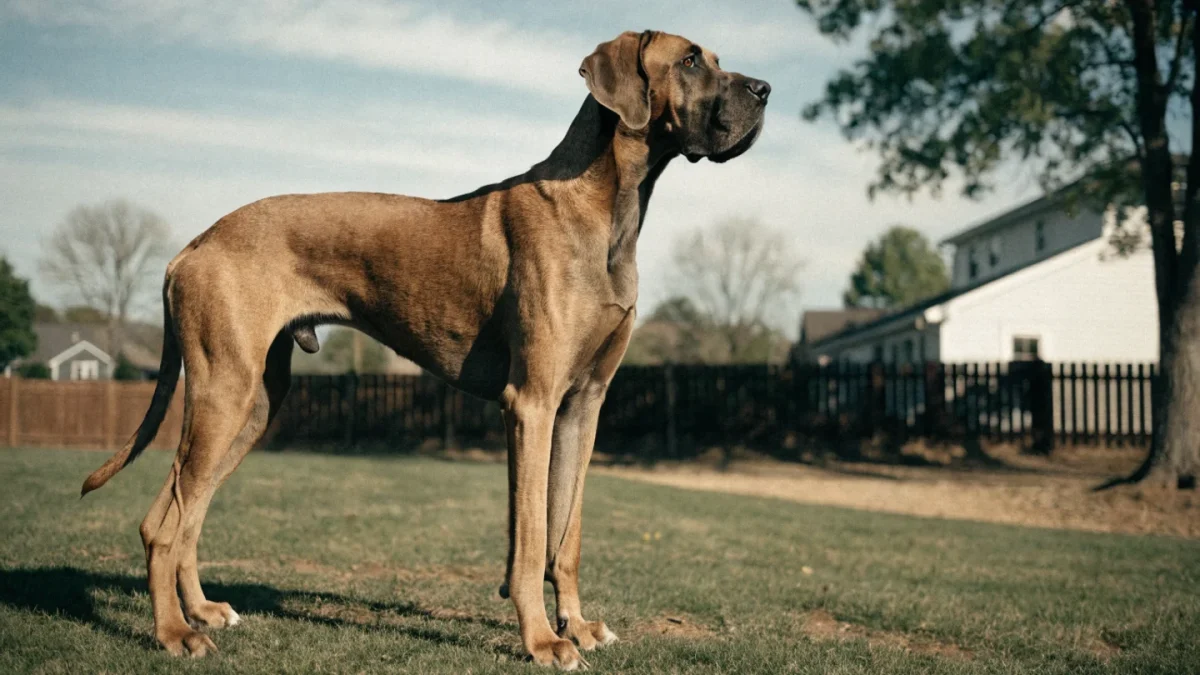
A Great Dane named Zeus held the record for tallest dog ever measured at 111.8 cm at the shoulder — tall enough to look most adults in the eye while standing on all four feet. He died at age five. That single fact captures both the appeal and the heartbreak of giant dog breeds: they are magnificent animals that don't live nearly long enough.
Giant breeds — generally defined as dogs exceeding 45 kg at maturity — include Great Danes, English Mastiffs, Newfoundlands, Saint Bernards, Irish Wolfhounds, Bernese Mountain Dogs, and several others. Most belong to the Working Group, reflecting their historical roles as guardians, draft animals, and rescue dogs. Their sheer physical presence is part of the attraction, but everything that makes them extraordinary also makes them expensive, medically complex, and heartbreakingly short-lived.
The Size-Longevity Tradeoff
The relationship between body size and lifespan in dogs is one of the most consistent patterns in canine biology. While small breeds routinely live 14 to 18 years, giant breeds typically live 7 to 10 years. Irish Wolfhounds average roughly 6 to 8 years. Great Danes average 7 to 10 years. Bernese Mountain Dogs average 7 to 8 years.
Why does size shorten lifespan? Research suggests multiple factors: larger dogs age faster at the cellular level, their organs work harder relative to body mass, and the growth rate required to reach giant size may itself accelerate aging processes. A Great Dane puppy that weighs 500 grams at birth reaches 60-70 kg by 18 months — a growth rate unmatched by almost any other domestic animal. That explosive growth places enormous metabolic stress on developing systems.
This isn't a fixable problem through better breeding alone. The size-longevity tradeoff appears to be a fundamental biological constraint. Prospective giant breed owners need to make peace with it before bringing one of these dogs home.
The Critical Growth Period
Managing growth is the single most important thing a giant breed puppy owner can do. Overfeeding or supplementing calcium during the growth phase causes skeletal abnormalities that are irreversible. Underfeeding creates its own problems. The target is steady, controlled growth — not maximum growth.
Giant breed puppies need food formulated for large-breed growth with controlled calcium-to-phosphorus ratios. Free-feeding is dangerous — their appetite will outpace skeletal development. Avoid forced repetitive exercise (jogging, stair climbing) while growth plates are open, which in giant breeds may not close until 18 to 24 months. Puppies should be lean — you should feel ribs easily. A chubby giant breed puppy is at elevated risk for developmental orthopedic disease.
Health Realities
Bloat (GDV) is the most acute life-threatening emergency in giant breeds. Gastric dilatation-volvulus occurs when the stomach fills with gas and rotates, cutting off blood supply to the stomach and spleen. Without emergency surgery — often within hours — GDV is fatal. Deep-chested giant breeds (Great Danes, Irish Wolfhounds, Saint Bernards) are at highest risk. Prophylactic gastropexy — surgically tacking the stomach to prevent rotation — is increasingly performed as a preventive measure, often during spay/neuter surgery.
Hip and elbow dysplasia affect virtually every giant breed. Screening reduces incidence but doesn't eliminate it.
Cardiac disease — dilated cardiomyopathy in Great Danes, Irish Wolfhounds, and Newfoundlands; subaortic stenosis in Newfoundlands and Rottweilers.
Cancer claims giant breeds at elevated rates. Osteosarcoma is particularly prevalent in Irish Wolfhounds, Great Danes, and Rottweilers. Bernese Mountain Dogs face exceptionally high rates of histiocytic sarcoma. Amputation alone — without follow-up chemotherapy — typically buys 3 to 4 months, because 90% of dogs already have microscopic spread to the lungs at diagnosis. Add chemotherapy and median survival roughly triples, to 10 to 12 months. Neither number is the one owners want to hear, but they're the honest ones.
Living With Giants
Giant breed ownership costs substantially more than owning a medium-sized dog — food, weight-dosed medications, larger equipment, and vehicle space all scale with body weight. Emergency GDV surgery alone can cost several thousand dollars. These costs are not reasons to avoid giant breeds; they're reasons to plan honestly.
Indoors, giant breeds are often surprisingly gentle. Great Danes, Newfoundlands, and Mastiffs tend toward moderate energy as adults. But a 65 kg dog wagging its tail will clear a coffee table, and counter-surfing isn't a bad habit — it's simply standing at normal height.
The emotional bond with a giant breed can be extraordinary. That bond, compressed into 7 to 10 years, is the essential bargain of giant breed ownership: you get less time, but what you get is often profound. For broader context on where these breeds fit, most giants belong to the Working Group.
Frequently Asked Questions
What's the biggest dog breed?
The tallest breed is the Irish Wolfhound, with males routinely standing over 81 cm at the shoulder. The heaviest breed is the English Mastiff, with males commonly weighing 68 to 90 kg, though individual dogs have exceeded 113 kg. Great Danes compete for tallest individual dogs — the tallest dog ever recorded was a Great Dane. "Biggest" depends on whether you measure by height or mass.
Can giant breeds live in apartments?
Some can, with caveats. Great Danes and Mastiffs have relatively low indoor energy levels and adapt to apartment living better than their size suggests. The dog needs space to lie down comfortably, turn around, and move through doorways without difficulty. The bigger challenge is often building logistics — elevators, stairs, narrow hallways — rather than apartment square footage itself. High-energy giant breeds like Irish Setters or young Newfoundlands are harder to manage in apartments.
How do I know if my giant breed puppy is growing at a healthy rate?
Work with a veterinarian experienced in giant breeds to track growth curves. Your puppy should be gaining weight steadily but not rapidly — you should always be able to feel ribs without pressing. Visible signs of concern include bowed legs, knuckling over at the pasterns (wrists), or reluctance to move or play. Giant breed puppies should be lean and active, not pudgy. If your puppy's growth seems unusually fast or you notice any skeletal abnormalities, consult your veterinarian immediately.