
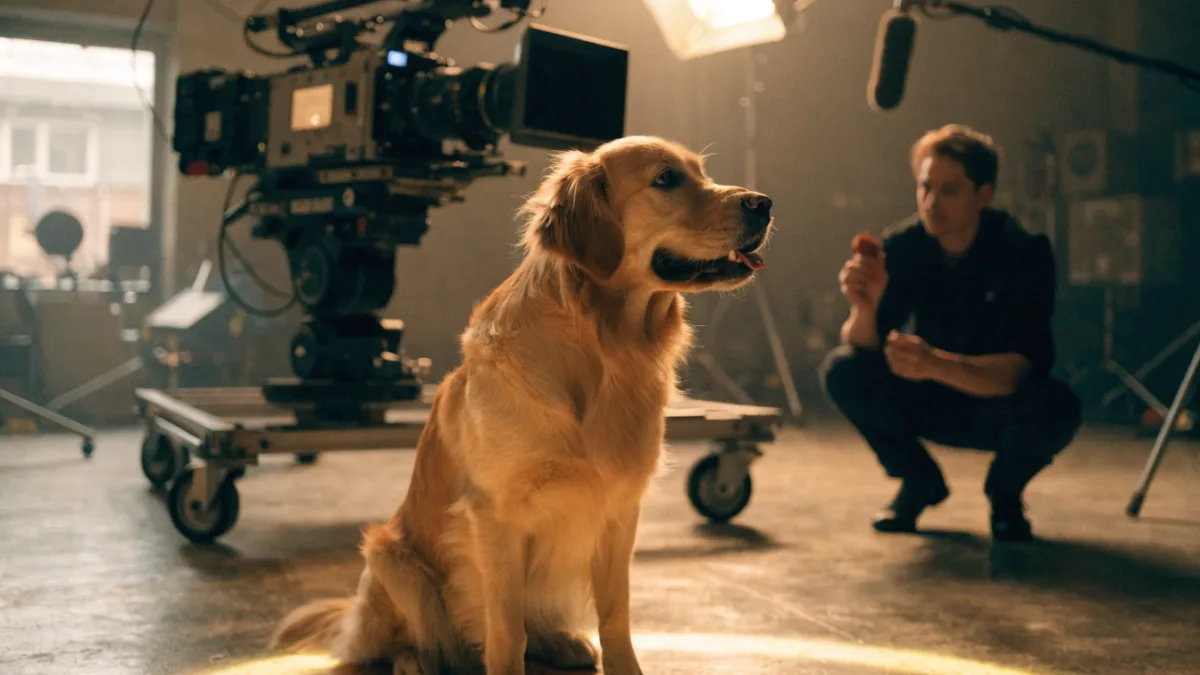
That scene where the dog looks up at the actor with pure devotion in his eyes? Yeah, he’s not gazing at his human co-star. He’s staring at his trainer, who’s crouched just out of frame waving a piece of hot dog. Movie magic is built on moments like that — and once you see how the sausage gets made, you can’t unsee it. But honestly? Understanding how animal actors are trained makes you appreciate the craft even more. It’s not about forcing a dog to emote. It’s about breaking complex behaviors into tiny pieces and rewarding each one until the final product looks seamless on screen.
The Editing Room Is Where the Real Magic Happens
Here’s the thing most people don’t realize about animal acting: what looks like one continuous, heroic action on screen is almost never performed that way. That incredible sequence where the border collie runs across the field, jumps the fence, grabs the rope, and pulls it to save the day? That’s probably four different training sessions stitched together by an editor.
Trainers call these micro-behaviors “bits.” A dog might learn to run to a specific spot. That’s one bit. Then separately, they learn to pick up a rope. Another bit. Then they learn to tug. Another bit. The editor pieces these fragments together so it looks like one fluid motion. This isn’t cheating — it’s how you keep the animal from getting overwhelmed and how you keep training sessions short and positive. You’re never asking one dog to perform a thirty-second choreographed sequence start to finish. You’re asking for five seconds of brilliance, over and over, in different contexts.
Studio Behaviors: A Whole Different Vocabulary
Obedience training for your pet and training for film are two completely different worlds. A well-trained family dog might sit, stay, come when called, and walk nicely on leash. A film dog needs a specialized skill set that has nothing to do with real-world manners. Industry trainers teach specific “studio behaviors” that exist solely to make filming possible.
Hitting Marks
An animal actor needs to go to a specific taped spot on the floor — a “mark” — and stay there while cameras roll. This is how directors get an animal positioned perfectly in the frame without someone physically placing them there and stepping away. The dog learns to find the mark and plant themselves on it like it’s the best spot in the house.
Targeting with an Aim Stick
This one’s clever. Trainers use a stick with a small ball or target on the end, and they teach the animal to touch it with their nose or paw. Want a dog to walk over to a specific prop and “investigate” it? The trainer holds the aim stick near the prop, the dog touches it, and the stick gets edited out in post-production. The audience just sees a dog naturally wandering over to sniff something important to the plot.
Head Cues and Emotional Direction
That soulful head-tilt? The alert ear-perk? The “sad” downward gaze? These are trained behaviors, often cued with subtle hand signals from a trainer standing just off camera. A dog who looks up and to the left at the right moment can sell an entire emotional beat. It’s not that the dog feels the emotion — it’s that the trainer has reinforced that specific head position hundreds of times until it’s reliable on cue.
Working Away from the Trainer
This is harder than it sounds. Most pet dogs want to be near their person. A film dog needs to perform behaviors — sometimes complex ones — while their trainer stands twenty or thirty feet away, outside the camera frame. This takes a lot of foundation work, building confidence and distance gradually so the dog trusts that the reward is coming even when they can’t see their handler.
Why There’s Almost Always More Than One Dog
If you’ve ever watched a movie and thought, “That dog is incredibly talented — he can do everything,” I’ve got news for you. Production companies almost always use multiple identical-looking animals for a single role. It’s called twinning or double casting, and it’s not deception — it’s welfare.
One dog might be phenomenal at action sequences: running, jumping, agility work. Another might specialize in “talking” — those cute head tilts and lip curls that look like the dog is about to speak. A third might be the calm one who can lie still on a bed for a quiet scene without fidgeting. By splitting the workload, no single animal gets overworked or stressed. Each dog gets to do what they’re naturally good at and enjoy.
I used to think a single dog performed every scene in movies like Homeward Bound. When I learned that Shadow was probably played by several different golden retrievers — each with their own specialty — it actually made me respect the production more. It means someone was paying attention to what each individual dog could handle.
Cats Are a Completely Different Game
If training a dog for film is like assembling IKEA furniture with the instructions, training a cat is like assembling it blindfolded while someone keeps hiding the Allen wrench. Dogs are generally eager to work with you. Cats need to be convinced that whatever you’re asking is worth their time.
For a film like Homeward Bound, where Sassy the cat had to perform alongside two dogs, trainers relied heavily on target sticks, flickering laser pointers, and food lures. A cat might be willing to jump across a series of rocks — but they’ll only do it once or twice before they decide they’re done. So the crew isolates each action into a single brief shot. Get the jump on the first take, move on. Don’t push for a second take unless absolutely necessary, because the cat will tell you very clearly when the collaboration is over.
The independence isn’t a flaw. It’s just a different species with different motivations. You work with it, not against it.
When the Trainer Is the Real Co-Star
Here’s an open secret: in almost every scene where an animal appears to interact with a human actor, the real directing is happening off-camera. The trainer is positioned just past the actor’s shoulder, holding a high-value treat or a favorite toy. When the dog looks lovingly into the lead actor’s eyes, they’re actually staring at their trainer — or at the piece of liver in their trainer’s hand.
This doesn’t diminish the performance. If anything, it highlights the relationship between trainer and animal. That dog trusts their trainer enough to perform in a chaotic environment full of lights, strangers, and strange equipment. The trainer has put in hundreds of hours building that trust through positive reinforcement — treats, clickers, play, praise. Modern film training is built on operant conditioning. The animal performs because the behavior has a history of producing good outcomes, not because they’re afraid of what happens if they don’t.
The Darker History and Why It Matters
I’d be lying if I said the industry has always been clean. It hasn’t. Since 1940, the American Humane Association has overseen animal treatment on film sets, and their “No Animals Were Harmed”® end credit is only awarded to productions that meet strict welfare guidelines. But oversight doesn’t catch everything, and not every trainer has operated ethically.
Historically, there have been allegations of food and water deprivation to keep animals highly motivated by treats on set. There have been trainers who relied on physical force — pinch collars, shock collars, intimidation — to get instant compliance. These methods don’t produce willing, confident animal actors. They produce stressed animals who perform out of fear, and the difference shows on camera if you know what to look for.
The 2017 scandal around A Dog’s Purpose was a turning point. Behind-the-scenes footage leaked showing a terrified German Shepherd being forced into churning water. The public outcry was immediate and fierce. Studios scrambled to tighten protocols. The AHA and SAG-AFTRA implemented stricter rules around water sequences, extreme temperatures, and pyrotechnics. Mandatory rest periods became non-negotiable. If an animal shows signs of distress, the set shuts down. Full stop.
The Exotic Animal Problem
Domestic dogs and cats on film sets are one thing. Wild animals are another conversation entirely — and it’s a conversation the industry is still wrestling with.
Animal rights organizations have campaigned for years against the use of wild and exotic animals in film. Bears, big cats, primates, large predators — these are not domesticated species. Forcing a wild animal to perform unnatural behaviors on a loud, bright, chaotic set raises serious ethical questions regardless of the training method used. Even with the best welfare protocols, a tiger on a Hollywood soundstage is still a tiger in an environment it was never evolved to navigate.
Historically, films like Ace Ventura and Jumanji relied heavily on captive-bred wild animals. Today, conservationists push hard for alternatives. The concern isn’t just individual welfare on set — it’s the broader industry of exotic animal breeding, trading, and captivity that supplying film productions can inadvertently support. When endangered or threatened species are involved, the stakes get even higher.
CGI and the Future of Animal Acting
The biggest shift in recent years isn’t a training technique at all — it’s the move away from live animals entirely. Films like The Call of the Wild (2020) and the live-action The Lion King (2019) used entirely digital animals. Part of this is technological — CGI has gotten incredibly good. But part of it is a direct ethical response to decades of controversy.
There’s also a middle ground emerging: motion capture. Real animals wear specially designed motion-capture suits in safe, controlled green-screen environments — essentially just playing. Their natural movements get recorded and mapped onto digital characters. The animal gets to be a dog or a horse doing dog or horse things. The digital version does the dangerous stunts on screen. It’s a model that respects both the craft of animal training and the welfare of the animals themselves.
I’ll be honest — when I first heard about fully CGI animal films, I was skeptical. Part of me worried it would erase the artistry of animal trainers entirely. But the more I’ve sat with it, the more I think this shift is the right call for high-risk sequences and wild species. The best animal trainers I know care first and foremost about the animals in their care. If technology can replace a stressful or dangerous shot without losing the emotional impact of the scene, that’s not a loss. That’s progress.
The next time you watch a movie with an animal performance that makes you tear up, appreciate the craft. Know that behind that moment is a trainer who spent weeks building trust, a dog who got to do something they genuinely enjoyed, and probably an editor who stitched five separate takes into one perfect second of screen time. And when it comes to the animals we share this planet with — whether they’re on a film set or in the wild — the standard should always be the same. Their welfare comes first. The scene can wait.