

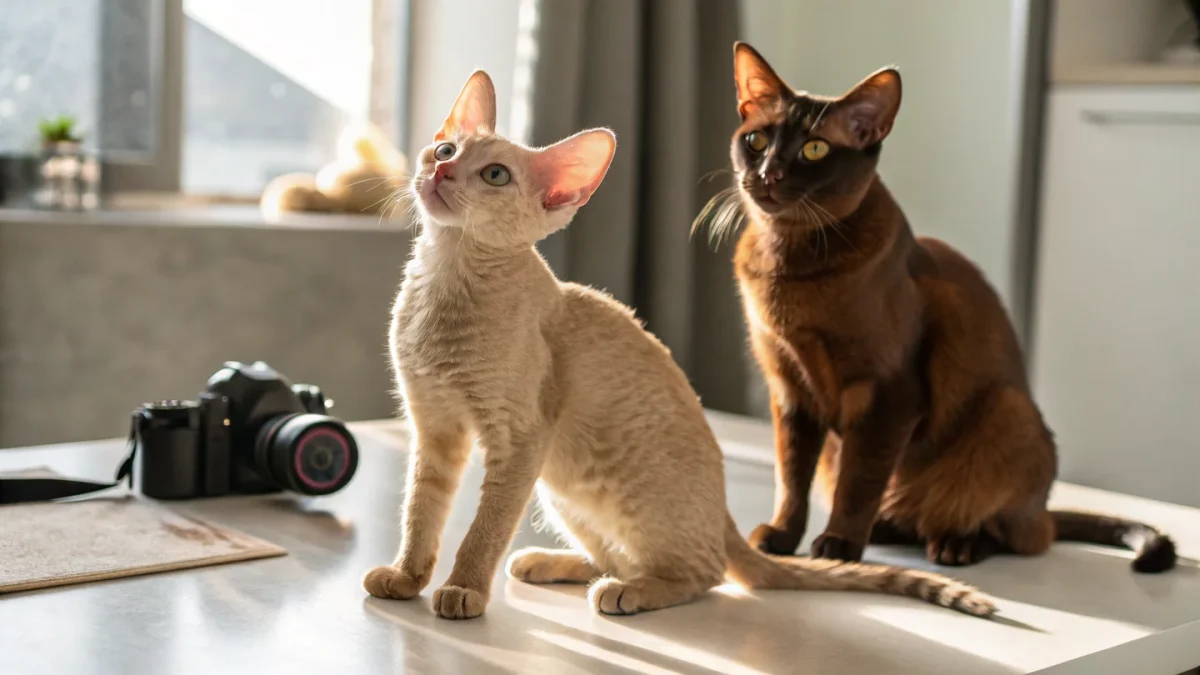
Sometime around July 1950, a farm cat in Cornwall delivered a litter that included one wavy-coated kitten. His owner noticed, wrote to a geneticist, and started something that would eventually be recognized as the Cornish Rex breed. The path from "unusual kitten" to "internationally recognized breed" takes decades, careful genetic management, and navigation of multiple registry systems.
Understanding how breeds are created helps explain both what breeds represent (consistent genetic expression of specific traits) and their limitations (narrow genetic bases, breed-specific health risks, maintenance requirements shaped by the trait that defines them).
For context on how existing breeds fit into categories, the cat breed categories overview covers the full landscape. For the genetics underlying coat variation, the genetics underlying coat variation provides the foundation.
Route 1: Natural Geographic Isolation
The oldest cat breeds developed without human intervention in the formal sense. In geographically isolated populations — on islands, in specific regions, in climates with distinct selection pressures — cats developed consistent traits over generations.
Maine Coon: Descended from cats in the northeastern United States, shaped by the harsh New England climate. The heavy coat, large paws (historically noted for snow navigation), and tufted ears reflect adaptation to environment. The breed emerged from this gene pool before formal breeding programs.
Norwegian Forest Cat: Similarly, Scandinavian cats adapted to northern European winters over centuries. The dense, water-resistant, triple-layered coat is a direct response to climate selection.
Turkish Angora and Turkish Van: Both developed in specific regions of Turkey — the Angora region and the Lake Van area respectively — producing distinct but related longhaired types.
These breeds are often called "natural breeds." Their genetic foundation is broader than deliberately created breeds and their health profiles tend to reflect this.
Route 2: Spontaneous Mutation
Many modern breeds began with a single unusual kitten — a mutation in the genetic blueprint that produced something different. The Cornish Rex's wavy coat, the Scottish Fold's folded ears, the American Curl's backward-curled ears, the Manx's taillessness: all began as spontaneous mutations in individual cats.
The mutation alone doesn't create a breed. It creates a founder. To establish a breed, that founder must be bred deliberately, the trait must be demonstrably heritable, and the gene pool must be broadened through outcrossing to prevent the genetic bottleneck that comes from breeding too closely.
The Cornish Rex story illustrates this: Kallibunker, the founding cat, was bred back to his mother to confirm heritability, then an outcrossing program began — using domestic shorthairs and later Burmese — to establish a genetically diverse foundation while maintaining the rex coat mutation.
Not every mutation becomes a breed. Some are not heritable. Some produce phenotypes with significant health implications that responsible breeders don't pursue. Some simply don't find an advocate willing to do the work of breed establishment.
Route 3: Deliberate Hybrid Crossing
The Bengal, Savannah, and Chausie are hybrid breeds — created by crossing domestic cats with wild cat species. The intent is typically to create a domestic-manageable cat with the aesthetic of a wild animal.
Bengal: Asian leopard cat × domestic cat, developed systematically from the 1960s-70s onward by breeder Jean Sugden Mill. The spotted coat with iridescent quality comes from the leopard cat heritage. Modern Bengals are many generations removed from wild stock.
Savannah: Serval × domestic cat. The serval is a substantially larger African wild cat; early-generation Savannahs are significantly taller than typical domestic cats.
Hybrid programs involve complex genetic work, significant time investment, and ongoing management of welfare considerations in both the wild cat parents and the hybrid offspring.
The Recognition Process
Creating the cats is only part of establishing a breed. Recognition by major registries (CFA, TICA, FIFe, GCCF, and others) requires:
- Demonstrating consistent breed standards across multiple generations
- A breeding population large enough to suggest genetic viability
- Documentation of temperament, health, and distinct characteristics
- Formal breed standard documentation
- A sponsoring group of breeders committed to the breed's ongoing development
The process typically moves through stages, though the fine print differs by registry. CFA advances a breed from Miscellaneous to Provisional to Championship whenever the breed committee judges it's matured enough — enough cats shown, enough favorable judge feedback — there's no fixed clock on it. TICA does set a floor: a breed can't even be considered for Championship until it's logged at least three years in Advanced New Breed status. Either way, from the first odd kitten to full championship recognition, you're usually looking at a decade or more, sometimes closer to two — I've watched breeds crawl through this in real time.
Different registries recognize different breeds. A breed fully recognized by TICA may still be provisional with CFA, or not recognized at all with FIFe. This fragmentation is a consistent characteristic of the international cat fancy world.
What This Means for Breed Health
The history of how a breed was created directly affects its current health profile. Natural breeds from broad geographic gene pools tend to have fewer concentrated genetic health issues. Mutation-founded breeds with narrow early gene pools have higher risks of founder-effect genetic disease — the health conditions that were either present in the founding cats or were introduced during the early breeding program carry forward.
The Scottish Fold's osteochondrodysplasia is inseparable from the mutation that creates the fold — the gene does both things simultaneously. The Persian's brachycephaly is a consequence of selecting for skull compression — a process that also produced the remarkable breadth of Persian coat colors and patterns that define the breed today. These aren't accidents; they're the predictable outcomes of specific breeding choices.
Understanding breed history helps owners choose with better information and ask better questions of breeders.