
Drying a dog after a bath is not an afterthought. It's the completion of the bathing process, and doing it wrong—or doing it insufficiently—can cause skin problems more serious than whatever you were trying to address by bathing the dog in the first place. For the full bathing process from start to finish, see the complete bathing guide for dogs and cats.
The central risk: moisture trapped near the skin. A dog that's damp at the skin level, even when the outer coat appears dry, is sitting in a warm, moist environment that's ideal for bacterial and yeast growth. Hot spots (acute moist dermatitis) commonly develop within hours of inadequate post-bath drying in susceptible dogs. This is especially true in skin folds, dense undercoat, and the ears.
When Towel Drying Is Sufficient
Short, smooth-coated breeds—Boxers, Dalmatians, Vizslas, Beagles, Greyhounds—can be thoroughly dried with a towel and a brief air-dry period. The coat is thin enough that moisture doesn't accumulate in significant volume, and drying happens quickly. Absorb as much moisture as possible with a towel (squeeze rather than rub to avoid frizzing the coat), then let the dog air-dry in a warm environment.
Important even for shorthairs: dry the skin folds if your dog has them (Boxers, Bulldogs, Shar-Peis), dry the ear flaps and inside the ears, and dry between the toes. These areas hold moisture longer than the flat coat.
When Blow-Drying Is Necessary
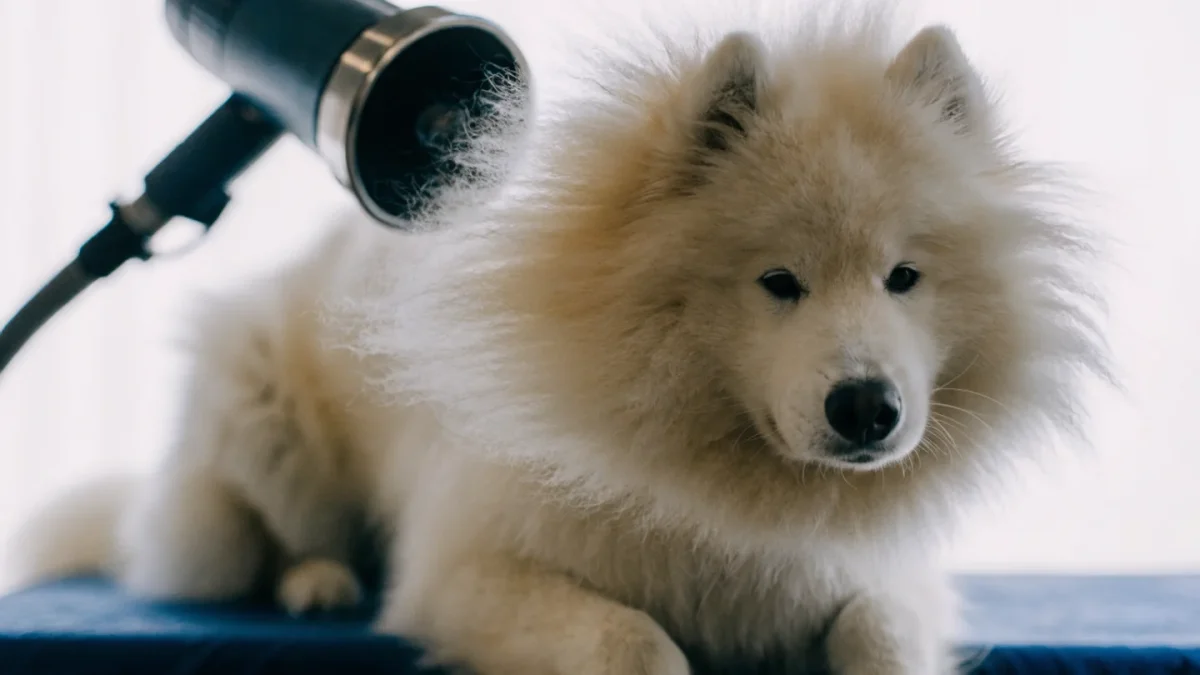
Any double-coated breed—and really any medium to long-coated dog—needs blow-drying to ensure the undercoat reaches the surface dry. After a thorough towel session, the surface may feel nearly dry while the undercoat is still significantly damp. You can test this by parting the coat and pressing a dry cloth against the skin: if the cloth absorbs moisture, the undercoat is still wet.
Breeds where this matters most:
- Huskies, Malamutes, Samoyeds
- German Shepherds, Collies
- Golden and Labrador Retrievers
- Poodles and curly-coated breeds
- Any thick-coated small breed (Pomeranians, Chow Chows)
For these dogs, blow-drying is not optional. It's part of the process.
Blow-Drying Technique
Temperature setting: warm, not hot. Pets feel heat differently than humans; what feels tolerable on your arm may be too warm for a dog's skin with extended exposure. Many professional groomers use high-velocity dryers that move large volumes of air at lower heat—the air movement does the drying work rather than heat alone.
Distance: maintain at least six to eight inches between the nozzle and the coat. Closer increases heat concentration.
Keep it moving: don't hold the dryer on one spot. Constant movement prevents overheating any single area.
Brush while drying: work a slicker brush or pin brush through each section as you dry it. This accomplishes two things simultaneously: it separates the coat fibers so air reaches all the way to the skin, and it detangles any knots before they dry into the coat. Dried-in tangles are harder to brush out than wet ones. The shampoo used affects how easy the coat is to work through while drying—see choosing the right dog shampoo for formulas that improve coat manageability.
Work section by section: start at the back of the neck, work toward the tail, then do the legs and belly. The belly and groin areas are often forgotten and stay damp longest.
The Crate Drying Option
Some owners put their dog in a crate after a bath with good airflow rather than blow-drying. This works adequately for short-coated dogs in warm environments. For double-coated dogs, it's insufficient—the undercoat will remain damp for eight to twelve hours, which is too long.
If you use crate drying for any breed, ensure the crate is in a warm, not-cold room, the dog has been thoroughly toweled first, and check that the dog is actually dry before closing the crate for an extended period.
Ear Drying
The ears need specific attention regardless of coat type. After any bath, water that entered the ear canal needs to be addressed. Gently wipe the outer ear canal with a soft cloth or cotton ball. A small amount of cotton wool loosely placed at the ear opening can absorb water over the first few minutes out of the bath. Never push anything into the ear canal.
Long-eared dogs (Spaniels, Setters, Basset Hounds) are particularly prone to ear infections following bathing if the ears aren't dried—the pendulous ear leather creates a warm, moist seal over the canal.
FAQ
Can I use a human hair dryer on my dog?
Yes, with important caveats. Use the lowest heat setting. Keep the dryer moving constantly. Maintain distance from the skin. Human hair dryers are designed for human use and can deliver more heat than a pet coat can safely tolerate if used incorrectly. A purpose-built pet dryer or high-velocity dog dryer is safer for regular use, but a careful human hair dryer on low heat works.
Why does my dog develop hot spots after baths?
Almost certainly from incomplete drying. Hot spots develop when moisture is trapped against the skin, creating conditions for bacterial growth. Increase your drying thoroughness—particularly in the areas where the hot spots form. If a dog develops hot spots repeatedly after bathing, the coat likely isn't being dried thoroughly enough near the skin in those areas.
My dog hates the blow dryer. How do I manage?
Introduce the dryer away from bathing—during non-bath times, with the dryer running at a distance, treating the dog for calm behavior near it. Gradually decrease the distance over multiple sessions. Many dogs that resist the dryer initially accept it well once it's been systematically desensitized. For dogs that strongly resist despite this, a high-velocity no-heat blower is often more tolerable than a hot-air dryer because the noise is different and there's no heat sensation.
How long does it take to blow-dry a double-coated dog?
Significantly longer than most owners expect. A full bath and blow-dry for a Husky or Golden Retriever typically takes forty-five minutes to an hour even with a high-velocity dryer. Professional groomers often use multiple tools and techniques to speed this up; home groomers without professional equipment should allocate adequate time.