

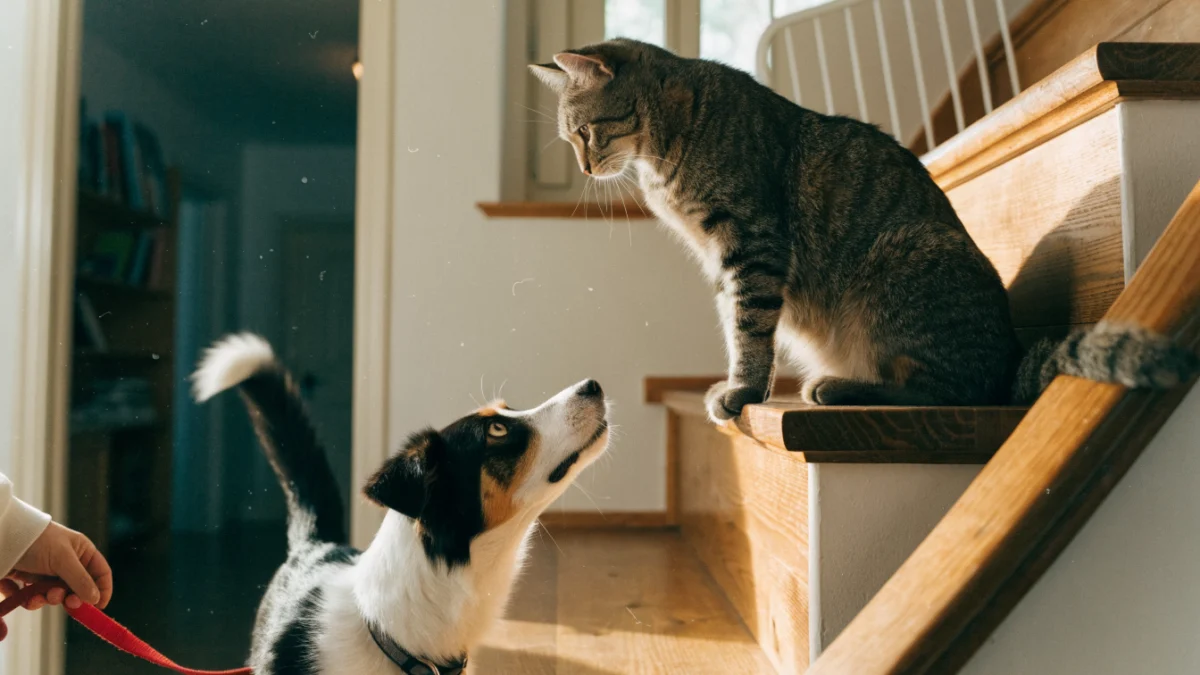
Look, dogs are wonderful. I love them. But let’s be brutally honest: introducing a new dog into a cat’s territory is basically inviting a furry, chaotic wrecking ball into a finely tuned, silent dictatorship.
When I brought home Otis—a scruffy, overly enthusiastic terrier mix with zero concept of personal space—my resident cat, Saffron, a calico who rules my living room like a medieval queen, was unimpressed. That first weekend was an absolute disaster of mismatched body languages. Otis wanted to play; Saffron wanted to draw blood.
The problem is that dogs and cats speak entirely different languages. A wagging tail on a dog usually means “I am so happy right now!” while a twitching, thumping tail on a cat means “I am calculating the trajectory of my leap onto your face.”
If you are blending a canine into a feline household, you cannot just cross your fingers and hope they sort it out. You need a strategy. Here is how to navigate the delicate balance of feline flow and canine chaos without losing your mind.
Forget the “They’ll Work It Out” Myth
There is a surprisingly common, incredibly stubborn myth in the pet community that if you just throw the animals into a room together, they will establish a hierarchy and figure it out. Let’s permanently bury this idea.
Letting pets “figure it out” on their own in a shared space is a recipe for severe stress, territorial aggression, and expensive emergency vet bills. Modern veterinary behaviorists firmly reject the free-roaming approach. Instead, they lean heavily on,[1] using positive reinforcement and counter-conditioning.
This means moving through phases—scent, sight, and finally physical proximity—at the pace of the most stressed animal. If your cat is hiding under the bed hyperventilating, you are moving too fast. The introduction process is a slow burn, taking anywhere from a few weeks to several months. Patience isn’t just a virtue here; it’s the entire point.
Phase One: The Art of the Scent Swap
Before the animals ever lay eyes on each other, their noses need to negotiate a peace treaty. Scent swapping is arguably the most critical step in this entire process.
Animals gather far more information about their world through smell than sight. If a new dog just suddenly appears in the hallway, the cat’s territory feels instantly invaded. We want to make the dog’s smell a normal, boring part of the environment first.
You can do this by taking a blanket or a toy the new dog has slept on and placing it near the cat’s food bowl or favorite lounging spot. Do the same for the dog, giving them a blanket that smells like the cat.
This is where counter-conditioning comes in. You want the cat to think, “Hmm, this weird new smell keeps appearing right when I get my favorite treat. Maybe this smell isn’t so bad.” Whenever Saffron investigated Otis’s blanket, she got a high-value lickable treat. We were actively training her brain to associate the scent of the dog with a massive payday.
Phase Two: Through the Looking Glass
Once they are completely unbothered by each other’s smell (no hissing at the blanket, no frantic sniffing), you can move on to visual introductions.
This must be done safely. You need a physical barrier. A baby gate is fine, but a [2] or a sturdy screen door, is even better. The goal is to let them see and smell each other without the risk of a physical altercation.
Keep these sessions incredibly brief—just a few minutes at a time.
Respect the Resident’s History
You might be thinking, “But my cat already lives with a dog! She loves dogs!”
I cannot stress this enough: past comfort does not guarantee immediate acceptance of a new dog. Even if your cat is currently best friends with your neighbor’s Golden Retriever, a *new* dog entering the home has its own unique energy, body language, and prey drive. Saffron tolerates my parents’ elderly lab because he sleeps twenty-two hours a day. Otis was a bouncing, yipping puppy tornado. To Saffron, they are entirely different species. Every new dog requires a structured introduction from scratch.
The Main Event: Face-to-Face Supervision
Once they can hang out on opposite sides of a gate without the cat yowling or the dog lunging, you can finally drop the barrier. But do not just open the gate and walk away to make a sandwich.
During these initial face-to-face meetings, there should ideally be two people present. One person is assigned to monitor and manage the dog, and one person is there for the cat. You need a 1-to-1 supervision ratio. The dog should be on a loose leash—not to drag them away, but just as a safety net. The cat should be free to move around or, better yet, held and comforted by their designated person.
Again, keep it brief. Five calm minutes is a massive victory. End the session before anyone gets overstimulated.
The Multi-Dog Dilemma
If you are introducing a new dog to a home that already has multiple dogs, do not introduce them to the cat as a pack. Dogs act completely differently in a group than they do alone. Pack mentality kicks in, and a cat can easily feel cornered, overwhelmed, or treated like prey.
Each dog must be introduced to the resident cat separately. Otis needed to learn how to behave around Saffron on his own merit before he was ever allowed to be near her while his canine siblings were in the room.
Prey Drive vs. Compatibility
Let’s address the elephant in the room: some dogs are genetically wired to chase small, fast-moving things.
There is an ongoing, sometimes heated debate among pet owners about breed tendencies versus individual temperaments. Terriers and sighthounds were literally bred for centuries to hunt small, furry creatures. Can they live harmoniously with a cat? Absolutely. But it requires acknowledging that genetic reality rather than pretending your dog’s breed history doesn’t matter.
This is where you have to be brutally honest with yourself about your new dog’s prey drive. If your dog locks onto the cat, body stiff as a board, pupils dilated, and cannot be distracted by even the most delicious piece of roast chicken, you have a high prey drive situation. That is not a “they’ll figure it out” scenario. That is a management scenario.
I’ll be the first to tell you to [3] for the heavy lifting on impulse control. My friend Jake, who trains working dogs, always reminds me that you can’t train instinct out of a dog entirely—you can only train an alternative behavior. You are looking for a dog that can look at the cat, think about chasing, and then actively choose to look back at you for a treat instead. If your dog’s brain short-circuits the moment the cat runs, you will need strict, permanent management in your home.
Creating Feline Flow in a Canine World
Ultimately, the key to a peaceful household is modifying your home to accommodate both energy levels. Cats need “flow”—the ability to move vertically and horizontally through a space without ever having to touch the floor where the chaotic canine roams.
Invest in tall cat trees, install floating wall shelves, and clear off the tops of bookcases. Your cat needs to feel like they have an escape route at all times. If a cat feels trapped, they will fight. If they feel elevated and secure, they will eventually learn to ignore the dog.
This process isn’t a straight line. There will be setbacks. One day they will be napping in the same room, and the next day the dog will sneeze and the cat will launch off the couch in a panic. Take a deep breath, go back a step in your training phases, and try again.
While blending a resident predator with a new one might feel like a purely domestic struggle, it’s a fascinating reminder of how deeply instinct shapes animal behavior. When we take the time to understand the biological drives behind our pets’ actions—whether it’s a dog’s ancient prey drive or a cat’s need for vertical territory—we become much more empathetic caretakers. Supporting animal welfare starts in our own homes, but it extends outward. By choosing to adopt and taking the time to humanely integrate rescue animals into our lives, we help build a society that values coexistence, patience, and the incredible diversity of the animal kingdom.
Sources
- structured, gradual introductions — sdhumane.org
- tall pet gate with a built-in cat door — bestfriends.org
- defer to a professional dog trainer — facebook.com