

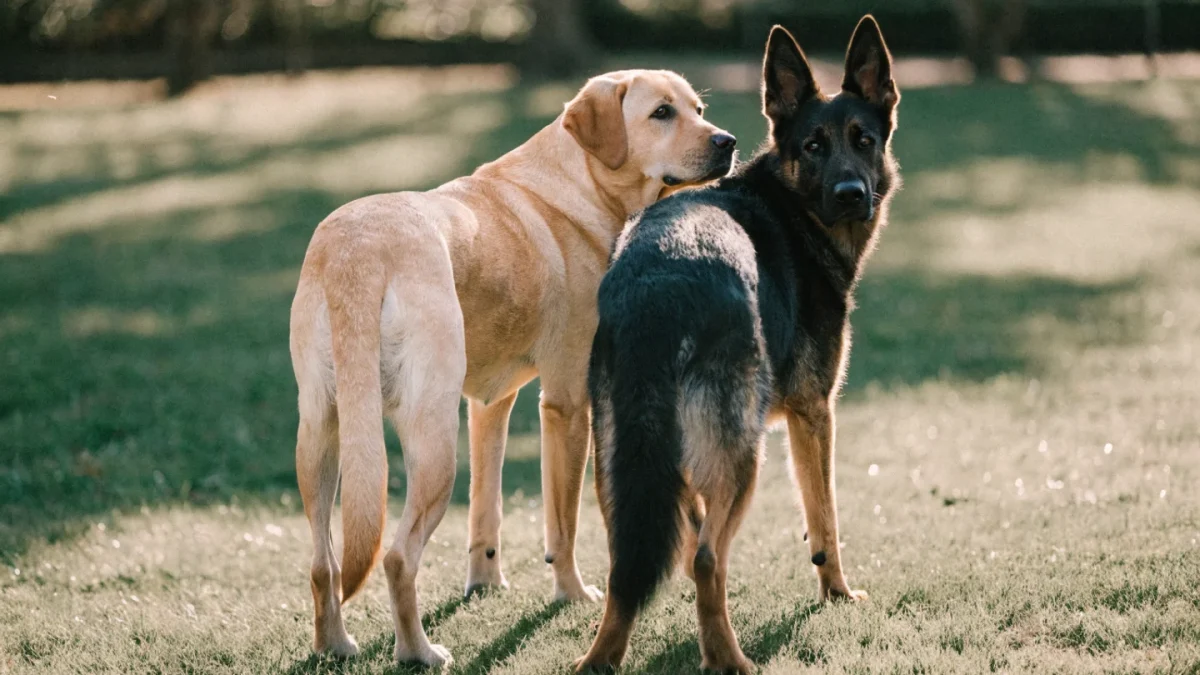
The Labrador Retriever and the German Shepherd have traded places at the top of breed popularity rankings across multiple countries for decades. The Lab dominated most popularity lists for over 30 years until the French Bulldog overtook it recently; the GSD has held steady in the top three for even longer. More people are choosing between these two breeds than arguably any other pairing — and they're more different than their shared popularity suggests.
Labs originated in 1830s Newfoundland as fishermen's helpers, retrieving nets, hauling lines, and swimming in the frigid North Atlantic. The German Shepherd was engineered in 1899 by Max von Stephanitz as the ultimate all-purpose working dog. One was built for cooperation with anyone. The other was built for loyalty to a handler.
Size and Build
| Trait | Labrador Retriever | German Shepherd |
|---|---|---|
| Height (male) | 57-62 cm | 60-65 cm |
| Height (female) | 55-60 cm | 55-60 cm |
| Weight (male) | 29-36 kg | 30-40 kg |
| Weight (female) | 25-32 kg | 22-32 kg |
| Build | Sturdy, broad, otter tail | Angular, sloped topline, longer body |
Labs are built for swimming — the otter-like tail, webbed feet, and water-repellent double coat are all functional adaptations. GSDs are built for sustained trotting over varied terrain, with a ground-covering gait that's efficient over distance.
Temperament
This is where the decision usually gets made.
Labrador Retrievers like everyone. The postal carrier, your in-laws, the neighbor's cat, the veterinarian who just gave them an injection — all receive the same full-body enthusiastic greeting. Labs are socially indiscriminate in the best possible way. Their default setting is trust, which makes them terrible guard dogs and exceptional therapy dogs, family pets, and service animals.
German Shepherds are loyal to their people and neutral-to-wary with everyone else. They don't offer affection freely to strangers. That selectivity is the foundation of their effectiveness as protection and police dogs — they differentiate between "my people" and "everyone else" instinctively. A GSD that's properly socialized is confident and calm in public. An undersocialized GSD can become fearful and reactive, which in a strong, athletic dog creates genuine problems.
Labs are more forgiving of inconsistent training. They recover quickly from handler mistakes and don't hold grudges. GSDs are more sensitive to training quality — they perform brilliantly under skilled handlers and can develop anxiety or behavioral issues under inconsistent ones.
Exercise Needs
Both need a minimum of 60 minutes of structured daily exercise. Both are working breeds that deteriorate behaviorally without adequate physical and mental stimulation.
Labs are water dogs first. Swimming, retrieving from water, dock diving — anything involving water and fetching satisfies their deepest instincts. They also enjoy hiking, jogging, and general outdoor activity. Their exercise style is enthusiastic and somewhat chaotic.
GSDs prefer structured activity. Tracking, obedience drills, scent work, and protection sport (when properly guided) leverage their intelligence and working drive. They're more methodical exercisers — they prefer tasks with clear parameters over unstructured play.
Both breeds can develop destructive behaviors when under-exercised. The Lab chews furniture. The GSD escalates to more complex behavioral problems including excessive barking, pacing, and anxiety-driven behaviors.
Grooming
Both shed. A lot. If shedding is a meaningful factor in your decision, neither breed helps you.
Labs have dense double coats that shed year-round with seasonal blowouts. Weekly brushing manages the baseline; daily during shedding peaks. Their coat is wash-and-wear — Labs dry relatively quickly and don't mat.
GSDs have medium-length double coats that also shed heavily year-round with seasonal increases. They require brushing three to four times weekly, and the loose undercoat during blowouts is substantial. The longer coat around the ruff and hindquarters tangles more readily than the Lab's shorter coat.
Neither breed needs professional grooming. Both need regular ear cleaning, nail trimming, and dental care.
Health Concerns
Labradors face hip and elbow dysplasia, progressive retinal atrophy, exercise-induced collapse (a recessive genetic condition with an available DNA test), obesity (Labs are among the breeds most prone to weight gain), and bloat. Centronuclear myopathy is breed-specific and testable. Cancer occurs but without the extreme predisposition seen in some other breeds. Average lifespan: 10 to 12 years, with some reaching 14.
German Shepherds are predisposed to hip and elbow dysplasia, degenerative myelopathy (a progressive spinal cord disease), exocrine pancreatic insufficiency, bloat, and allergic skin conditions. Lines bred for extreme rear angulation face compounded orthopedic problems. Working lines with more balanced structure generally have fewer joint issues. Average lifespan: 9 to 13 years.
The Lab's obesity predisposition is genuinely dangerous — an overweight Lab faces accelerated joint degeneration and increased cancer risk. Weight management is the single most impactful health intervention for the breed. For more on how German Shepherds compare with another popular protection breed, see Doberman vs German Shepherd.
Living Situation
Labs adapt to most environments if exercise needs are met. They're tolerant of household chaos, compatible with multi-pet and multi-child homes, and generally easygoing about routine changes. They're house dogs — they want to be where the family is.
GSDs prefer predictability. They thrive on routine, respond well to structured household rules, and can struggle with chaotic environments. They need a clear role in the family hierarchy. They also excel with access to outdoor space — a GSD with a yard to patrol is a GSD with a job.
Both breeds can adapt to apartment living with sufficient exercise, but both are more comfortable with space.
Who's the Right Fit
The Labrador Retriever is your breed if you want a social, forgiving, enthusiastic family dog that gets along with virtually everyone. Labs are genuinely suitable for first-time dog owners who commit to exercise and weight management. They're the easier dog to live with of the two — not because they're less of a dog, but because they're more tolerant of imperfect humans.
The German Shepherd suits experienced owners who want a loyal, intelligent, trainable companion with natural protective instinct. You'll need to invest in socialization, provide structured activity, and understand that the bond a GSD forms with its handler is deep and specific — they're your dog in a way that a Lab, who loves everyone equally, simply isn't.
Both breeds have earned their popularity honestly. The question is whether you want the dog that loves the world or the dog that loves you specifically. For a broader view, see our dog breed comparisons guide. For a complete profile of the German Shepherd — covering Max von Stephanitz's founding standard, working versus show line distinctions, and the breed's full health picture — see the German Shepherd complete breed guide. For a deep dive into the Labrador's Newfoundland working heritage, exercise-induced collapse genetics, and obesity management, the Labrador Retriever complete breed guide covers the breed in full.