

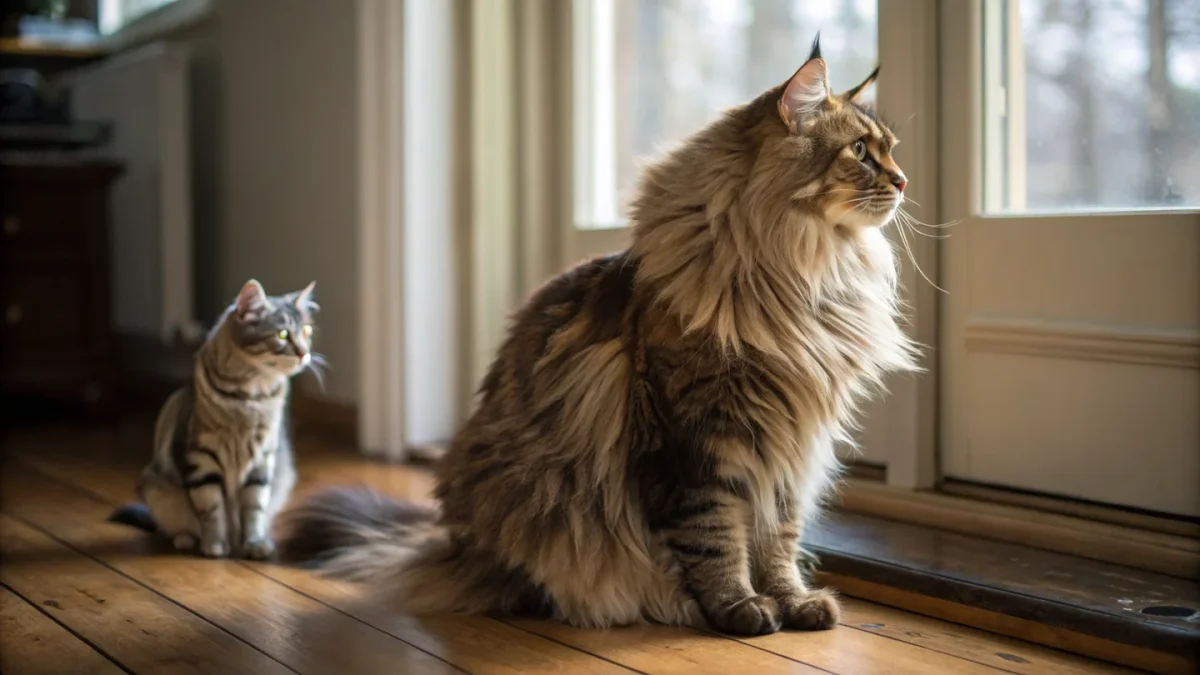
"Large cat" in domestic terms means somewhere between 5 and 10 kg for a healthy adult. This isn't lion-territory, but it's genuinely substantial — a large Maine Coon male is bigger than some small dog breeds. They take up half the bed. They require larger cat trees, larger food portions, and larger carriers. They also take significantly longer to reach full adult size than most breeds — Maine Coons aren't fully grown until age 3-5.
For context in the full breed classification picture, the cat breed categories guide covers the broad landscape.
1. Maine Coon
The most famous large domestic cat breed, and frequently cited as the largest. The Maine Coon breed profile covers the full history, health screening, and what owning the largest domestic cat actually involves. Adult males typically weigh 5.9-9 kg, with some individuals reaching 10+ kg. Females are substantially smaller at 3.6-5.4 kg. The large size takes time to develop — most Maine Coons aren't fully mature until 3-4 years, sometimes 5.
The large size in the Maine Coon comes with large personality: active, playful, dog-like, and interactive. They need cat trees and furniture that can accommodate their weight and size.
2. Ragdoll
Adult males typically 5.4-9 kg; females 4.5-6.8 kg. One of the longest cat breeds in terms of body length. The size is complemented by the calm temperament — a large, floppy Ragdoll in your lap is a genuinely distinctive experience.
Ragdolls are also slow-maturing: 3-4 years to reach full adult size. The semi-long, silky coat grows with the cat and looks most impressive at full maturity.
3. Norwegian Forest Cat
Adult males typically 4.5-7.5 kg; females 3.5-5.5 kg. Deceptively large — the heavy coat makes them look bigger than the scale reveals, but they're still substantial animals. Built for physical work: muscular, long-legged, and powerful.
The coat is the breed's dominant feature, requiring regular brushing to manage the seasonal shed.
4. Siberian
Adult males typically 5-9 kg; females 3.5-7 kg. The stocky, barrel-chested build gives the Siberian a very solid feel. Siberians are dense for their size. The thick coat adds apparent bulk.
5. Ragamuffin
Adult males typically 5.4-9 kg; females 4.5-6.8 kg. The Ragamuffin is closely related to the Ragdoll and similarly large — the distinction from Ragdoll breeding programs is historical and organizational rather than obvious in physical type.
6. Savannah
Savannahs can be very tall and lean rather than heavy — particularly early-generation individuals. F1 Savannahs may be the tallest domestic cat breed, measuring significantly taller at the shoulder than other breeds. Weight varies considerably by generation. The Savannah breed profile covers the generation system (F1 through F5+), temperament differences by generation, and the significant care requirements that distinguish this breed from more conventional domestic cats.
Practical Considerations for Large Cats
Slow maturation: Budget for kitten-appropriate nutrition for longer than with standard breeds.
Equipment sizing: Cat trees, beds, and carriers need to be appropriately sized. A standard cat tree that wobbles under a Maine Coon creates anxiety rather than enrichment.
Food costs: Not dramatically more than average cats, but meaningfully more.
Veterinary costs: Weight-based medications, larger procedure costs.
Lifespan: This isn't the dog world, where a 100-pound gap between breeds tracks with real differences in aging. Cat breeds only span 10-15 pounds top to bottom, so size itself isn't doing much work here — breed-specific genetics is the bigger factor. Maine Coons typically live 12-15 years, and a UK veterinary practice study backed that up with a below-average median lifespan for the breed, likely tied to conditions like hypertrophic cardiomyopathy rather than sheer bulk. Compare that to Siamese and Birman cats, which aren't small by any stretch and still posted some of the longest median lifespans in that same dataset, in the 14-16 year range.