

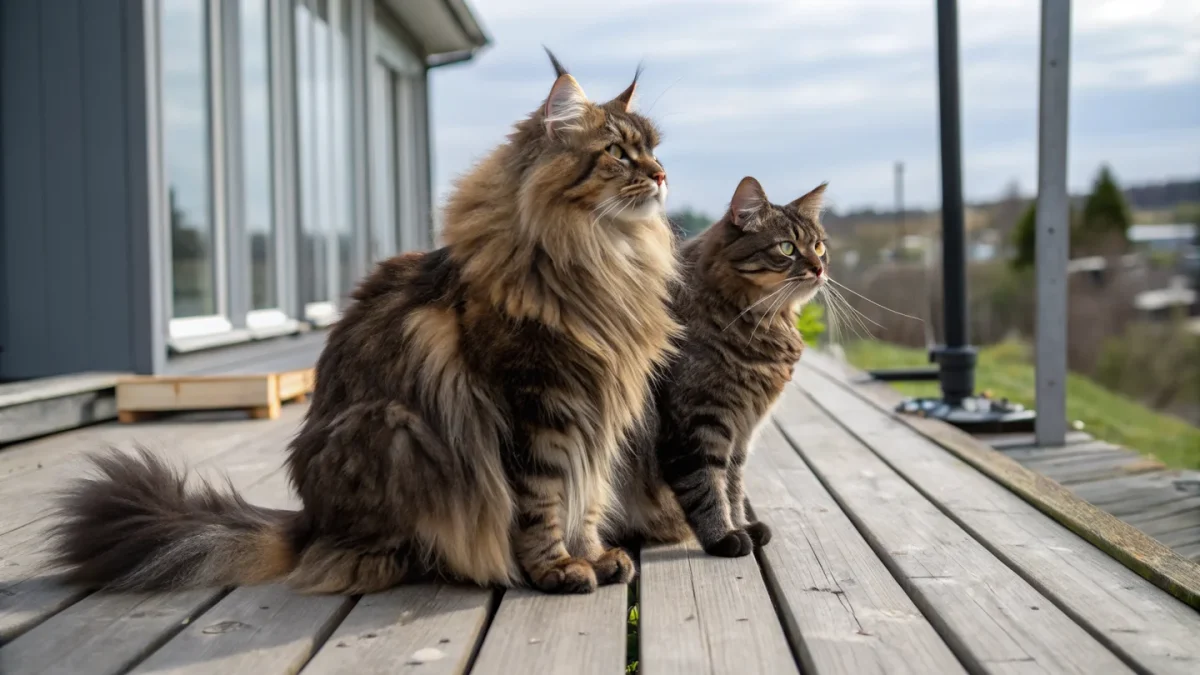
Few comparisons in the pedigree cat world generate more confusion than the Maine Coon versus Norwegian Forest Cat question. Both are large. Both are longhaired. Both have dramatic ear tufts. Both come in brown tabby patterns that look nearly identical in casual photographs. Both have been popularized extensively enough that there are many mixed-heritage cats that resemble both breeds without being either.
And yet they are clearly distinct animals to anyone who has spent time with them. The differences are specific, learnable, and practically useful for telling them apart.
The Profile Test: The Most Reliable Distinction
The single most reliable physical difference between these two breeds is visible from a direct side view of the head.
Maine Coon: When viewed in profile, the Maine Coon's face has a slight concave dip — sometimes described as a gentle ski-jump curve — in the profile between the bridge of the nose and the forehead. This produces a very slight scoop that is consistent across well-bred specimens.
Norwegian Forest Cat: The Wegie's profile is completely straight from brow to nose tip. No dip, no curve — a flat, direct line. This straight profile is a breed-defining characteristic.
This difference is subtle in a side-by-side photograph, but trained eyes and hands-on experience make it immediately apparent. It is the most consistent single physical marker for distinguishing the two breeds.
Head Structure
Beyond the profile, the head structures differ:
The Maine Coon has a broader, squarer head — longer than it is wide, with high cheekbones and a strong, squarish muzzle. The chin is strong and square.
The Norwegian Forest Cat has a more triangular head — an equilateral triangle from the front. The face is narrower through the forehead relative to the cheekbones, and the muzzle is less dramatically squared.
Body Structure
Both breeds are large. The Maine Coon is often wider through the chest and more solidly rectangular in body shape — the backbone is long and the torso broad. The tail base is proportionally very large.
The Norwegian Forest Cat is longer and more angular, with a more gradual taper toward the back and hindquarters that are notably athletic and muscular. The Wegie's hindquarters are higher than the shoulders when the cat is standing relaxed — a characteristic posture.
Adult weight ranges overlap: Maine Coon males commonly reach 6 to 8 kilograms (sometimes more), while Norwegian Forest Cat males typically land in the 5.5 to 7.5 kilogram range. Both are among the larger domestic breeds.
Ear Tufts
Both breeds have ear tufts, but the style differs.
Maine Coon ear tufts (called "lynx tipping") typically extend straight upward from the tips of the ears in a way that makes the already-large ears look even taller.
Norwegian Forest Cat ear tufts tend to be more developed and more dense, framing the inner ear more fully. The ear itself is typically wider at the base than the Maine Coon's and set at a slightly different angle.
Coat
Both have impressive double coats with similar color and pattern possibilities. The actual texture and behavior of the coats differs:
The Maine Coon coat tends to be slightly silkier and to lie in a more defined, flowing way. The Norwegian Forest Cat's coat has a more pronounced water-resistance in the guard hairs.
Both require similar grooming commitment: manageable weekly maintenance with intensive attention during spring shedding season.
Temperament Comparison
Both are intelligent, active, and relatively independent compared to the most people-dependent breeds. Both handle multi-pet households well.
The Maine Coon is often described as slightly more openly sociable with strangers — the "dog-like" friendly cat. The Norwegian Forest Cat's temperament is equally warm with its family but tends to be more measured in its extension of that warmth to newcomers.
Play drive is high in both breeds. Vertical space is a significant need for both.
Which Is Right for You?
This is a question where the answer genuinely is "whichever you find more beautiful and whose temperament nuances suit you better." Both are excellent large-breed companion cats. The choice often comes down to access to a reputable breeder for the specific breed, followed by aesthetic and temperament preference.
The Norwegian Forest Cat breed guide covers the Wegie in full. Both breeds reward the owner who meets their needs with genuine and lasting companionship.