

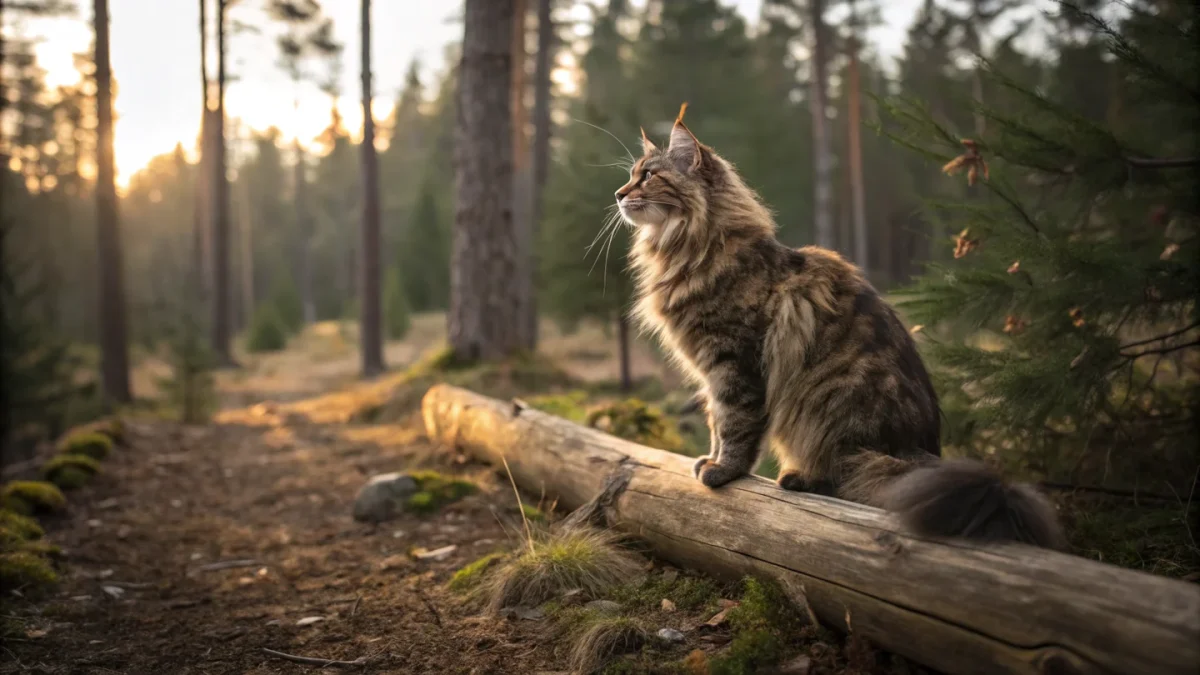
The Norwegian Forest Cat's coat is legitimately impressive — it evolved to protect a cat living through Scandinavian winters, and it shows. The long guard hairs are water-resistant. The dense undercoat is insulating. The ear tufts, toe tufts, and dramatic mane are functional as much as aesthetic.
But this coat, which looks like it should require hours of weekly attention, is actually reasonably self-managing under most circumstances. The structure that makes it weatherproof — the separation between guard hairs and undercoat, the natural resistance of the guard hairs — also makes it more resistant to matting than its volume suggests. Weekly maintenance handles most of the year. Spring shedding season is where the real work happens. The techniques in longhair cat grooming and mat prevention apply directly to this breed.
Understanding the Double Coat
The Norwegian Forest Cat coat has two distinct layers:
Guard coat: Long, coarse, and water-resistant. These hairs form the outer layer — the dramatic mane, the flowing tail, the ear and toe tufts. They are designed to repel moisture and dirt, which they do effectively. The water resistance that makes them weatherproof also makes them slightly difficult to wet in a bath (which is worth knowing if bathing ever becomes necessary).
Undercoat: Dense, fine, and woolly. This is the insulating layer. In winter it's thick and full, creating the impressive coat mass. In spring it releases — all at once, effectively — creating the shedding season challenge.
The separation between these layers under normal conditions means mats don't form the way they would in a breed whose guard and undercoat grow more intermingled (the Persian is the extreme contrast here). As long as the coat is brushed regularly enough that shed undercoat doesn't pack at the base of the guard hairs, the Norwegian Forest Cat's coat is manageable.
Year-Round Maintenance: Weekly Sessions
For the roughly nine or ten months outside heavy shedding season, weekly grooming keeps the Norwegian Forest Cat coat in good condition.
Tools for regular maintenance:
- Wide-toothed metal comb: the primary tool. Works through the guard coat and reaches the undercoat without damaging the guard hairs
- Slicker brush: useful for finishing and for the shorter coat on legs and face
- Stainless steel fine-toothed comb: good for the mane, chest ruff, and tail where longer fur can begin to clump
Work through the coat section by section, starting from the neck and moving toward the tail. The areas most likely to develop tangles are:
- The armpits and inner forelegs (friction from movement)
- The chest mane (where the longest fur is most dense)
- Behind the ears
- The base of the tail
Address any small tangles immediately — gently work them apart with fingers first before applying the comb. Large mats should be addressed by a veterinarian or professional groomer rather than forced through; the skin underneath is sensitive and mats that have been present for some time can be tightly adhered.
Spring Shedding Season: The Intense Period
In spring, the Norwegian Forest Cat sheds its winter undercoat. This is not a gradual process. The undercoat releases in significant volume over a period of several weeks — typically four to six weeks, though this varies considerably by individual and climate.
During this period, daily grooming is necessary. Not optional — daily.
Use the wide-toothed comb deeply through the coat to pull out the releasing undercoat. A shedding comb (designed specifically to pull out loose undercoat without cutting guard hairs) is a useful addition to the toolkit during this period. The volume of released undercoat will be substantial — significantly more than most owners of longhaired breeds are prepared for the first time they experience it.
Skipping grooming sessions during heavy shedding allows the released undercoat to pack at the base of the guard hairs. Once this happens, genuine mats form, and these are considerably harder to address than preventive brushing. For comparison, Maine Coon coat care covers another working double-coated breed with a similar spring shedding challenge.
After the main shed completes, the coat lightens noticeably and the grooming frequency can return to weekly.
Toe Tufts: The Often-Overlooked Area
The Norwegian Forest Cat's heavily furred paws — particularly the inter-digital tufts (fur growing between the toe pads) — can accumulate debris, litter, and outdoor material. In longer-tufted individuals, this fur can also mat between the pads.
Periodically trim the inter-digital fur with small, round-tipped scissors, keeping it level with the pads. This is a minor but practical maintenance step that most grooming guides for this breed omit.
Bathing
Bathing a Norwegian Forest Cat is occasionally necessary and more challenging than bathing most cats, specifically because of the coat's water resistance. The guard hairs genuinely repel water, meaning it can take some time and effort to wet the coat thoroughly.
Use warm water and work against the grain to wet the coat fully before applying shampoo. Rinse very thoroughly — shampoo residue left in this dense coat causes skin irritation and coat degradation. A forced-air dryer (used carefully at appropriate distance) speeds drying; towel drying alone leaves the deep undercoat damp for a long time.
Under normal circumstances with regular brushing, bathing is only needed when the cat has encountered something that can't be brushed out.
The grooming is genuinely the most time-intensive aspect of Norwegian Forest Cat ownership — but "intensive" means focused daily attention for six weeks per year and 15 minutes per week the rest of the time. In the context of caring for a breed that can live 15 years, this is a manageable commitment. The complete cat grooming guide frames this breed in the full spectrum of feline grooming requirements.