

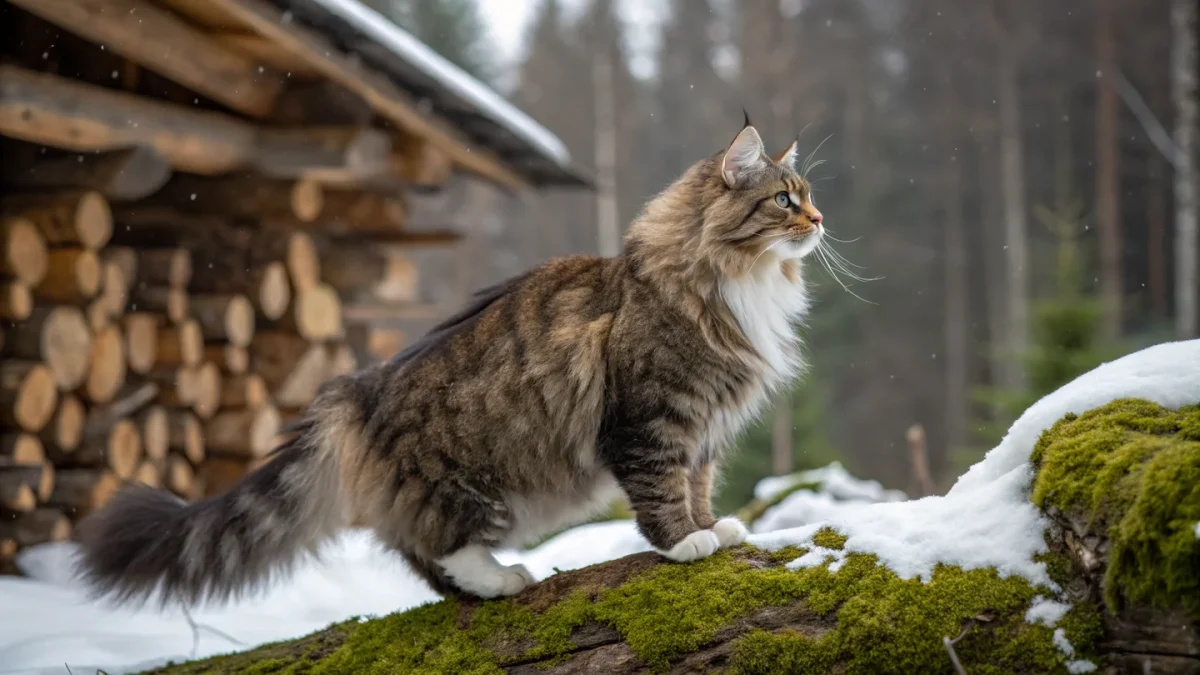
There is a line in Norse mythology that describes the goddess Freya's chariot being drawn by two large cats — sometimes described as grey, sometimes as simply large and long-haired, sometimes simply as skogkatt, the forest cats of Scandinavian legend. That this image has attached itself to the Norwegian Forest Cat is completely understandable. The breed looks like something that belongs in old growth forests, has a confidence that seems older than domesticity, and carries its thick weatherproof coat like an animal that has dealt with Scandinavian winters on its own terms for a very long time.
Whether those mythological cats were literally the ancestors of today's Norwegian Forest Cat is a question history cannot answer. What we can say is that large, thick-coated cats have been part of Norwegian agricultural and cultural life for centuries, and that the breed formalization in the 20th century drew directly from that working population.
The Mythology: Cultural Context, Not Documented History
The Norse connection is worth taking seriously as cultural history even while maintaining clarity about what it is and isn't.
The skogkatt — forest cat — appears in Norse folklore and in records of Norwegian rural life. These were semi-feral farm cats that lived at the edge of human settlement, controlling rodent populations, surviving winters that would eliminate less hardy cats. The physical characteristics of today's Norwegian Forest Cat — the dense undercoat, the water-resistant guard coat, the tufted paws, the athletic musculature — are precisely the characteristics you would expect natural selection to produce in cats living those conditions over many generations.
The Freya connection is mythological rather than genealogical. Freya was associated with cats in Norse mythology; large, impressive cats appear in the mythological texts. Whether the specific animal imagined by the Norse people resembled today's Norwegian Forest Cat is not determinable. What is clear is that Scandinavia has had an association between impressive longhaired cats and its cultural imagination for as long as there are records.
This is legitimate context. It is not documented breed history.
20th Century: From Farm Cat to Formal Breed
The Norwegian Forest Cat's documented breed development begins in the 1930s. Norwegian cat enthusiasts began working to identify and formalize the type — selecting from the working farm cats of the Norwegian countryside, establishing what the breed's characteristics were, and eventually showing the cats publicly.
The first formal show appearance of a Norwegian Forest Cat — the male Pans Truls — was recorded in Oslo in 1938. This is the beginning of the documented breed history as a formal pedigree breed.
World War II intervened. The breed nearly disappeared as a distinct type; resources were scarce, breed programs lapsed, and uncontrolled crossbreeding diluted the distinct farm-cat type that breeders had begun to formalize. The Norwegian Forest Cat that emerged from the postwar period was partly reconstructed.
The Norsk Skogkattring (Norwegian Forest Cat Club) was established in the 1970s to rebuild the breed systematically. This organization worked from the surviving farm cat population to establish a studbook, standardize the physical type, and seek international recognition.
Fédération Internationale Féline (FIFe) recognized the Norwegian Forest Cat in 1977. North American registration followed through the 1980s.
Pans Truls and the Foundation Animals
The 1938 Oslo show appearance of Pans Truls is often cited as the breed's founding moment in terms of formal recognition. The cat's photograph — a large, dense-coated tabby-and-white with prominent ear tufts — shows a type recognizably consistent with today's Norwegian Forest Cat standard.
The foundation animals of the 1970s reconstruction were working farm cats of Norway: cats that had been maintaining themselves in a semi-working relationship with Norwegian farmers, selected by the conditions of their environment rather than by deliberate human breeding for aesthetics. This gives the Norwegian Forest Cat's modern gene pool a practical robustness that breeds developed from very narrow genetic bases sometimes lack.
What the History Tells Us
The Norwegian Forest Cat is a breed shaped by its actual conditions of existence. The physical characteristics were developed not in a show hall but in Norwegian forests and farmyards. The mythology attached to it is real mythology — part of how Scandinavian culture has imagined and valued these animals — but the Norwegian Forest Cat breed guide and the temperament of the living animal both reflect a cat shaped by practical reality rather than legend.
The Viking connection is cultural resonance. The breed is the genuinely impressive outcome of a working animal meeting serious conditions over a long time. Both things are worth appreciating.