

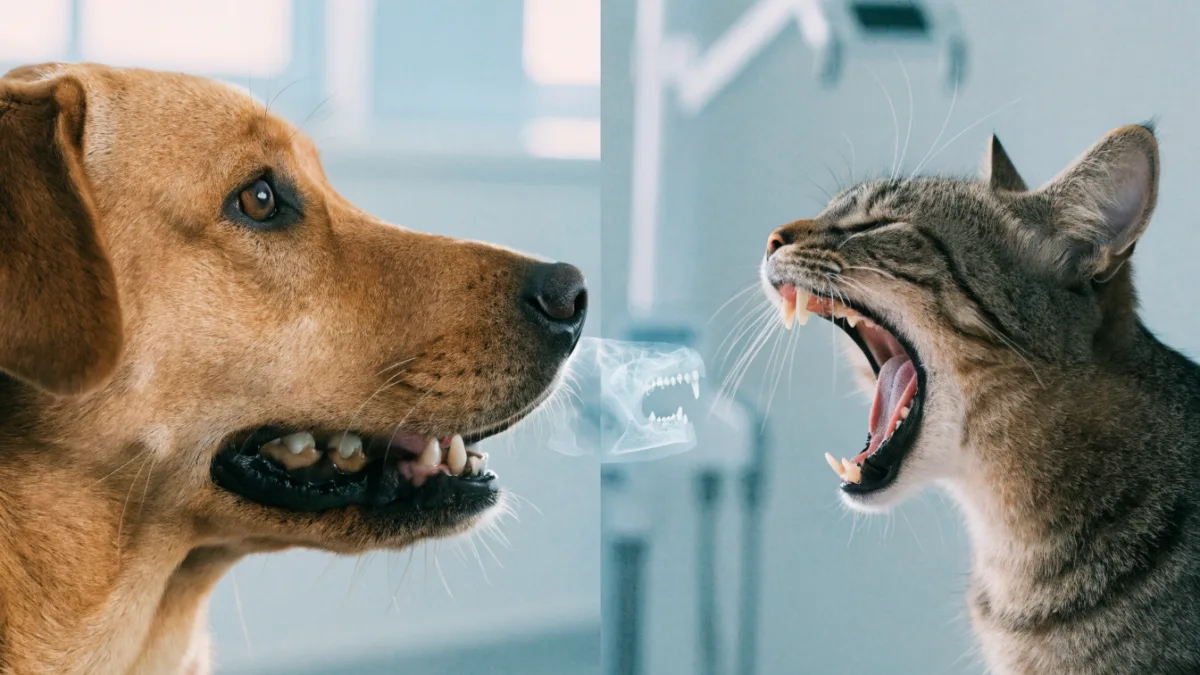
You know that unpleasant feeling when you forget to brush your teeth before bed? Now imagine skipping that step for years. For our pets, that scenario is an everyday reality. Periodontal disease isn’t just a fancy term for bad breath; it’s a progressive, sneaky condition that affects up to 80% of dogs and cats by the time they blow out their third birthday candle. I see it constantly in clinical practice, and the tricky part is that our pets possess a remarkably strong, instinctual drive to eat through the pain. They rarely show obvious symptoms until the structural damage to their mouths is already severe.
The Anatomy of a Plaque Attack
To understand why our pets suffer, we have to look at how this disease takes hold. It doesn’t start with a loose tooth; it starts with an invisible enemy. Every day, a microscopic film of bacteria called plaque forms on the teeth (you can read more about the.[1]). If this sticky film isn’t mechanically wiped away—usually through daily brushing—it interacts with minerals in your pet’s saliva and hardens into tartar, also known as dental calculus.
This tartar is the ugly yellow or brown concrete you often see clinging to your pet’s teeth near the gum line. But the real danger happens below the surface. The bacteria migrate deeper toward the base of the tooth where the gum tissue (the gingiva) meets the tooth. Eventually, the bacteria push under the gum line, destroying the delicate ligaments and jawbone that hold the teeth in place. By the time you notice a loose tooth, the jawbone is already compromised.
The Canine Experience: Crowding and Concrete
Dogs often present periodontal disease in a very visual way. They tend to build up heavy, visible tartar, particularly on those large upper back teeth known as the carnassial teeth, which do the heavy lifting during chewing.
Take my patient Buster, an eight-year-old Yorkshire Terrier, who came into the clinic last month. His owner mentioned:
He’s just getting older and prefers his kibble soaked in warm water now.
It’s a common assumption that slowing down at the food bowl is just a sign of aging, but when I looked in Buster’s mouth, the reason for his sudden dietary preference was clear. He had severe tartar buildup and angry, inflamed gums.
Size plays a massive role in canine dental health. I’ve seen large breed dogs—like retrievers or shepherds—maintain relatively healthy teeth with minimal intervention. They simply have larger mouths, meaning their teeth are well-spaced. However, small and toy breed dogs like Buster are highly predisposed to early, severe periodontal disease. They have the exact same number of teeth as a Great Dane, but those teeth are crammed into a tiny jaw. This severe crowding traps food and plaque, accelerating the disease process.
The Feline Mystery: Masters of Disguise
If dogs are somewhat obvious about their dental issues, cats are absolute ninjas at hiding them. Felines are notoriously stoic, and their instinct to mask vulnerability means they will often suffer in complete silence until the pain is unbearable.
Consider Luna, a six-year-old Domestic Shorthair. Her owner brought her in because Luna’s beautiful, sleek coat had become dull and matted. Her owner noted, “She’s just stopped grooming herself.” A physical exam revealed severe, painful inflammation in the back of her mouth. Luna wasn’t suddenly getting lazy; it simply hurt too much to move her rough tongue across her fur.
Cats are also uniquely susceptible to specific dental nightmares that dogs rarely experience. One of these is Feline Tooth Resorption, a bizarre and excruciating condition where the cat’s own body begins breaking down and absorbing the tooth structure right at the gum line. Another is Feline Chronic Gingivostomatitis (FCGS), a severe immune-mediated condition where the body vastly overreacts to plaque, turning the entire mouth into a fiery, painful landscape.
Because cats hide their pain so well, you have to be a detective. Look for these subtle signs:
- A dull, matted coat from a lack of grooming
- Dropping food out of the mouth while eating
- Swallowing kibble whole without chewing
- Pawing at the mouth or face
- Visible tartar on the teeth or bleeding gums
Beyond the Mouth: The Hidden Health Risks
I’ll be honest: I’ve changed my mind on this over the course of my career. Early in practice, I thought dental disease was mostly a localized issue—a matter of bad breath and eventually losing a few teeth. But research and clinical experience have proved me completely wrong.
Periodontal disease is a systemic problem. Those bacteria multiplying under the inflamed gums don’t just stay there. Every time a dog or cat chews, bacteria are pumped from the infected mouth directly into the bloodstream. They hitch a ride through the body and can lodge themselves in major organs. This bacterial shower is particularly dangerous for the heart, where it can damage the valves, as well as the liver and kidneys, which filter the blood. Treating the mouth isn’t just about saving teeth; it’s about protecting the heart and kidneys.
Debunking Dental Myths: Bones and “Natural” Cleanings
When we talk about prevention, I completely understand the appeal of natural solutions. Many pet owners want to avoid chemicals and expensive procedures, which leads to some common, well-meaning home remedies that often do more harm than good.
The Raw Bone and Antler Debate
Many people give their dogs hard antlers, hooves, or raw meaty bones, believing that chewing will naturally scrape the teeth clean. It’s true that the mechanical action of chewing does provide some scraping benefit for the crowns of the teeth. However, veterinary professionals strongly warn against these ultra-hard objects. I see fractured teeth in my clinic every single week from these chews. When a dog bites down on something harder than their own enamel, the tooth can split right down the middle. Furthermore, these diets carry risks of gastrointestinal blockages and bacterial contamination, and they still do nothing to clean that crucial area below the gum line.
Anesthesia-Free Dentals
The idea of having your pet’s teeth cleaned while they sit happily awake sounds safer and cheaper. Groomers sometimes offer this, calling it a “non-anesthetic dental scaling.” But here is the clinical reality: [2] Scraping the visible tartar off the outside of the tooth is purely cosmetic. To properly clean and evaluate the roots without causing immense pain and stress, general anesthesia is absolutely necessary. Anesthesia-free cleanings only give a false sense of security while the real disease continues to destroy the jawbone unnoticed.
Modern Solutions: X-Rays and the VOHC
The good news is that veterinary dentistry has made incredible strides in recent years. We now have the tools to truly combat the plaque attack.
Digital Dental Radiology
If you’ve been to the clinic recently, you might have noticed a massive push toward standardizing dental X-rays. Because up to 60% of a tooth’s structure is hidden beneath the gums, modern veterinary standards dictate that full-mouth X-rays are essential during any dental procedure. You simply cannot treat what you cannot see. X-rays allow us to spot hidden abscesses, bone loss, and root issues before they become emergencies.
The VOHC Seal
When you walk into a pet store, the dental aisle is overwhelming. Instead of guessing, look for the Veterinary Oral Health Council (VOHC) seal of acceptance. This independent body awards its seal only to specific treats, water additives, and diets that have been scientifically proven to reduce plaque and tartar. It takes the guesswork out of buying products. Of course, always consult your own vet before starting any new diets, supplements, or treatments to ensure they are right for your specific pet.
A Final Word on Tooth and Claw
Whether you share your home with a goofy Golden Retriever or a dignified tabby cat, [3] you can do for their long-term health. Daily brushing with pet-safe enzymatic toothpaste, using VOHC-approved products, and scheduling professional cleanings under anesthesia are the gold standard for prevention.
And while our domestic companions have us to brush their teeth and fix their ailments, it’s worth remembering that wildlife isn’t entirely immune to dental woes. Wild canids and felids in captivity can also suffer from periodontal disease if their diets do not replicate the natural mechanical cleaning of consuming whole prey—including bone, fur, and connective tissue. In conservation centers, specialized veterinary teams often perform root canals and cleanings on big cats and wolves, proving that no animal, wild or domestic, is entirely safe from the relentless plaque attack. By taking care of our pets’ mouths, we ensure they live longer, happier, and much more comfortable lives.
Sources
- signs and symptoms of periodontal disease here — alvinanimalclinic.com
- true periodontal disease occurs below the gum line — southeastanimaleyevet.com
- proactive dental care is one of the most impactful things — animalfoundation.com