


A dog turned up at a clinic last year with breath so bad the owner had started feeding him at arm's length. "Probably just normal dog breath," she said. It wasn't. Grade 3 periodontal disease, several teeth requiring extraction, and a bacterial load that had been entering the bloodstream for who knows how long. Three years of annual exams at another practice — nobody had mentioned anything about the teeth.
I'm not telling that story to be alarmist. I'm telling it because dental disease is the most commonly diagnosed health condition in adult pets, it progresses silently, and the consequences extend far beyond the mouth. This guide covers everything you need to know to protect your pet's teeth and gums for the long term.
The Anatomy of a Pet's Tooth
Understanding what you're protecting starts with knowing what's there.
Each tooth has a crown (the visible portion above the gumline) and a root (embedded in the jawbone below the gumline). The crown is covered by enamel — the hardest substance in the body, but it doesn't regenerate when damaged. Under the enamel is dentin, a slightly softer tissue that surrounds the pulp cavity, which contains nerves and blood vessels.
The structures supporting each tooth include the periodontal ligament (which suspends the root in the bony socket), the cementum (covering the root), and the alveolar bone (the jawbone itself). Periodontal disease destroys these supporting structures — which is why severe dental disease causes tooth loss and jawbone damage, not just surface problems.
Dogs have 42 adult teeth. Cats have 30. Most owners have a working knowledge of maybe four of them.
What Causes Dental Disease in Pets
Within hours of eating, bacteria in the mouth begin forming a thin film on tooth surfaces called plaque. Plaque is soft and removable with brushing — which is precisely why daily brushing matters.
If plaque isn't removed, it mineralizes over days to weeks into calculus (also called tartar), a hard, porous deposit that adheres tightly to the tooth surface. Calculus can't be removed by brushing — it requires professional scaling with specialized instruments.
Calculus itself isn't the primary problem. The real damage is caused by the bacteria living within and under that calculus, particularly at and below the gumline. These bacteria trigger an inflammatory response — periodontitis — that progressively destroys the periodontal ligament, the cementum, and the alveolar bone supporting each tooth.
This is the cycle of periodontal disease: bacterial plaque → calculus → bacterial inflammation → tissue and bone loss → tooth loss (and potentially systemic effects).
The Four Stages of Periodontal Disease
Veterinarians grade periodontal disease on a 1–4 scale. Understanding the stages helps you understand why early intervention matters so much.
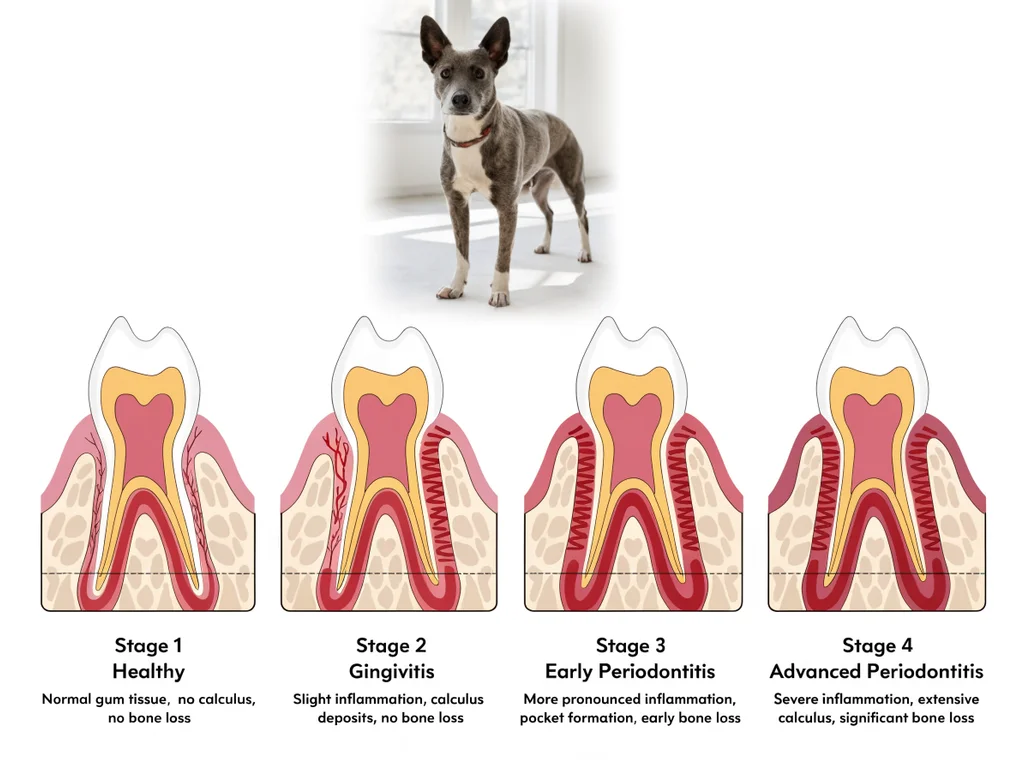
Stage 1 — Gingivitis: The gum line is inflamed and slightly red. Some plaque and early calculus present. No bone loss. This is the only fully reversible stage — remove the bacterial burden and the gum tissue heals completely.
Stage 2 — Early Periodontitis: Mild attachment loss (less than 25% of the supporting structures). Calculus visible above and below the gumline. The gum tissue is starting to detach from the tooth root. Reversible with professional treatment, but some permanent damage has occurred.
Stage 3 — Moderate Periodontitis: 25–50% attachment loss. Significant bone loss visible on dental radiographs. Deep pockets form between the gum and root where bacteria thrive without oxygen. Some teeth may still be saveable with advanced treatment; others may need extraction.
Stage 4 — Advanced Periodontitis: More than 50% attachment loss. Severe bone destruction. Teeth are typically painful and mobile. Extraction is usually the appropriate treatment.
Most pets presented for their first professional dental cleaning are already at Stage 2 or 3. That's where the system fails — not because owners don't care, but because dental disease is invisible until it's quite advanced, and most pets give no clear indication of pain until the situation is severe.
How Dental Disease Affects the Rest of the Body
The mouth is not a closed system. Bacteria from periodontal pockets enter the bloodstream in a process called bacteremia, and research in both veterinary and human medicine has linked periodontal disease to conditions affecting the heart, kidneys, and liver. A review by veterinary dentist Colin Harvey in Veterinary Clinics of North America: Small Animal Practice documented measurable changes in kidney, liver, and heart tissue tied to oral infection in dogs — and found that treating the periodontal disease brought certain liver-generated inflammatory markers back down, which is about as close to cause-and-effect as this kind of research gets.
In dogs, there is a documented association between severe dental disease and certain cardiac conditions. The kidneys, which filter blood, may also be affected by chronic bacteremia over time. The evidence is stronger for some associations than others, but the direction is consistent: poor dental health is not simply a local problem.
This doesn't mean dental disease reliably causes organ failure — the relationship is complex and multifactorial. It means there are sound reasons beyond bad breath and lost teeth to take oral health seriously.
How to Recognize Dental Problems at Home
Most dental disease happens below the gumline where you can't see it. But there are visible signs that warrant a vet visit:
In the mouth:
- Brown or yellow calculus buildup on the teeth, especially the back upper teeth
- Red, swollen, or bleeding gum margins
- Loose or missing teeth
- Swelling on the face (especially below the eye — may indicate tooth root abscess)
- Mouth ulcers or growths on the gum tissue
In behavior:
- Dropping food while eating
- Preferring soft food after previously eating dry
- Chewing only on one side of the mouth
- Pawing at the mouth or face
- Reluctance to be touched around the muzzle
- Changed grooming patterns in cats (dental pain can reduce self-grooming)
- Unusual irritability that could reflect oral pain
Bad breath:
Every pet has some degree of mouth odor — but "bad breath" that's genuinely foul or tissue-like is a sign of bacterial load that shouldn't be normalized. A healthy mouth has mild, not offensive, odor.
The Role of Professional Dental Cleaning
Home care alone cannot remove established calculus or treat bacteria in periodontal pockets. Professional dental cleanings — performed under general anesthesia — are required.
This is worth explaining, because anesthesia-free dental cleanings are marketed in some areas and appear less risky. In practice, they're less effective: they can remove visible calculus above the gumline cosmetically, but they don't allow the subgingival (below-gumline) cleaning, periodontal probing, and dental radiographs that constitute actual dental care. An animal who isn't sedated won't tolerate the instruments needed to probe pocket depths or scale below the gum margin.
A proper veterinary dental cleaning includes:
- Pre-anesthetic assessment and bloodwork
- Anesthetic induction and intubation (a breathing tube protects the airway from water and debris)
- Full-mouth radiographs (dental X-rays detect disease below the gumline that's invisible to the naked eye)
- Supragingival scaling (above the gumline)
- Subgingival scaling (below the gumline, into the pockets)
- Periodontal probing to measure pocket depths at each tooth
- Polishing to smooth the enamel surface and slow future plaque adhesion
- Extractions as needed, with appropriate analgesia
- Dental charting for future reference
Full-mouth radiographs are not optional for quality dental care. The classic evidence on this comes from two UC Davis studies — separate papers for dogs and for cats, both published in 1998 in the American Journal of Veterinary Research — which found additional disease on radiographs in roughly half of patients referred for dental treatment. Even in mouths that looked completely normal on oral exam, radiographs still turned up problems in 28% of dogs and 42% of cats.
Home Dental Care: What Actually Works
The gold standard is daily tooth brushing with a toothbrush and toothpaste formulated for pets. Human toothpaste contains fluoride and foaming agents that should not be swallowed and are not safe for pets.
You don't need a full-size human toothbrush — a small-headed soft toothbrush, a finger brush, or a wrap of soft gauze around your finger all work for different pets and sizes. The mechanical action of bristles on tooth surfaces is what removes plaque. The toothpaste is secondary to the brushing motion, though enzymatic formulations provide some additional antibacterial benefit.
For a complete walkthrough of techniques, including how to introduce brushing to a resistant pet, home dental care for pets covers the process in detail.
When brushing isn't possible:
Some pets won't accept brushing despite patient training, and some owners have legitimate limitations on their ability to perform it. The following options have varying but meaningful evidence for reducing plaque and calculus accumulation:
- Dental chews — look for products with evidence behind them. In some countries, certain products carry a seal of approval from veterinary dental organizations confirming independent testing. Rawhide and hooves are not recommended due to fracture risk.
- Water additives — added to the drinking water, these reduce bacterial counts. Effectiveness is less than brushing but requires no pet compliance.
- Prescription dental diets — specialized kibble with a texture designed to mechanically clean teeth as the pet chews. These are not the same as regular dry food — the texture and size are specifically engineered. Generally recommended for pets with active periodontal disease.
- Dental gels and sprays — applied to tooth surfaces. Less effective than brushing but better than nothing for resistant patients.
None of these options replaces professional cleaning. They slow the accumulation of plaque and calculus between professional cleanings — they don't eliminate the need for cleaning.
How Often Should Pets Have Professional Cleanings?
The honest answer is: it varies, and your vet should guide you based on your individual pet's situation.
Most guidelines suggest at least once yearly for adult pets. In practice, pets with a predisposition to rapid calculus buildup — small breeds, brachycephalic breeds, certain individual animals — may need cleanings every 6 months. Pets with excellent home care habits and naturally slow calculus accumulation may maintain well with annual cleanings.
The frequency question should be answered by looking at your pet's mouth at each annual vet checkup and comparing to their previous assessment. Escalating frequency when calculus is accumulating faster, or maintaining the current interval when home care is effective, is a more individualized approach than a fixed schedule.
Dental Health by Species and Breed
Dogs: Small breeds and toy breeds — Chihuahuas, Pomeranians, Dachshunds, Yorkshire Terriers — tend to have overcrowded teeth and faster calculus accumulation. They typically need more frequent professional cleaning and rigorous home care. Large breeds often have fewer problems with crowding but can still develop significant periodontal disease. Brachycephalic breeds (flat-faced dogs) have crowding issues due to their compressed anatomy.
Cats: Cats have specific dental conditions dogs don't. Feline tooth resorption (sometimes called FORLs) is a condition where the tooth structure breaks down from within — a painful condition often identified on dental radiographs. Stomatitis, a severe inflammatory condition affecting the entire mouth, requires aggressive treatment and sometimes full-mouth extractions. Adult cats with healthy smiles are the minority in my experience — routine dental care in cats is genuinely important.
Other pets: Rabbits and guinea pigs have continuously growing teeth that can develop painful malocclusions. Ferrets are highly prone to dental disease and should receive the same home care standards as dogs and cats. Birds and reptiles have dental considerations specific to their anatomy.
The Puppy and Kitten Period
Puppy and kitten dental development follows predictable timelines. Baby teeth (deciduous teeth) erupt within the first weeks of life and fall out between 12–24 weeks as adult teeth erupt.
Retained deciduous teeth are common, particularly in small dogs — a baby tooth that doesn't fall out when the adult tooth erupts creates crowding and misalignment. These should be extracted when identified, usually at the time of spay or neuter.
Starting tooth brushing during the puppy and kitten period is dramatically easier than introducing it to an adult — both because young animals are more adaptable and because you build positive associations before the pet has any reason to dislike the process. Even one or two brief positive sessions per week during this period establishes a foundation for adult cooperation.
When to See Your Vet
Dental problems can develop quickly. See your vet promptly if you notice:
- Visible swelling on the face or jaw
- Sudden reluctance to eat or complete appetite loss
- Drooling more than usual, or drooling tinged with blood
- Pawing at the mouth persistently
- Any tooth that appears loose or out of position
- Sudden behavior change that could reflect pain (irritability, withdrawal)
Good preventive pet care includes addressing dental disease as a real health priority — not a cosmetic concern and not something to address "someday." The earlier dental disease is caught and treated, the more teeth your pet keeps, the less discomfort they experience, and the lower the cost compared to treating advanced disease.
Frequently Asked Questions
How do I know if my pet has dental pain?
Many pets with significant dental disease show no obvious signs of pain — this is a normal adaptation that evolved to avoid appearing vulnerable. Subtle signs include preference for soft food, dropping kibble, one-sided chewing, reduced grooming in cats, and occasional pawing at the face. The absence of obvious pain does not mean the mouth is fine.
Is dental disease in pets genetic?
Predisposition varies by breed, and certain breeds have structural factors that increase risk — crowded teeth in small breeds, compressed facial anatomy in brachycephalic breeds. However, dental disease is largely preventable regardless of genetic predisposition through consistent home care and professional cleaning. Genetics sets the baseline; management determines the outcome.
My pet is old — is it safe to anesthetize them for a dental cleaning?
Age is not a contraindication to anesthesia — health status is. Pre-anesthetic bloodwork identifies organ function concerns that affect anesthetic protocol. Many geriatric pets do very well under anesthesia with appropriate preparation and monitoring. The risk of dental disease left untreated in an older pet — chronic pain, bacteremia, and progressive tissue loss — often exceeds the risk of a properly conducted anesthetic procedure.
Are dental treats as effective as brushing?
No. Dental chews and treats reduce plaque accumulation and slow tartar buildup, which is meaningful. But they don't provide the same mechanical cleaning as daily brushing, and they don't address subgingival disease at all. Think of them as useful supplements to a dental care routine, not replacements for it.
How much does a professional pet dental cleaning cost?
Costs vary significantly by region, practice, and what the cleaning involves. Routine cleanings without extractions are less expensive than cleanings involving multiple extractions or specialist care. Pre-anesthetic bloodwork, dental radiographs, and anesthesia monitoring each add to the total. Ask your vet for a cost estimate before scheduling — most practices can give you a range based on a preliminary oral exam.