

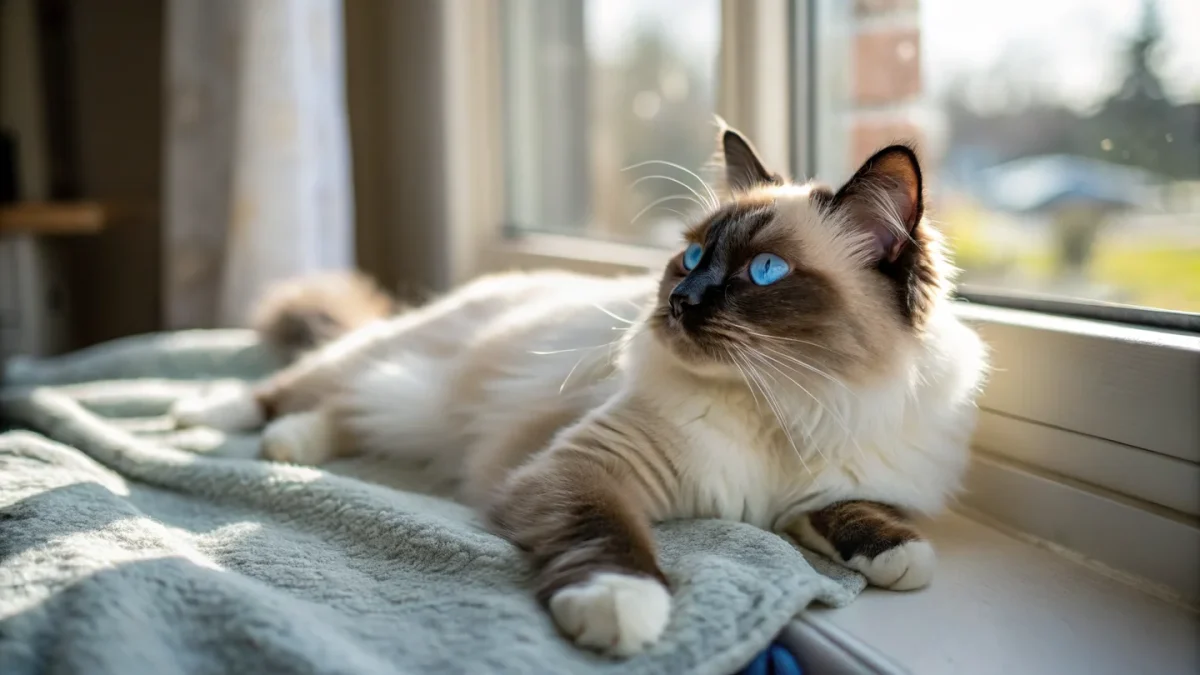
All Ragdolls share one genetic foundation: the colorpoint gene, which concentrates pigmentation on the cooler extremities (face mask, ears, legs, and tail) while leaving the warmer body areas lighter. Beyond that shared base, the breed offers three distinct pattern types and six recognized base colors, creating 18 standard combinations — plus lynx (tabby) and tortie variations that expand the range further.
For the complete breed overview, see the complete Ragdoll breed guide. For a closer look at the breed's personality, see Ragdoll temperament.
The Three Pattern Types
Colorpoint — the classic Ragdoll pattern. Color appears on the mask (face), ears, legs, and tail. The body ranges from a warm white (in lighter-colored varieties) to a warm cream. There is no white in the coat. The face has a full colored mask.
Mitted — similar to colorpoint, but with the addition of white mittens on the front paws and white boots on the back legs. A white chin runs down to a white belly stripe. A small spot or blaze of white may appear on the nose or between the eyes. The presence of white on all four paws gives the mitted pattern a distinctive, almost formal appearance.
Bicolor — characterized by an inverted white "V" on the face (the "butterfly"), white on all four legs, and a white underbelly. The body retains the lighter colorpoint base, and the points appear only on the ears and top of the head (since much of the face is white). Bicolor Ragdolls have more white than the other patterns.
The Six Base Colors
Seal — the darkest and most common. Rich dark brown points (the seal color) against a warm cream or fawn body. The contrast is strong and dramatic. Seal is to Ragdolls what black is to most coat genetics — it's the "default" dark color before dilution.
Blue — the dilute of seal. Cool gray-blue points against a bluish-white body. Less contrast than seal but with a distinctive cool, calm coloring. A blue bicolor Ragdoll is one of the breed's more elegant appearances.
Chocolate — warm milk-chocolate brown points against an ivory or warm white body. Lighter than seal, warmer in tone than blue. Chocolate Ragdolls have a soft, warm appearance that some owners find particularly appealing.
Lilac — the dilute of chocolate. Pale pinkish-gray points against a magnolia or warm white body. The most delicate-looking of the Ragdoll colors.
Red (flame) — warm orange-red points against a cream body. The Himalayan pattern in red creates a striking appearance, and red mitted Ragdolls are visually distinctive.
Cream — the dilute of red. Pale cream points against a near-white body. The subtlest of the Ragdoll colors — in some lighting conditions, the body and points are almost indistinguishable.
Lynx and Tortie Variations
Lynx variations add tabby patterning within the colored points — the mask shows the characteristic tabby "M" marking, and the legs have tabby striping. A seal lynx colorpoint Ragdoll has the dark seal point color organized into tabby stripes rather than solid color.
Tortie (tortoiseshell) variations mix red or cream into the base color of the points, producing a patchwork of color at the extremities. Seal tortie points have a mix of seal and red; blue-cream torties have blue and cream. Tortie Ragdolls are almost always female — because the orange gene is located on the X chromosome, producing both orange and non-orange patches in the same coat requires two X chromosomes, meaning males (XY) can only be tortoiseshell when a chromosomal anomaly produces an extra X, which is rare. Recent research published in Current Biology (2025) identified the specific ARHGAP36 gene deletion responsible for the orange coloration in cats, confirming its X-linked mechanism.
Lynx and tortie can combine: a seal tortie lynx Ragdoll (sometimes called "torbie") has tabby striping in a tortoiseshell-colored point. This produces some of the most visually complex and individually patterned Ragdolls.
How Colors Develop Over Time
All Ragdoll kittens are born white. Point color begins developing in the first weeks of life as thermoregulation establishes and the temperature differential between extremities and body creates the conditions for the colorpoint gene to express.
At 8-12 weeks (typical adoption age), point color is visible but light. A seal point kitten's points are noticeably lighter than an adult seal's deep brown. By 6 months, the color has deepened substantially. Full adult color — darker and richer than the kitten suggested — develops over 2-3 years. The CFA breed standard notes that Ragdolls reach full coat color at approximately two years, with full size and weight arriving by four years.
Practical implication: the kitten you adopt is not showing you its full adult color. If you're choosing based on color preference, asking a breeder to show you adult examples of the color you like is more reliable than judging from the kitten's current points.
Why All Ragdolls Have Blue Eyes
The blue eyes are a consequence of the colorpoint gene itself, not a separately selected trait. The same temperature-sensitive TYR gene mutation that restricts pigment to the extremities also suppresses melanin production in the iris — so the iris's underlying blue structural layer is visible without pigment on top. According to the UC Davis Veterinary Genetics Laboratory, this mechanism applies to all cs/cs (homozygous colorpoint) cats. All true Ragdolls must carry cs/cs to express the colorpoint pattern, which is why the blue eyes are universal to the breed.
The intensity of blue varies. Vivid, deep blue is the breed ideal. Some individuals have a lighter, softer blue. Both are consistent with being Ragdolls — the exact shade varies between individuals.