

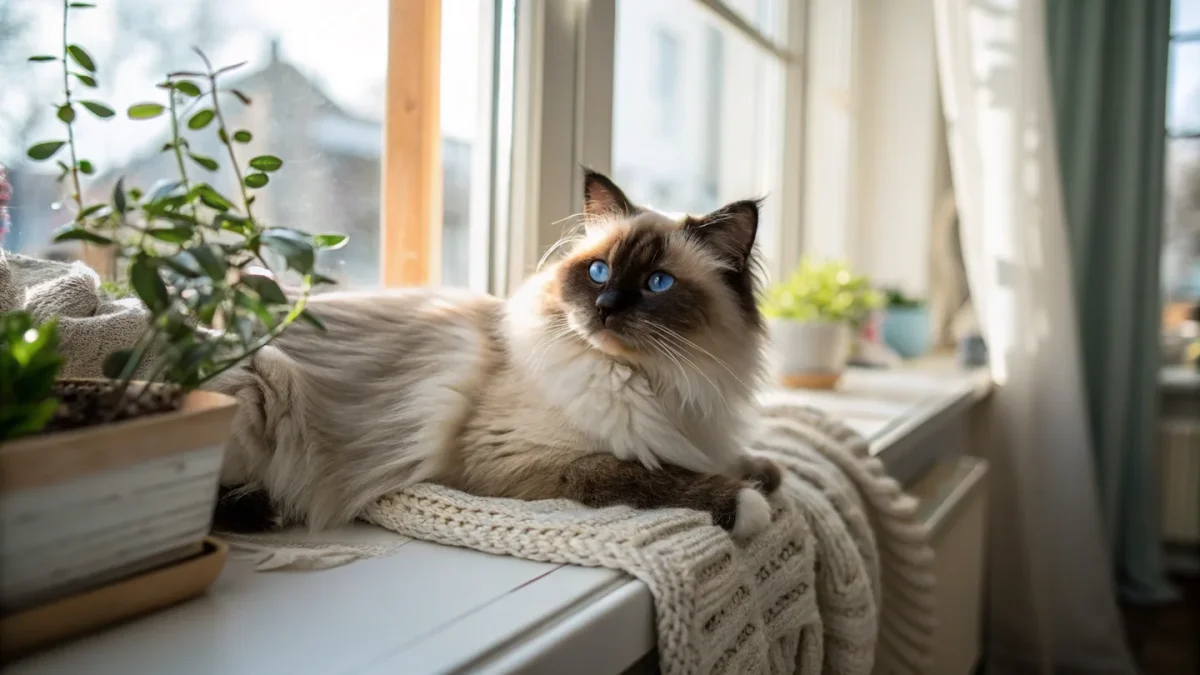
The Ragdoll and the Ragamuffin are so closely related — genetically and historically — that the comparison between them is essentially a story of one breed that became two. Understanding why they split, what they share, and what distinguishes them helps explain not just the differences in the cats but the politics and personality of the cat fancy world.
For the complete Ragdoll profile, see the complete Ragdoll breed guide.
The Origin of the Split
When Ann Baker developed the Ragdoll in the 1960s, she imposed tight restrictions on anyone who wanted to breed Ragdolls: franchise agreements, fees, and most significantly, the requirement to register with her IRCA (International Ragdoll Cat Association) rather than mainstream cat registries.
In the 1990s, a group of Ragdoll breeders who had been working under these restrictions broke away. They wanted to breed and register their cats with established mainstream organizations without paying Baker's fees or following her idiosyncratic rules. When they attempted to register their cats as Ragdolls, Baker's trademark on the name prevented them.
So they named the breed something else. In 1994, a group of IRCA breeders led by Janet Klarmann, Curt Gehm, and Kim Clark voted to leave Baker's organization and seek registration with established registries. The name "RagaMuffin" was coined by Curt Gehm for the ACFA breed acceptance application — a deliberate nod to the cats' street-urchin origins. The breed was then developed through outcrossing to Persians, Siberians, and domestic longhairs to introduce new colors and strengthen genetic diversity. This is why the breeds are so similar: the Ragamuffin is essentially a post-Baker Ragdoll with expanded color possibilities.
The Visual Differences
Color range is the most significant distinction.
Ragdolls are always colorpoint — the same Siamese-pattern gene that produces colored points on a lighter body. All Ragdolls have blue eyes, always.
Ragamuffins come in any color, including solid colors with no colorpoint pattern, tabby, tortoiseshell, and bicolor patterns that include colors impossible in the Ragdoll. Ragamuffin eye color ranges from green to gold to blue to odd-eyed, depending on the coat color. This expanded palette was achieved through deliberate outcrossing to Persians, Siberians, and domestic longhairs after the 1994 split from Baker's lines — outcrosses that simply weren't permitted under IRCA rules.
Body structure shows subtle differences. Ragamuffins are described as having a broader, more rounded body structure — sometimes described as "broader in the chest" — compared to the Ragdoll. Both are large, substantial cats, but side-by-side, experienced fanciers can often identify the difference. To a general observer, both look like large, semi-longhaired cats with soft, plush coats and gentle expressions.
Coat texture is similar in both breeds — semi-long, silky, with minimal undercoat — though some describe the Ragamuffin coat as slightly thicker or more rabbit-like in texture. This is a subjective distinction most commonly noted by breeders who handle both; breed standards from organizations such as ACFA describe the Ragamuffin coat as having a "thick, plush" quality, while Ragdoll standards emphasize the silky texture.
Temperament: More Similar Than Different
Both breeds share the defining docile, people-oriented temperament that originated in Baker's breeding program. The gentleness, the tolerance for handling, the tendency to go limp when held — these traits appear in both breeds at similar rates.
Neither breed is particularly vocal. Both are good with children and other animals. Both prefer indoor life. Both have low reactive aggression.
If there's a temperament difference, it's minor and more individual than breed-wide. Ragamuffins may have slightly more personality variation owing to the broader outcrossing that expanded their color range — Persian and Siberian genetics both carry distinct temperament profiles — but formal breed-level temperament data comparing the two is limited, and any difference remains at the margin of individual variation.
Which to Choose?
| Ragdoll | Ragamuffin | |
|---|---|---|
| Colors | Colorpoint only | Any color |
| Eye color | Always blue | Any color |
| Size | 10-20 lbs | 8-20 lbs |
| Coat | Semi-long, silky | Semi-long, silky-plush |
| Temperament | Docile, people-oriented | Docile, people-oriented |
| Grooming | 2-3x weekly | 2-3x weekly |
| Recognition | Widely recognized | Varies by organization |
If you love the colorpoint pattern and want the classic blue eyes, the Ragdoll's visual identity is distinct and consistent. If you want the Ragdoll-type temperament in a wider range of coat colors and patterns — or if you particularly want a solid-colored or non-blue-eyed version — the Ragamuffin gives you that.
The honest answer is that the difference is primarily cosmetic, rooted in a breed politics story more than in fundamentally different animals. Both are excellent cats in the right household. The choice comes down to which appearance you prefer and which breed has reputable breeders accessible in your area. For a full profile of the other side of the comparison, see the Ragamuffin breed guide.