

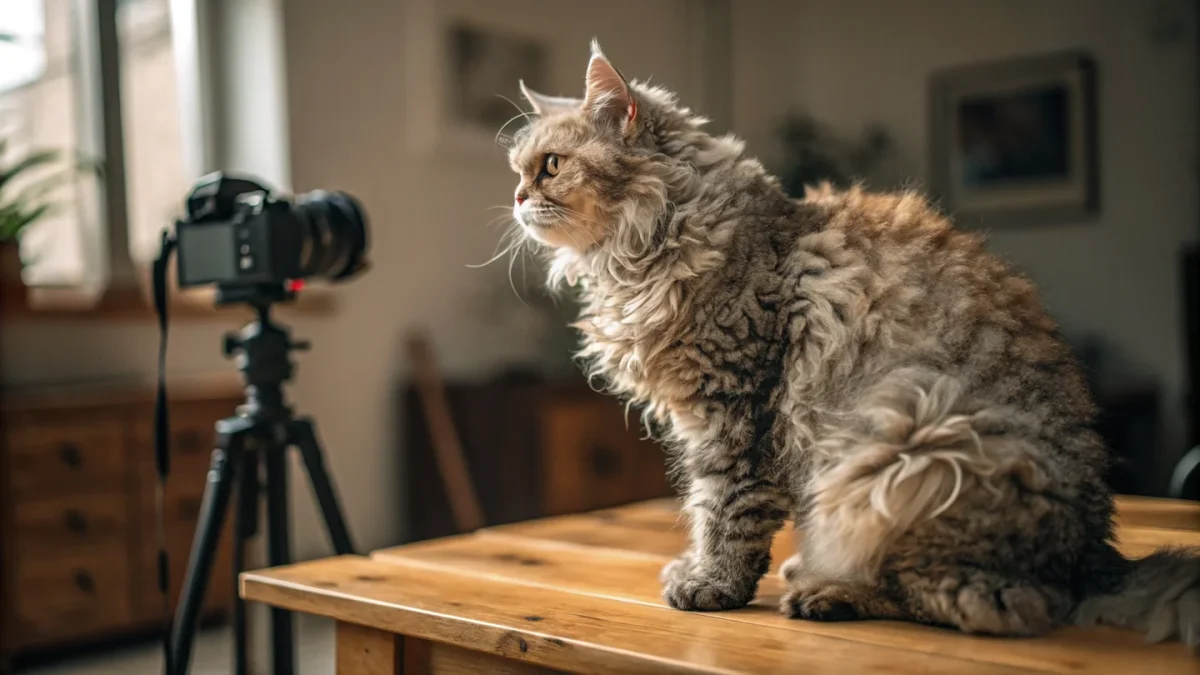
The internet cat conversation is dominated by Maine Coons, Persians, Ragdolls, and Bengals — the breeds with good marketing, photogenic qualities, and decades of established following. But the full range of recognized and developing cat breeds is considerably wider and, in some cases, considerably stranger.
These are breeds that appear rarely in pet stores and rarely in shelters. Finding one usually means connecting directly with dedicated specialist breeders. Their scarcity is part of their interest.
For context in the full breed classification, the cat breed categories guide is useful background.
Khao Manee — Thailand's Diamond-Eyed Sacred Cat
The Khao Manee (meaning "white gem") is an ancient Thai cat historically associated with royalty and considered a bearer of good fortune. They are always pure white, and the most prized individuals have "odd eyes" — one blue eye and one gold eye. In Thailand, they were historically kept by royalty and given as diplomatic gifts.
Personality: active, intelligent, and social. They're not a quiet breed — they're communicative and engaged. The all-white coat requires occasional bathing to stay pristine. Registry paperwork is still catching up to the breed's centuries of documented history: TICA advanced the Khao Manee to full championship status in 2015, while the Cat Fanciers' Association only accepted it for registration in 2018 and still shows it in the Provisional class. FIFe hasn't recognized the breed at all. Ancient lineage, remarkably recent bureaucracy.
Turkish Van — The Swimming Cat
The Turkish Van is one of the oldest natural cat breeds, developed in the Lake Van region of eastern Turkey over centuries. They're distinctive for their "van pattern" — colored markings limited to the head and tail, with an otherwise white body — and for their unusual documented interest in water. Photographs of Turkish Van cats swimming in Lake Van are well-known in cat fancy circles.
They're large, active, and independent-spirited — not lap cats. The semi-longhaired coat is single-layered, making it surprisingly water-resistant and easy to manage despite its length.
Selkirk Rex — The Teddy Bear
The Selkirk Rex is genetically distinct from the Cornish Rex and Devon Rex — a spontaneous mutation discovered in Wyoming, USA in 1987. A curly-coated kitten named Miss DePesto of Noface — born in Sheridan, Montana, in 1987 — was eventually crossed with Persian cats to establish the breed, which accounts for the Selkirk's notably heavier, rounder build compared to the slender Rex breeds.
The coat is full and plush with loose, flowing curls — quite different from the tight waves of the Cornish Rex. The curls appear in both shorthaired and longhaired varieties. The dominant mutation means that a single copy of the gene produces the curly phenotype. For a full comparison of the curly-coated cat breeds — Cornish Rex, Devon Rex, Selkirk Rex, and LaPerm — and how their independent mutations produce different curl textures, that article covers each in depth.
Chausie — The Jungle Cat Hybrid
The Chausie is a hybrid breed developed from crosses between domestic cats and jungle cats (Felis chaus), an African and Asian wild species considerably larger than domestic cats. The hybrid program aimed to create a large, active domestic cat with wild-type appearance. Modern Chausies are many generations removed from wild stock.
The result is a very large, athletic, active cat — one of the tallest domestic breeds — with a strongly ticked coat and wild-cat aesthetic. They require significant space and enrichment.
Pixiebob — The Legend of Wild Blood
The Pixiebob originated in the Pacific Northwest of North America in the 1980s and is surrounded by a founding story claiming descent from wild bobcat hybrids. DNA testing conducted by the Veterinary Genetics Laboratory at UC Davis has found no bobcat markers in Pixiebob lines, and current scientific consensus treats the Pixiebob as a fully domestic cat breed.
What is real: their distinctive short bobbed tails, their polydactyl tendency (many Pixiebobs have extra toes), their dog-like personality, and their larger-than-average size. The wild-heritage mythology has proven persistent despite the genetics.
LaPerm — The Curly Originating from Barn Cats
The LaPerm appeared in 1982 on a cherry orchard in The Dalles, Oregon, from barn cats — similar to the Cornish Rex's barn cat origin. The story of how a spontaneous mutation in farm cats becomes a recognized breed — through genetic verification, deliberate breeding programs, and registry navigation — is covered in detail in how cat breeds are created from founding mutations. The curly coat comes from a dominant mutation that produces springy, soft ringlets rather than the tight waves of the Cornish Rex.
LaPerms come in both shorthaired and longhaired varieties, are active and social, and have the characteristic rex breed engagement and people-focus. Their rarity outside of North America and Australia makes them genuinely difficult to find in other regions.