

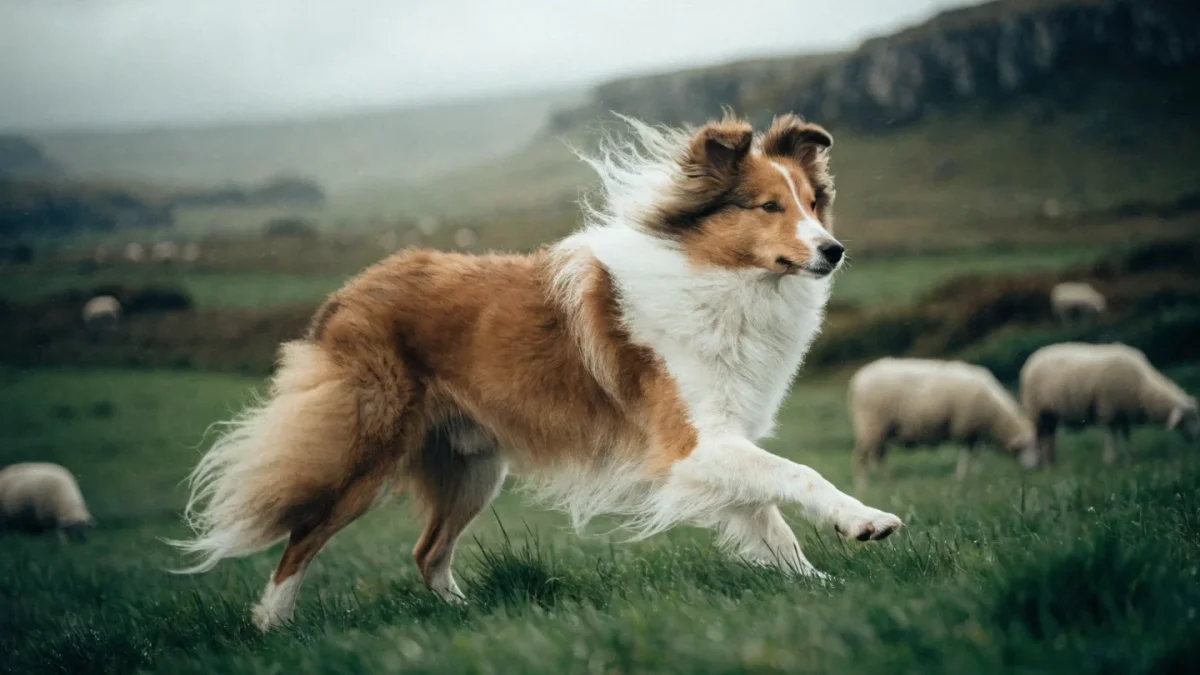
The Shetland Sheepdog has been a fixture in obedience competition since the 1940s and remains one of the most successful breeds in agility worldwide, yet it still gets routinely misidentified at dog parks. Part of the problem is the name — "Shetland" conjures images of tiny ponies, and people assume the same miniaturization logic applies. Part of it is the coat, which invites comparisons that don't hold up under scrutiny.
Here are five shetland sheepdog misconceptions myths that keep circulating despite being straightforwardly wrong.
1. Shelties Are Just Miniature Collies
This is the misconception that follows the breed everywhere, and the one that most frustrates people who know the breed's actual history.
Shetland Sheepdogs and Rough Collies share a visual resemblance — the long coat, the wedge-shaped head, the general herding-dog silhouette. They also share some distant ancestry. But the Sheltie is not a scaled-down Collie any more than a fox is a small wolf. The two breeds developed on parallel but distinct tracks.
Shelties originated on the Shetland Islands off Scotland's northern coast, where small livestock suited to sparse grazing required small, agile herding dogs. The island dogs were crossed with small working Collies, Spitz-type breeds, and possibly King Charles Spaniels over centuries. The complete breed guide traces this development in detail. Rough Collies, by contrast, developed on the Scottish mainland as larger dogs for larger flocks on open terrain.
The breeds differ in size, structure, temperament, working style, and several breed-specific health predispositions. Calling a Sheltie a "mini Collie" erases a distinct breed history spanning hundreds of years.
2. They're Too Small to Be Real Working Dogs
Shelties stand 33 to 41 centimeters at the shoulder and weigh roughly 6 to 12 kilograms. That compact frame leads people to classify them as companion dogs who happen to look like herders. The assumption underestimates both the breed and the Shetland Islands.
On the Shetlands, these dogs herded sheep, controlled poultry, and kept livestock out of unfenced crofters' gardens — working in wind-blasted terrain with minimal shelter and unreliable food supply. The environment selected for efficiency, endurance, and agility rather than mass. A smaller dog ate less, moved faster over rocky ground, and could turn livestock in tight spaces that a larger herding breed couldn't navigate.
Modern Shelties retain that working capacity. The breed consistently excels in agility, flyball, and herding trials. Their speed relative to body size is impressive — a fit Sheltie running an agility course covers ground with a quickness that catches first-time spectators off guard.
Small and non-functional are not the same thing. The Shetland Islands produced small sheep, small ponies, and small herding dogs — all of them built to work.
3. You Can Train the Barking Away
Shelties bark. They bark at doorbells, at passing dogs, at birds, at changes in routine, at things they heard three rooms away. New Sheltie owners often treat this as a training problem to be solved. Experienced owners know it's a feature to be managed.
The breed's vocalization is not random noise — it's herding communication. Shetland Sheepdogs used their bark to move livestock, alert handlers, and coordinate work. That vocal instinct was selected for over generations because it made the dogs more effective at their job. When your Sheltie barks at the mailman, it's running centuries-old software designed to announce changes in the environment.
Can training reduce excessive barking? Yes, meaningfully. Structured exercises that teach a "quiet" cue, redirection of alert barking, and management of trigger exposure all help. But eliminating barking from a Sheltie is like eliminating digging from a terrier — you can moderate the behavior, but you cannot remove the instinct.
The Sheltie temperament profile describes how this vocal tendency interacts with the breed's sensitivity and alertness. People who need a quiet household should know upfront that Shelties are not the breed for that requirement.
4. They're Fragile or Delicate Dogs
The elegant coat and refined bone structure create an impression of fragility that doesn't match reality. Shelties were developed in one of the harshest climates in the British Isles — wind speeds on the Shetland Islands regularly exceed 100 kilometers per hour, and winter conditions are severe.
The breed's double coat provides serious insulation. The lighter bone structure compared to mainland herding breeds is an adaptation to rocky, uneven terrain where agility mattered more than raw power. Shelties are athletic, durable dogs with good stamina for their size. A healthy Sheltie in proper condition can handle extended hikes, sustained agility training, and active outdoor lifestyles without difficulty.
Where fragility concerns do apply is in health — the breed carries predispositions to conditions like Collie Eye Anomaly and MDR1 drug sensitivity that require awareness and screening. But physical fragility in daily activity is not among the breed's characteristics.
5. They're Shy Dogs With a Temperament Problem
Shelties are frequently described as "shy" by people who encounter one for the first time and find the dog uninterested in greeting them. This interpretation confuses reservation with dysfunction.
The breed was developed to work closely with one handler or family on an isolated island. Strong bonding to familiar people and measured caution toward strangers is exactly what that selection pressure produces. A Sheltie that stands back and observes a new person before engaging is displaying the same temperament that made these dogs reliable, attentive working partners.
Some individual Shelties do cross the line from reserved into genuine fearfulness — trembling, cowering, or panic around normal stimuli. That's a temperament issue that needs addressing and may reflect poor socialization, poor breeding, or both. But standard Sheltie reserve, where the dog warms up on its own timeline and eventually engages on its terms, is breed-typical behavior and not something that needs fixing.
The owners who do best with this trait are those who respect it rather than trying to force sociability. A Sheltie that's allowed to approach strangers at its own pace usually arrives there. One that's pushed past its comfort zone repeatedly may develop the very anxiety its owner was trying to prevent.