

Look at a Rough Collie, then look at a Shetland Sheepdog. Every proportion is kept exact — the long, tapered muzzle, the dense mane and frill, the almond eyes, the semi-erect ear with its characteristic tip. Even the gait has the same elegant, floating quality. It's the same dog passed through a reducing lens, shrunk to roughly a third the size without losing a single detail. That's not an accident. It's the result of deliberate crossing during the late 1800s, when island farmers and opportunistic breeders started refining a rougher working dog toward something that would sell to the tourists arriving by steamship from the Scottish mainland.
But the reducing lens only explains part of the story. The small, hardy base underneath all that Collie refinement had been shaped by the Shetland Islands themselves for centuries before anyone thought to register it as a breed. The shetland sheepdog history origins is a story about environment shaping genetics — about why an island with almost no trees, persistent gale-force winds, and a brutally short growing season would produce a dog built for efficiency, hardiness, and maximum function at minimum caloric cost.
The Islands That Built the Breed
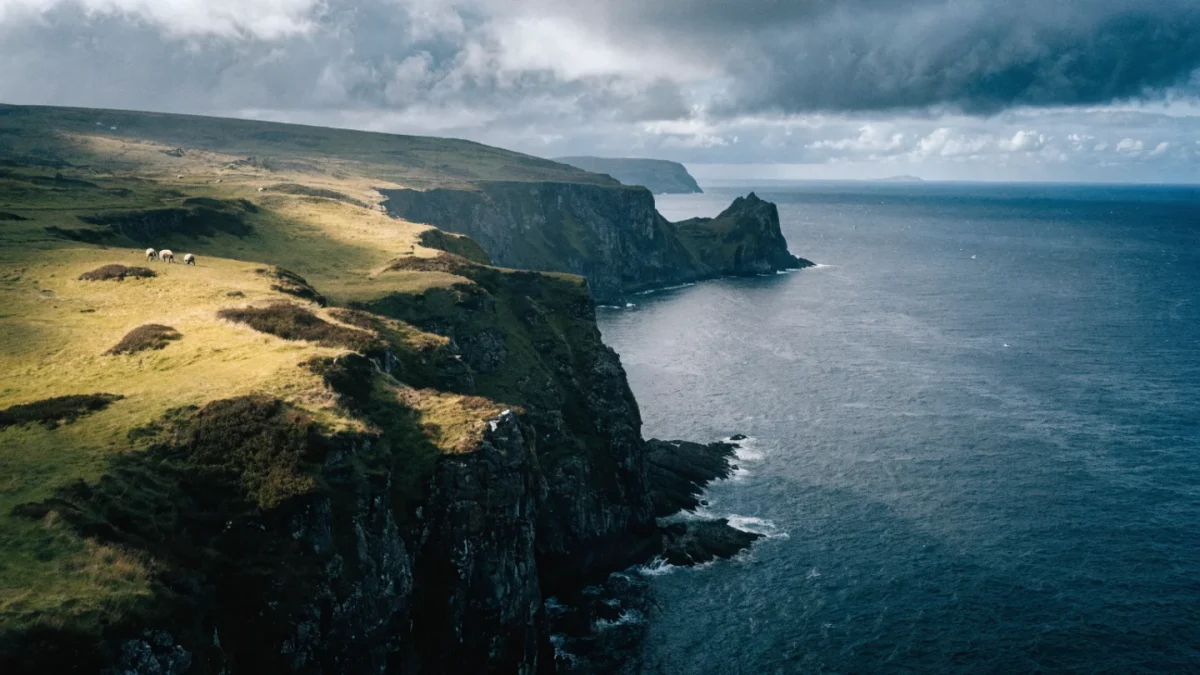
The Shetland Islands are an archipelago of roughly 100 islands — 16 of them inhabited — sitting at 60 degrees north latitude, level with Bergen, Norway, and the southern tip of Greenland. The climate is defined by wind. Average wind speed across the year exceeds 25 km/h, gales are frequent, and trees are so rare that their presence is noteworthy. Rainfall is moderate but nearly constant — drizzle and mist rather than heavy downpours, distributed across 250 or more wet days per year.
The growing season is short. Grazing land is limited. Everything that thrives on the Shetlands does so by being hardy, efficient, and small.
This miniaturization pattern appears across multiple Shetland species and breeds. Shetland ponies average 102 cm at the shoulder — among the smallest horse breeds. Shetland sheep are smaller than mainland breeds, adapted to survive on sparse heather and rough grass. Shetland cattle are compact and thrifty. The selective pressure was consistent: in an environment where calories are scarce and conditions are harsh, animals that need less food and tolerate more weather survive. The rest don't.
The dogs followed the same trajectory. Farmers on the islands needed herding dogs, but they couldn't afford to feed a full-sized collie. A smaller dog that could manage the small Shetland sheep flocks on minimal rations was a practical necessity, not an aesthetic choice.
The Original Island Dogs
Pinpointing the exact ancestry of the pre-breed Shetland working dogs is difficult because no one was keeping records. Farmers bred for function — could the dog herd, could it alert to predators, could it survive the winter — and pedigree documentation wasn't a consideration.
What's generally accepted is that the foundation stock included several components. Scandinavian spitz-type dogs almost certainly contributed genes. Norse settlers colonized the Shetlands beginning in the 9th century and brought their dogs. The Yakki, a small Icelandic-type dog known to have been present on the islands, is frequently cited as an ancestor, though its exact nature and whether it represents a distinct breed or a local type is debated among breed historians.
Scottish working collies from the mainland also entered the gene pool, brought by farmers and traders. The King Charles Spaniel may have contributed to the mix — a surprising inclusion, but one that multiple early breed historians reference. The spaniel influence, if present, likely came through dogs kept by landed gentry visiting the islands rather than through deliberate breeding programs.
The result was a small, rough-coated, prick-eared or semi-prick-eared dog that was sharp, agile, and vocal. These dogs — sometimes called "toonies" (from the Norwegian "tun," meaning farm) or "fairy dogs" by islanders — were general-purpose farm dogs. They herded sheep, chased birds away from crops, alerted to strangers, and served as companions in isolated farmsteads where the nearest neighbor might be kilometers away.
They were not beautiful by show-ring standards. Coats were rough and functional rather than luxurious. Ears varied. Size varied. Color varied. What was consistent was temperament: alert, responsive to their handler, suspicious of strangers, and vocal. Every one of those traits persists in the modern Sheltie.
The Tourism Effect
The Shetland Islands became increasingly accessible to mainland visitors during the late 1800s, and the small, appealing island dogs caught tourists' attention. People wanted to buy them and take them home.
Local farmers recognized the opportunity. A dog that might be valued primarily as a working partner on the farm could be sold to a tourist for a meaningful sum. But tourists wanted dogs that looked striking — more like the elegant Rough Collies they were familiar with from the mainland, less like the rougher island working type.
This market pressure drove deliberate crosses between island dogs and Rough Collies. The Collie genetics refined the head shape, lengthened and softened the coat, and produced the distinctive mane and frill that define the modern breed's silhouette. The transformation was rapid. Within a generation or two of crossing, the dogs began looking substantially different from the original island type.
This period represents the fundamental turning point in Sheltie history. The breed became two things simultaneously: a working island dog with centuries of functional selection behind it, and an emerging show prospect being shaped by aesthetic preferences imported from the mainland. The history of the Border Collie shows a parallel development on the British mainland — another herding breed shaped by the same working collie gene pool that the Shetland breeders drew from. That duality has never fully resolved.
Recognition and the Name War
The first breed club formed in Lerwick, the Shetland capital, in 1908. Members initially called the dogs "Shetland Collies" — a name that seemed natural given the visible Collie influence in the refined versions of the breed.
Rough Collie breeders objected forcefully. They argued that the small island dogs were not collies and that using the name would confuse the public and diminish the Collie brand. The dispute was heated enough that the Kennel Club intervened. The breed was registered under the name "Shetland Collie" in 1909 but pressure from the Collie establishment led to the name being changed to "Shetland Sheepdog" by 1914.
The renaming wasn't just administrative. It reflected a genuine philosophical split. Some breeders wanted to develop the Sheltie as a miniature Rough Collie — essentially creating a scaled-down version of the larger breed. Others insisted the Sheltie was a distinct breed with its own heritage and should be developed on its own terms, even if that meant accepting a less refined appearance.
Both factions used Rough Collie outcrosses, but they disagreed on how much Collie influence was appropriate. As the complete Shetland Sheepdog breed guide notes, this tension between "miniature Collie" and "distinct island breed" has shaped the Sheltie's identity for over a century.
Early Development in Britain
Through the 1920s and 1930s, the breed stabilized into something recognizable as the modern Shetland Sheepdog. Breed standards were written, revised, argued over, and revised again. The question of size was particularly contentious — how small was too small, and how large was too large?
The standard settled on 33 to 37 cm (later expanded to 33 to 41 cm in some registries), but oversized dogs remained common. The Collie crosses had introduced genes for larger body size that didn't breed out easily, and to this day, Shelties exceeding the upper limit of the standard appear regularly in litters from otherwise conforming parents.
Several influential kennels in England and Scotland shaped the breed during this period. Show competition drove the coat toward greater length and density, the head toward finer refinement, and the overall appearance toward the elegant silhouette that modern Shelties are known for. Working ability, while still valued in principle, became secondary to appearance in most breeding decisions.
World War II disrupted breeding programs across Britain, and the Sheltie population contracted sharply. Post-war recovery was slow but steady, with surviving breeding stock forming the foundation for the breed's expansion in the second half of the century.
Arrival and Growth in North America
Shelties arrived in North America in the early 1900s, with importation increasing through the 1920s and 1930s. The breed's combination of manageable size, trainable temperament, and striking appearance found an enthusiastic audience.
The breed's popularity in North America grew steadily through the mid-twentieth century, driven partly by success in obedience competitions. Shelties proved to be extraordinary obedience dogs — their handler sensitivity and quick learning made them competitive at the highest levels. By the 1970s and 1980s, the Shetland Sheepdog temperament — responsive, eager, intensely bonded — had made the breed a fixture in competitive obedience.
Show breeding in North America followed a somewhat different trajectory than in Britain. American-bred Shelties tended to develop heavier coats and slightly different head proportions compared to their British counterparts, though both populations remained within the same general standard framework. The divergence is visible to breed enthusiasts but subtle to casual observers.
From Working Dog to Companion
The modern Shetland Sheepdog retains the instincts of its island ancestors but lives a dramatically different life. Very few Shelties work livestock today. Most are companions, show dogs, or performance competitors. The herding drive expresses itself in backyard circling, heel-nipping, and an obsessive need to keep track of household members rather than in actual sheep management.
What hasn't changed is the temperament core. Shelties are still watchful. Still vocal. Still deeply bonded to their people. Still suspicious of strangers until they've had time to evaluate. The islands selected for those traits over centuries, and a hundred years of show breeding hasn't overwritten them.
The breed's journey from anonymous island worker to recognized purebred followed a path common to many breeds — function first, appearance second, then a gradual reversal of those priorities. Whether that reversal served the breed well depends on your perspective. The modern Sheltie is undeniably beautiful, undeniably popular, and undeniably further from its working roots than the toonies of the Shetland Islands would recognize.
What the toonies would recognize is the dog looking out the window, watching everything, barking at anything that moves, and turning to check that its person is still nearby. That part hasn't changed at all.