

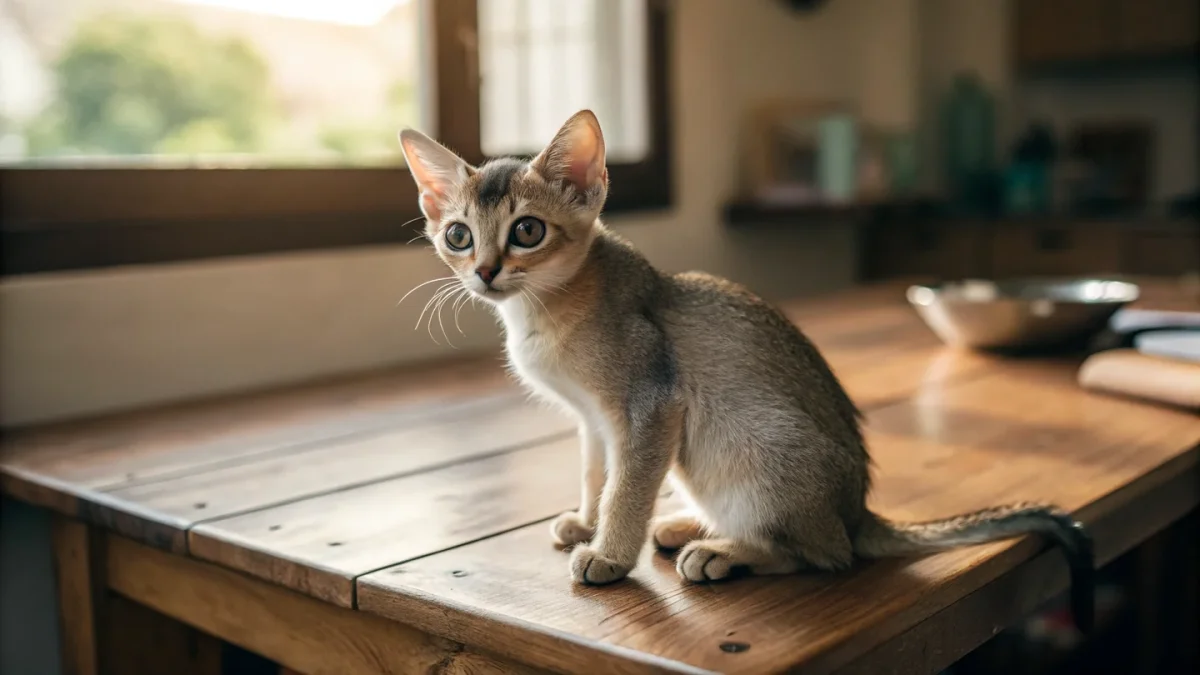
The idea of a permanently small, kitten-sized cat is appealing, and it has spawned some dubious internet claims about "teacup cats" and "miniature breeds." To be clear: "teacup" and "miniature" are not recognized breed designations — they are marketing terms, sometimes applied to cats who are simply small-for-breed individuals, and sometimes applied to cats whose small size results from health conditions rather than genetics.
Genuinely small domestic breeds exist. They're just not quite as small as some content would have you believe.
For context in the full classification picture, the cat breed categories guide covers the broader landscape.
The Genuinely Compact Breeds
Singapura — Typically 2-3 kg
The Singapura is consistently cited as the smallest recognized cat breed. Developed from street cats in Singapore, they are physically tiny — adult females sometimes weigh under 2 kg, adult males rarely exceed 3 kg. The face is dominated by enormous eyes relative to head size.
Despite the tiny size, Singapuras are active and curious. They're not fragile, delicate creatures — they pack considerable personality and energy into the small package.
Devon Rex — Typically 2.5-4 kg
The Devon Rex is small to medium in size, with a distinctive pixie-like face dominated by large eyes and huge ears. The Devon Rex breed profile covers the curly coat mutation, the oil-management bathing, and the dog-like personality in full. The small frame contains an extraordinarily active and people-focused personality.
Cornish Rex — Typically 2.5-4 kg
Similar size range to the Devon Rex, though the Cornish Rex's slightly different build makes them look more slender. The Cornish Rex breed profile covers this breed in full. Active, social, and permanently kitten-like in behavior.
American Curl — Typically 3-5 kg
On the larger end of "small," but the American Curl is a moderately compact breed with the distinctive backward-curled ears as its defining trait. The ear curve results from cartilage differences and is not associated with the joint problems of the Scottish Fold.
Munchkin — Typically 2.5-4 kg
The Munchkin's short legs result from a genetic mutation affecting bone growth. The breed is controversial: advocates describe healthy, adaptable cats; critics point to real anatomical concerns. A 2021 study in Veterinary and Comparative Orthopaedics and Traumatology found the dwarfism mutation produces measurable limb and spinal deformity — this shows up on radiographs, it's not manufactured outrage. What's less settled is how much of that deformity translates into actual day-to-day pain; long-term tracking of affected cats is still catching up to the anatomy.
What "Small Cat" Doesn't Mean
"Teacup" cats: Not a recognized breed or category. Usually means a cat with dwarfism, a cat who was stunted by poor early nutrition, or a small-for-breed individual. The health implications of deliberately breeding for extreme smallness are real.
Most cats described as "small breeds" online: Average domestic cats weigh 4-5 kg. A Siamese female at 3.5 kg is small for a Siamese — not a small breed.
Fragile: Small doesn't mean delicate. Singapuras and Devon Rex cats are active, durable animals who hold their own in multi-cat households despite the size.
Practical Notes
Small cats eat less, require smaller carrier and bed sizing, and may be more vulnerable to injury from rough handling or accidental impacts. In households with large dogs or young children with limited motor control, extra attention to safe interaction is important.
Lifespan is where the "small means long-lived" assumption — true for dogs — doesn't carry over to cats. A 2024 Royal Veterinary College life-table study of the UK cat population found no such size advantage: the Sphynx, a small breed, had the shortest life expectancy of any breed studied at 6.7 years, while the mid-sized Burmese and Birman topped the list at over 14. What the genuinely small breeds have going for them is unremarkable good health, not a size bonus — Devon Rex commonly reach 9-15 years, and Singapuras are regularly reported living into their mid-teens. Solid numbers, just not exceptional ones.