

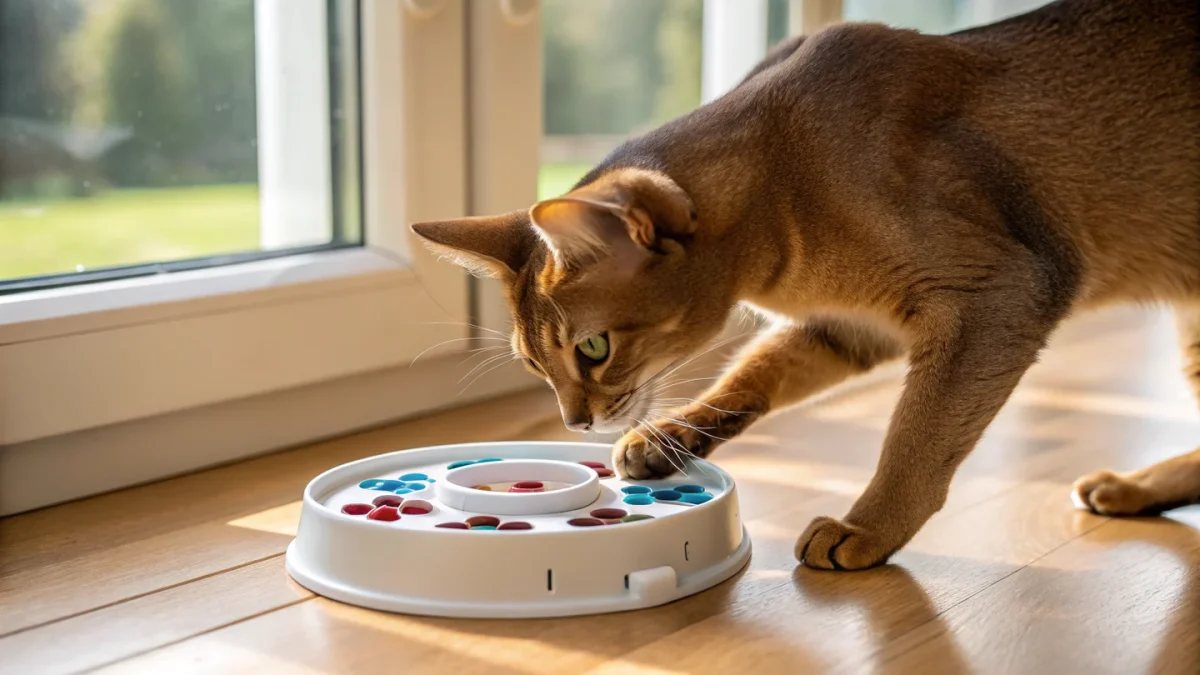
Measuring feline intelligence is genuinely difficult. Cats are not motivated to perform for people in the way dogs are — they won't run an agility course to please you; they'll run it if they feel like it, and if there's food involved, and if nothing more interesting is happening. Testing a cat's intelligence on tasks designed for dogs is like testing a sprinter on a swimming time trial.
What we can observe is problem-solving behavior in contexts cats find relevant: how quickly a cat learns to open a food-puzzle feeder, how well it generalizes a learned behavior to new situations, how rapidly it adapts to environmental changes, and whether it can be trained at all with positive reinforcement.
For the full context on what intelligence means for breed selection, the cat breed selection guide covers how behavioral traits affect day-to-day ownership.
A Caveat on "Intelligence Rankings"
Smart cats are, without exception, more demanding than less-smart cats. A highly intelligent cat that isn't given sufficient enrichment invents its own activities — often ones you'd prefer it hadn't. The Abyssinian that learns to open the treat cabinet, the Bengal that figures out the dripping tap, the Siamese that realizes exactly which behaviors get an immediate human response: these are features of intelligent cats that become challenging without appropriate management.
Choosing an "smart" breed for the abstract appeal of cleverness without accounting for the enrichment demands is one of the more common mismatches in cat ownership.
Breeds With Consistently Demonstrated High Intelligence
Abyssinian
One of the most frequently cited as highly intelligent — the Abyssinian breed profile covers the ancient domestic roots and ticked coat genetics alongside the temperament. Abyssinians learn quickly, adapt to new situations without apparent anxiety, and apply problem-solving in contexts they find motivating. They explore their environment systematically rather than randomly. Puzzle feeders are often too easy for experienced Abyssinians — graduated difficulty is necessary to maintain challenge.
Siamese
The Siamese intelligence is strongly socially directed — they read human emotional states, learn routines precisely, and figure out cause-and-effect relationships in social contexts quickly. A Siamese who has identified which behavior prompts an immediate human response will deploy that behavior systematically. The Siamese breed profile covers the breed's origins as a royal cat of Siam, the point color genetics, and the vocal traits that accompany the high social intelligence.
Bengal
Bengal intelligence has a practical, predatory focus. They solve problems connected to obtaining food or engaging with prey-like targets with impressive efficiency. They learn environmental patterns (which cabinet opens, which room contains interesting things) and act on that information.
Maine Coon
Trainable in a calm, reliable way — Maine Coons learn their names, respond to recall, and can be taught simple tricks with food motivation. They're curious and adaptable without the intense problem-seeking drive of the Abyssinian or Bengal.
Burmese
Social intelligence is high — Burmese learn household routines, read people well, and communicate effectively. They're the social-emotional intelligence end of the spectrum.
Cornish Rex
Quick to learn practical things (how to open doors, how to obtain specific attention responses) and retain that knowledge reliably.
Turkish Angora
Often noted as quick learners with a playful approach to problem-solving. They can learn to retrieve and show environmental problem-solving spontaneously.
FAQ
Can you train a cat like a dog?
Sort of. Cats can learn specific behaviors through positive reinforcement (treat-based training), but they can't be trained to the same reliability level as dogs for most behaviors. The motivation structure is different: cats work when they choose to. Short, food-motivated training sessions work well for many cats; persisting past their willingness is counterproductive. Some of the breeds on this list (Maine Coon, Bengal, Abyssinian) are more consistently trainable than average.
Are smarter cats less suitable as pets?
Not inherently — they're differently demanding. A smart cat in an appropriately enriched environment is a deeply engaging companion. A smart cat in an under-enriched environment creates its own enrichment from your belongings. The intelligence is neutral; the management requirement is the variable.