

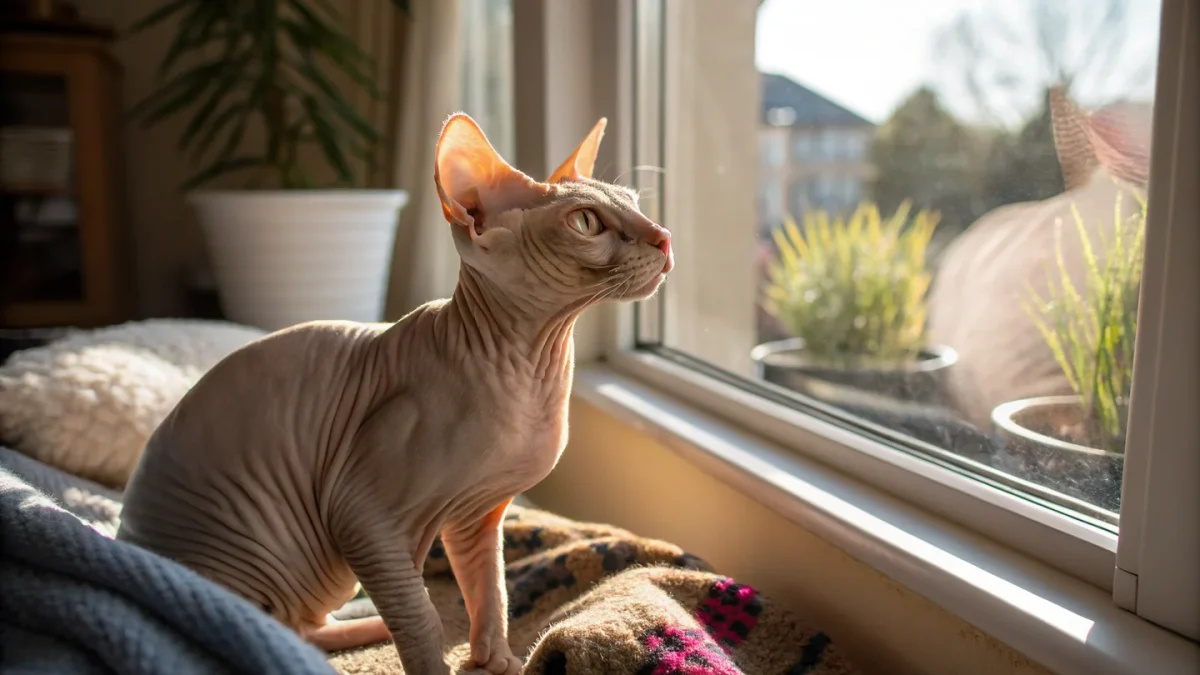
The genetic connection between the Sphynx and Devon Rex runs deep enough that Devon Rex cats have been used in Sphynx breeding programs to maintain genetic health. Both breeds share the mutation responsible for reduced or absent guard hairs; they share the large, dramatic ears; they share much of the angular, alien aesthetic. They are also genuinely distinct breeds with real differences in coat, body, and daily care.
Coat: The Central Difference
The Sphynx is essentially hairless — most individuals have a fine downy fuzz that you feel more than see, but no conventional cat coat. The skin is directly exposed.
The Devon Rex has what's technically a short, wavy coat — but "short" and "wavy" undersell just how minimal this coat is. The Devon Rex's mutation (the rexed gene) causes the fur to be extremely fine, very short, and irregularly waved. It's less a coat than a suggestion of one. The cat appears nearly hairless in some lights and shows its soft curling fur clearly in others, particularly on the belly and back.
This difference has practical consequences. Sphynx skin requires weekly bathing to manage oil accumulation. Devon Rex also produces skin oils, but the minimal fur manages them somewhat — most Devon Rex owners bathe their cats regularly (every one to two weeks for many) but the requirement is slightly less frequent than for the fully hairless Sphynx. Both breeds need ear cleaning attention more frequently than most coated cats.
Body Type
Both breeds are medium-sized with athletic, muscular builds. The differences are real but subtle.
The Sphynx has a notably heavier, more substantial body than its size suggests — broad chest, rounded abdomen, visible muscle structure on the limbs. The head is a rounded wedge with very large ears set widely.
The Devon Rex is typically lighter and more fine-boned. The body is slender, the legs longer in proportion, and the head structure creates a more extreme, almost bat-like impression — very large ears on a very small, triangular head. The Devon Rex reads as more elfin than the Sphynx.
Temperament: Similar, With Differences
Both breeds are highly social, people-oriented, and energetic. The comparison often comes out like this: if the Sphynx is the enthusiastic extrovert, the Devon Rex is the mischievous acrobat.
Devon Rex cats are extremely playful and maintain kitten energy levels remarkably late into life. They are quick, inventive, and tend toward aerial athleticism — they will access the highest point available, always. They are also very warm physically (the minimal coat means they seek your body heat exactly as the Sphynx does) and deeply social.
The difference in social intensity is modest: both breeds need significant interaction, both are unsuited to long solitary hours, and both form strong bonds with their household. The Sphynx, in my observation, tends slightly more toward the constant physical contact — the burrowing-under-covers, sitting-on-your-face behavior — while the Devon Rex channels more of that energy into movement and play.
Grooming and Care
| Sphynx | Devon Rex | |
|---|---|---|
| Bathing frequency | Weekly minimum | Every 1–2 weeks |
| Shedding | Minimal (no real fur) | Low (minimal fine fur) |
| Ear cleaning | Weekly | Weekly |
| Temperature sensitivity | High (hairless) | Moderate-high (minimal coat) |
| Nail care | Regular, some oil accumulation | Regular |
Both breeds benefit from warmth in the home and both are unsuited to cold environments.
Which Is Right for You?
The Sphynx is for someone who wants maximum physical warmth and the most emphatically social, people-attached experience in the hairless/near-hairless cat category. The grooming commitment is real and consistent.
The Devon Rex is for someone who wants a highly social, energetic, acrobatic companion with a slightly less intensive grooming schedule and a somewhat different aesthetic — the soft curling wisps of the rex coat have their own charm. They are equally unsuited to long solitary hours.
The Sphynx cat breed guide covers the full Sphynx picture if that's the direction you're leaning. The choice between these two breeds will often come down to aesthetic preference and a small calibration of grooming commitment — they are close enough in character that either makes an excellent choice for the right household.