

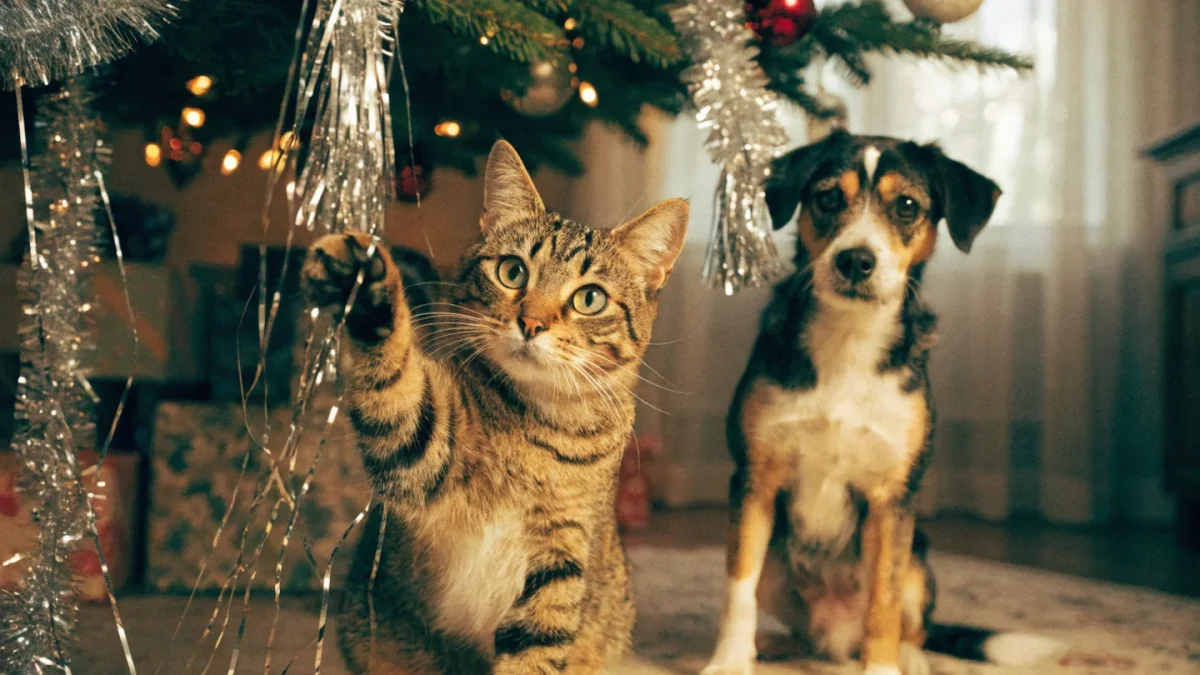
The call comes in reliably at some point every December: the cat ate tinsel, the dog got into the Christmas chocolates, or — and this one becomes an annual tradition — the dog consumed an entire plate of Christmas dinner left unattended while someone answered the doorbell.
I don't say this to be grim about the holidays. Christmas is genuinely wonderful. But a few days of preparation and some reasonable changes to how you manage your home during the season can make the difference between a normal December and a midnight emergency vet visit.
Here's what I actually see.
Tinsel: The Cat Owner's Annual Emergency
I would be comfortable saying that tinsel is the single most dangerous Christmas decoration for cats. Full stop.
Cats are drawn to shiny, dangling, lightweight objects. Tinsel moves, it catches light, it's the precise size and texture to seem interesting. Cats bat it off the tree, carry it around, and — critically — eat it.
Once swallowed, tinsel becomes what veterinarians call a linear foreign body. One end of the tinsel anchors somewhere in the GI tract — typically at the pylorus (the exit from the stomach) or gets tied up in the intestinal folds. As the intestine tries to move the tinsel along, it "walks" up the string while the anchored end holds. The intestine gathers on the tinsel like fabric on a drawstring. The result is intestinal plication — severe bunching of the intestinal segments — and eventually perforation, peritonitis, and sepsis.
The prognosis for cats who develop intestinal perforation from linear foreign bodies is serious. Surgery is required. Some cats don't make it.
The solution: don't use tinsel. It's a decorative item with a low-cost alternative — ribbon can be cut short, garland can be made of many things. Tinsel and cats don't mix.
If your cat has already eaten tinsel: don't pull any visible portion from the mouth or anus (this can worsen intestinal injury). Call your vet immediately.
Toxic Holiday Plants
Holly (Ilex species) — The red berries and the spiny leaves both contain saponins and other compounds that cause vomiting, diarrhea, lethargy, and potentially more serious effects with larger ingestions. The spiny leaves cause mouth trauma on the way down, which often drives gagging and drooling as the first signs.
Mistletoe — More concerning than many people realize. European mistletoe (Viscum album) and American mistletoe (Phoradendron species) both contain cardiac glycosides and lectins. Small amounts typically cause GI signs; larger amounts affect heart rate and blood pressure. Any mistletoe ingestion warrants a call to poison control or your vet.
Amaryllis — Hugely popular holiday bulb plant, beautifully dramatic, and significantly toxic. The bulb contains the highest concentration of toxin (phenanthridine alkaloids), but all plant parts are toxic. Causes vomiting, diarrhea, abdominal pain, low blood pressure, and neurological signs. Not a plant to have if you have dogs who chew things or cats who nibble plants.
Christmas cactus — A much gentler concern. Mild GI irritation possible; not seriously toxic.
Poinsettia — GI irritation from the milky latex sap; not the death plant of legend, but can cause drooling, vomiting, and mild lethargy. Worth keeping out of reach.
Christmas tree water — Standing water in a Christmas tree stand can accumulate preservatives, fertilizers, bacteria, and pine oils. Pets drink from tree stands more often than you'd think. Cover it completely or use a covered stand.
Christmas Foods: The Annual Pancreatitis Season
December is the peak month for pancreatitis in my practice. Not coincidentally, it's also when dogs are most frequently given fatty holiday foods from the table.
Turkey and ham. Plain, lean, cooked meat is fine. But holiday turkey and ham are typically roasted with butter, rubbed with fat, basted repeatedly, and served with drippings-based gravy. The fat content is the problem — high-fat meals can trigger acute pancreatitis in dogs, which is intensely painful, sometimes fatal, and requires hospitalization for IV fluids, pain management, and supportive care.
Bones. Cooked turkey and ham bones are brittle and sharp when fragmented — not flexible and digestible like raw bones. A dog who swallows cooked bone fragments can develop esophageal or GI lacerations, obstructions requiring emergency surgery, or peritonitis from perforation.
Onion and garlic. Stuffing, gravy, roasted vegetables, meat rubs — onion and garlic are everywhere in holiday cooking. Both are toxic to dogs and cats through a mechanism that damages red blood cells and can cause hemolytic anemia.
Chocolate in holiday quantities. Hot cocoa mix, baking chocolate, chocolate fondue sets, Christmas gift truffles left on the coffee table — December means more chocolate accessible than most other times of year. All forms are toxic; dark and baking chocolate most severely.
Alcohol. More accessible at holiday parties. Eggnog, mulled wine, champagne left unattended. Dogs who drink alcohol can develop serious hypoglycemia and neurological effects.
Christmas Decorations Beyond Tinsel
Glass ornaments. Beautiful, sharp when broken. A batted ornament that falls from the lower branches of a tree becomes a fragile, shattering object that leaves invisible glass fragments. Paw lacerations and GI injury from swallowed glass are both possible. Keep fragile ornaments on upper branches, or replace lower-branch ornaments with fabric or plastic versions.
Snow globe liquid. Many decorative snow globes contain ethylene glycol (antifreeze) in the liquid. A broken snow globe is a serious antifreeze ingestion risk. Keep them elevated, on stable surfaces, and if one breaks: clean it up immediately, keep pets away, and call poison control.
Battery-operated decorations. Button batteries, disk batteries, and AA batteries are all toxic if chewed and swallowed. Button batteries cause particularly severe chemical burns. Any battery ingestion is an emergency.
Electrical cords. The volume of lighting cords and extension cords increases dramatically during Christmas. Manage them so they're not accessible for chewing.
Practical Christmas Safety
Honestly, most of this comes down to a few simple decisions made in advance:
- No tinsel in a cat household, ever
- Secure all chocolate, candy, and alcohol as though you have a determined toddler in the house
- Give holiday guests explicit, specific instructions about not feeding the dog
- Put fragile ornaments on upper tree branches
- Cover the Christmas tree water dish
- Identify your nearest emergency vet before Christmas Eve, not during
- Consider a safe room for pets during peak guest activity
The pre-holiday five minutes spent on these items is worth it. I've had conversations with people who wished they'd thought about it before the emergency.
FAQ
How do I stop my cat from climbing the Christmas tree?
Some cats will climb trees regardless; others can be redirected with deterrents. Citrus scents (cats dislike them), double-sided tape on the base, and a stable tree mount that doesn't tip are practical measures. Don't put fragile ornaments or tinsel on the lower two feet of the tree. Accept that the bottom portion of your tree may look different than the top.
Is Christmas tree sap toxic?
The oils in true fir trees can cause mild GI irritation if chewed or ingested in quantity. Not an emergency-level concern, but a cat who gnaws on tree branches may get some GI upset.
My dog ate some holiday stuffing — should I worry?
Stuffing that contains onion, garlic, leeks, or chives is concerning — call your vet. Plain bread-based stuffing, while not ideal, is less acutely dangerous. The more important question is how much and what specifically was in it.
Is it safe to use artificial scented pine products around pets?
Scented pine candles, sprays, and diffused pine oils can cause respiratory irritation in cats and dogs. Pine oil in cleaning products can be more seriously toxic. Fresh pine trees themselves pose lower risk than concentrated pine oil products.
My dog got into a chocolate truffle assortment — they don't seem sick. Should I still call?
Yes. Call your vet or poison control with the chocolate type, estimated quantity, and your dog's weight. The initial absence of symptoms doesn't mean no toxicity occurred — chocolate toxicity can have a delayed onset, and early intervention is far preferable to treating signs.