

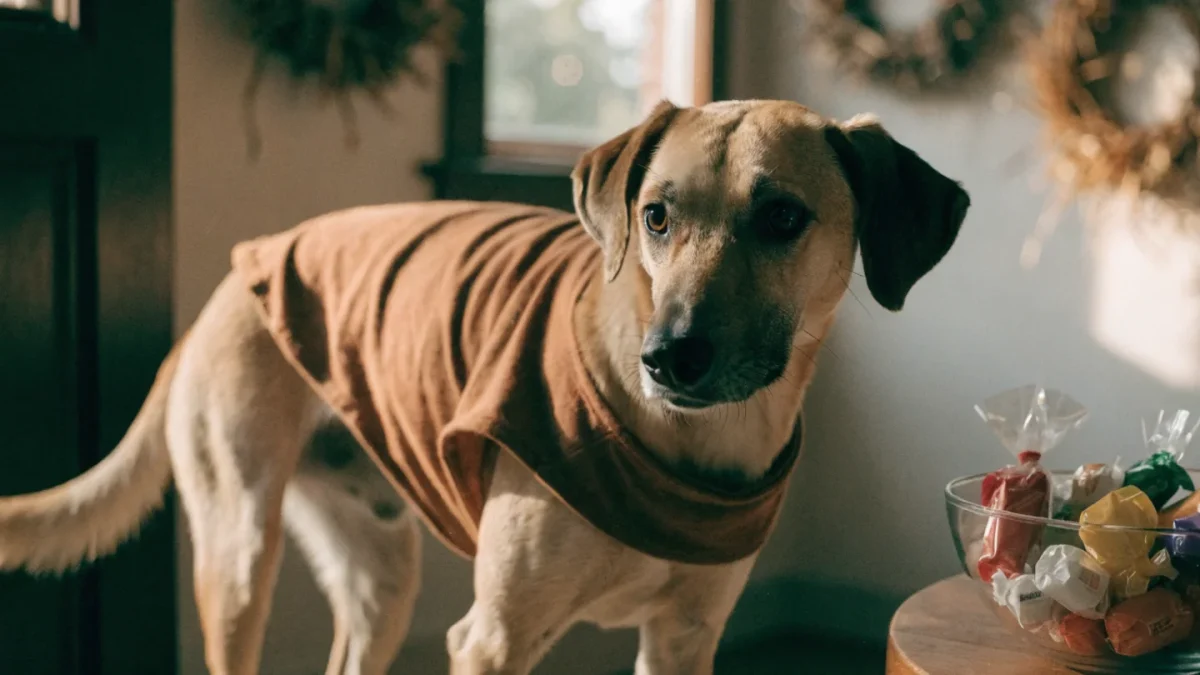
If I could send one message to every pet owner on October 30th every year, it would be this: put the candy somewhere the dog absolutely cannot access, and think about whether Halloween night is a good time for your dog to be near the front door.
Those two things prevent the majority of Halloween pet emergencies I see.
That said, Halloween has a few more hazards than just the candy bowl, and they're worth knowing about before the night arrives.
The Candy Problem
Halloween brings more candy into the average household than almost any other time of year. The hazard for dogs is that dogs are motivated, creative food seekers who will open bags, leap onto counters, nose into backpacks, and find candy wherever it is.
Chocolate is the primary concern. The toxic compounds in chocolate — theobromine and caffeine — cause vomiting, diarrhea, increased heart rate, tremors, and in severe cases, seizures and death. Dark chocolate and baker's chocolate contain much higher concentrations per ounce than milk chocolate, but given the quantities that come into a house on Halloween, even milk chocolate can represent a significant dose for a small dog.
Xylitol is the one that catches people off guard because it's less well-known. This artificial sweetener is present in some sugar-free candies, sugar-free gum (often in kids' Halloween bags), and certain peanut butter products sometimes used in Halloween treats. Xylitol causes rapid, severe hypoglycemia in dogs — blood sugar drops dramatically within 30-60 minutes of ingestion — and also causes acute liver failure. Even a few pieces of xylitol-containing candy can be fatal in small dogs. Check ingredient labels on anything that says "sugar-free."
Raisins sometimes appear in Halloween trail mix or healthy treat alternatives. Raisins are significantly toxic to dogs, causing kidney failure.
Candy wrappers aren't toxic but cause GI obstructions regularly. A dog who gets into the Halloween bag often ingests wrappers along with the candy.
Practical approach: treat Halloween candy like a controlled substance in your house. Not in a bowl on the coffee table, not in a bag on the floor, not in a backpack left by the door. In a closed cabinet, on a high shelf, behind a closed door.
The Escape Risk Nobody Talks About
Halloween night is, by some measures, the worst night of the year for pet escapes. The front door opens and closes dozens of times. Guests and visitors are unpredictable. Children in costumes look and sound unusual to dogs. The general chaos and stress can cause even normally calm dogs to bolt when a door opens.
Lost pets on Halloween are hard to find — it's dark, people are focused on their own activities, and a scared dog may have run much further than usual.
Before Halloween night:
- Check that your dog's ID tags are current and securely attached
- Verify that your microchip registration has your current contact information
- Consider where the dog should be during peak trick-or-treat hours (more on this below)
Dogs and the Doorbell
Every doorbell ring on Halloween is an excited child with a treat bag. That's maybe 50-100 doorbell rings in a neighborhood with active trick-or-treating. For dogs who react to the doorbell — which is many dogs — Halloween night is an extended stress event.
The best approach: set the dog up in a back room or other space away from the front door with something to occupy them — a food-stuffed toy, a chew, a comfortable bed. Play background music or leave the TV on to muffle the doorbell noise. This isn't punishment. It's recognizing that the main living area on Halloween night is genuinely stressful for most dogs and giving them a better option.
For dogs with significant noise sensitivity (not just the doorbell, but the sounds of excited children, unfamiliar voices, and general Halloween commotion), speak with your vet about anxiety options. This conversation goes better if you have it before October 31st.
Halloween Decorations
Jack-o'-lanterns and candles. Open flames in carved pumpkins at ground level, often on porches or in entryways, present a tail-wag burn hazard and fire risk. Battery-operated LED candles are a safer option inside carved pumpkins when pets are present.
Artificial spider webs. Cats will eat these. They're not highly toxic but can cause GI upset and — in large amounts — obstruction.
Glow sticks and glow jewelry. Very popular Halloween items. The liquid inside is dibutyl phthalate — bitter-tasting, highly aversive, but generally low in toxicity in the small amounts a pet might ingest from chewing one glow stick. It does cause profuse drooling, gagging, and distress. Rinse the mouth with water, offer food or water to clear the taste, and call your vet if signs don't quickly resolve.
Dry ice. Used in Halloween fog effects. Contact with skin causes cold burns. The CO₂ vapor, in confined spaces without adequate ventilation, can cause breathing distress. Don't use dry ice in areas where pets are confined.
Pet Costumes: The Safety and Ethics
Look — I find pet costumes deeply endearing when the animal is comfortable. A dog trotting around happily in a hot dog bun, tail wagging, clearly unbothered — that's delightful.
But a dog hunched, frozen, ears back, clearly distressed by the costume — that's not Halloween fun for the dog, and forcing it continues despite the obvious discomfort.
How to tell if your pet tolerates the costume:
- Do they move normally in it? Or freeze, shuffle, or try to shake it off?
- Is their body language generally relaxed (loose body, normal tail position) or stressed (tail down, ears back, wide eyes, crouching)?
- Are they licking or pawing at the costume?
If the costume causes distress, it doesn't go on. A festive bandana is an alternative that almost no dog objects to.
Safety checklist for costumes:
- No restriction around the neck, chest, or belly
- Can pant freely
- Can see and hear normally — nothing over the eyes or covering the ears significantly
- No small parts that can be chewed off and swallowed
- Fits without being tight around any limbs
- Remove the costume when unsupervised
Cats on Halloween
Cats face most of the same hazards — candy ingestion, door escape risk, stress from unusual visitors and sounds. But there's an additional specific concern: the cultural mythology around black cats on Halloween.
I want to address this directly: black cats are not at statistically elevated risk of mistreatment compared to other cats, according to current data. The concern is real in people's minds but not well-supported empirically. That said, I recommend that all cats be kept indoors on Halloween night regardless of coat color. The combination of increased pedestrian traffic, distracted people, excited children, and a stressed cat's reduced predictability makes indoor-only the sensible choice.
FAQ
How much chocolate is dangerous for a dog?
It depends on the type of chocolate and the dog's weight. Dark chocolate and baking chocolate are much more concerning per ounce than milk chocolate. A call to your vet or ASPCA Poison Control (888-426-4435) with the chocolate type, estimated amount, and your dog's weight will give you a specific risk assessment.
My dog ate glow stick liquid — should I go to the vet?
Probably not necessary for a small amount from a single glow stick. The liquid is highly unpleasant but low in toxicity. Rinse the mouth, offer food or water, and the symptoms (drooling, gagging, possible vomiting) should resolve quickly. Call your vet if symptoms persist or worsen.
Is it safe to take my dog trick-or-treating?
It depends entirely on your dog. A calm, well-socialized dog who genuinely enjoys meeting people and isn't reactive to unusual costumes can have a fine time. An anxious dog, a reactive dog, or one who's stressed by unusual stimuli should stay home.
My cat escaped during trick-or-treat — what now?
Don't panic, but don't wait either. Check immediately under porches, behind bushes, and in adjacent yards — escaped indoor cats usually stay very close to home. Post on local Facebook/Nextdoor groups. Contact local shelter in the morning. A current, good photo is essential for lost pet posts.
Should I put my dog in their crate during Halloween?
If your dog is crate-trained and the crate is their comfortable safe space, using it during the trick-or-treat window is a perfectly reasonable management strategy. It prevents escape and keeps them from doorbell stress.