

Dolly herds the cats. Every single time I visit my friend's house, she materializes from wherever she's been resting, locates the cats — there are three of them — and begins working them into a corner. She doesn't bark. She doesn't chase. She uses her body, creeping low, cutting angles, applying pressure from the flanks until the cats are bunched together against the kitchen cabinets looking profoundly offended. Dolly is a rescue mutt, probably part Australian Cattle Dog, and she has never seen a sheep in her life.
That's herding instinct. It doesn't require training, livestock, or a working context to express itself. It just expresses itself — on cats, on children, on the neighbor's dog, on anything that moves in a pattern the dog's nervous system recognizes as something to be gathered and managed. The herding breeds are a group defined by this particular kind of inherited intelligence: not the broad sociability of a retriever or the independent problem-solving of a scent hound, but a laser-specific, obsessive capacity for tracking and controlling movement. It's extraordinary to watch and genuinely challenging to live with if you weren't prepared for it.
How Herding Works
Herding styles vary significantly across breeds, and understanding those differences matters because they directly predict how each breed behaves in a household.
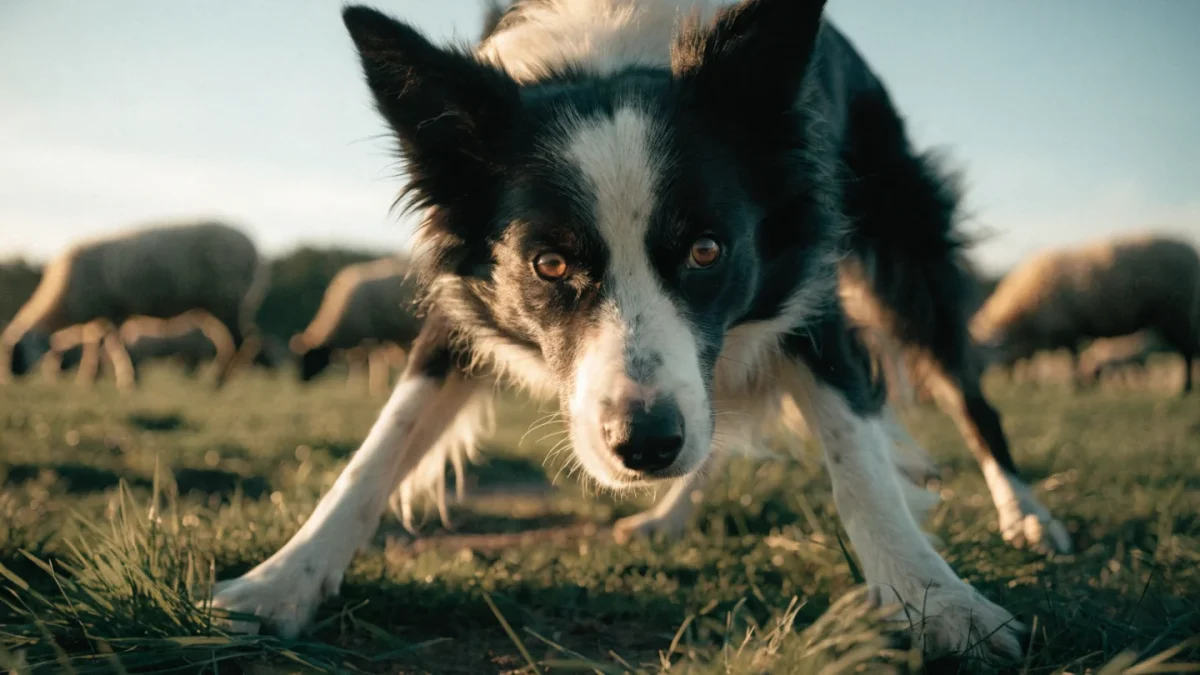
Headers work by moving to the front of livestock and turning them back toward the handler. Border Collies are the supreme example — they use intense eye contact (called "eye") and controlled stalking movement to pressure sheep without physical contact. This style requires extraordinary self-control and spatial awareness.
Heelers drive livestock from behind by nipping at the heels. Pembroke Welsh Corgis and Australian Cattle Dogs use this approach, which is why corgis were developed with short legs — they duck under retaliatory kicks from cattle. This driving style produces dogs that are bold, physical, and persistent.
Tending breeds patrol the boundaries of a flock, keeping livestock within a designated grazing area. German Shepherds originated as tending dogs — they patrol a perimeter rather than driving from behind or heading from the front. This background explains the German Shepherd's characteristic patrolling behavior and territorial awareness.
Loose-eyed herders use their body presence and bark rather than intense eye contact. Australian Shepherds and Old English Sheepdogs fall here — they're more physically active in their herding style, using wider movements and vocal pressure.
The Behavioral Profile
Every herding breed carries instinctive behavioral patterns that domestic life cannot erase:
Movement sensitivity. Herding dogs are hardwired to notice and respond to movement. Running children, bicycles, joggers, cats, and other pets trigger the herding impulse. A Border Collie circling your toddler isn't aggressive — it's expressing the same instinct that makes it brilliant with sheep. Managing this drive, rather than punishing it, is essential.
Intense handler focus. Herding breeds work in close communication with their handler, which makes them exceptionally trainable but also prone to separation anxiety when that connection is disrupted. These are not dogs that do well left alone for extended periods.
High mental demand. Physical exercise alone won't satisfy a herding breed. They need their brains worked — puzzle toys, scent games, obedience drills, agility courses, or actual herding work. A herding breed with nothing to think about becomes anxious, destructive, or develops compulsive behaviors like shadow-chasing or fence-running.
Vocal communication. Many herding breeds are barkers. Shelties are particularly notorious, but Australian Shepherds, Collies, and Border Collies all use voice as a management tool. This was an asset in the field. In an apartment or suburban home, it's something you'll need to address early and consistently.
Representative Breeds
The Border Collie is widely regarded as the most intelligent dog breed and the gold standard herding dog. Bred in the Scottish-English border region, it combines supreme athleticism with obsessive work ethic. Border Collies are extraordinary in the right hands and genuinely problematic in the wrong ones — they require more mental stimulation than most owners anticipate. The Border Collie complete breed guide covers the full picture including the working-line versus show-line divide.
The German Shepherd was developed by Captain Max von Stephanitz in Germany starting in 1899, specifically to be the ideal herding and utility dog. Its versatility has made it the world's most widely deployed working dog across police, military, search-and-rescue, and service applications — roles that exploit the breed's combination of intelligence, trainability, and physical capability.
The Australian Shepherd — despite the name, developed primarily in the western United States during the 1800s — is a loose-eyed herder bred for managing livestock on ranches. Aussies are high-energy, highly trainable, and increasingly popular as family dogs, though their exercise demands catch many first-time owners off guard.
The Pembroke Welsh Corgi is a heeling breed with a thousand-year history in Wales. At roughly 12 kg and 25-30 cm at the shoulder, it's the group's most compact member — but there's nothing small about a Corgi's personality, drive, or opinion about how things should be done.
The Shetland Sheepdog is not a miniature Collie, despite appearances. Developed on the Shetland Islands for managing small sheep in harsh conditions, the Sheltie is a sensitive, vocal, intensely loyal breed that bonds deeply with its family and can be reserved with strangers.
Health Patterns in the Herding Group
Several health conditions appear across multiple herding breeds with enough consistency to constitute group-level patterns:
MDR1 drug sensitivity affects Collies, Australian Shepherds, Shetland Sheepdogs, and several other herding breeds — though the rate varies a lot by breed. Washington State University's veterinary pharmacology lab, which runs the standard test, puts the mutation at roughly 70% of Collies and 50% of Australian Shepherds, dropping to around 15% of Shelties and under 5% of Border Collies. A mutation in the MDR1 gene makes affected dogs dangerously sensitive to certain common medications, including ivermectin and several anesthetic agents. DNA testing identifies carriers, and any herding breed owner should test for this mutation before their dog receives any medication.
Collie Eye Anomaly (CEA) is a congenital condition affecting Collies, Shetland Sheepdogs, Border Collies, and Australian Shepherds. Severity ranges from minor and asymptomatic to vision-threatening. DNA testing identifies carriers.
Hip dysplasia is prevalent in German Shepherds, Australian Shepherds, and larger herding breeds. The German Shepherd's extremely angulated rear structure in show lines has been a particular source of controversy and concern within the breed community.
Epilepsy occurs in several herding breeds, including Belgian breeds, Border Collies, and Australian Shepherds, at higher rates than the general dog population.
Degenerative myelopathy — a progressive neurological disease affecting the spinal cord — is particularly common in German Shepherds, Pembroke Welsh Corgis, and Cardigan Welsh Corgis. A DNA test exists for the SOD1 gene mutation associated with the condition.
The Herding Group and Family Life
Herding breeds can be exceptional family dogs — but only when their needs are met. The mistake most families make is falling in love with the breed's intelligence and beauty without fully grasping the energy commitment. A herding breed in an active household with clear structure and daily mental stimulation is a joy. The same breed in a sedentary household with inconsistent boundaries is a behavioral problem waiting to happen.
If you're drawn to terrier breeds for their independent personality, a herding dog will feel like the opposite — they want to be told what to do, they want to do it well, and they want to do it again immediately. That partnership dynamic is the herding group's greatest strength and its highest maintenance cost.
Frequently Asked Questions
Why does my herding dog try to herd my children?
Herding instinct doesn't distinguish between sheep and small humans. Your dog is responding to movement with the same behavioral sequence it would use on livestock — circling, nipping at heels, body blocking to redirect direction. This isn't aggression, but it does need management. Redirect the behavior toward appropriate outlets (herding balls, agility courses, structured games) and teach your children not to run screaming around the dog, which intensifies the herding drive.
Which herding breed is best for a first-time owner?
Shetland Sheepdogs and Pembroke Welsh Corgis are often more manageable for less experienced owners than Border Collies or Belgian Malinois. Both are intelligent and trainable but somewhat less intense than the group's most demanding members. However, even the "easier" herding breeds require more exercise and mental stimulation than most non-herding breeds. If you've never owned a high-drive dog, spend significant time around the breed you're considering before committing.
How much exercise does a herding breed actually need?
Most herding breeds need a minimum of 60 to 90 minutes of daily exercise — and that's physical exercise alone. Mental stimulation (training sessions, puzzle work, scent games) is equally important and should add another 20 to 30 minutes daily. Border Collies and Australian Shepherds at the high end can work productively for four to six hours. The key indicator isn't a time target — it's your dog's behavior. If your herding dog is destructive, anxious, or developing repetitive behaviors, it's not getting enough stimulation.