

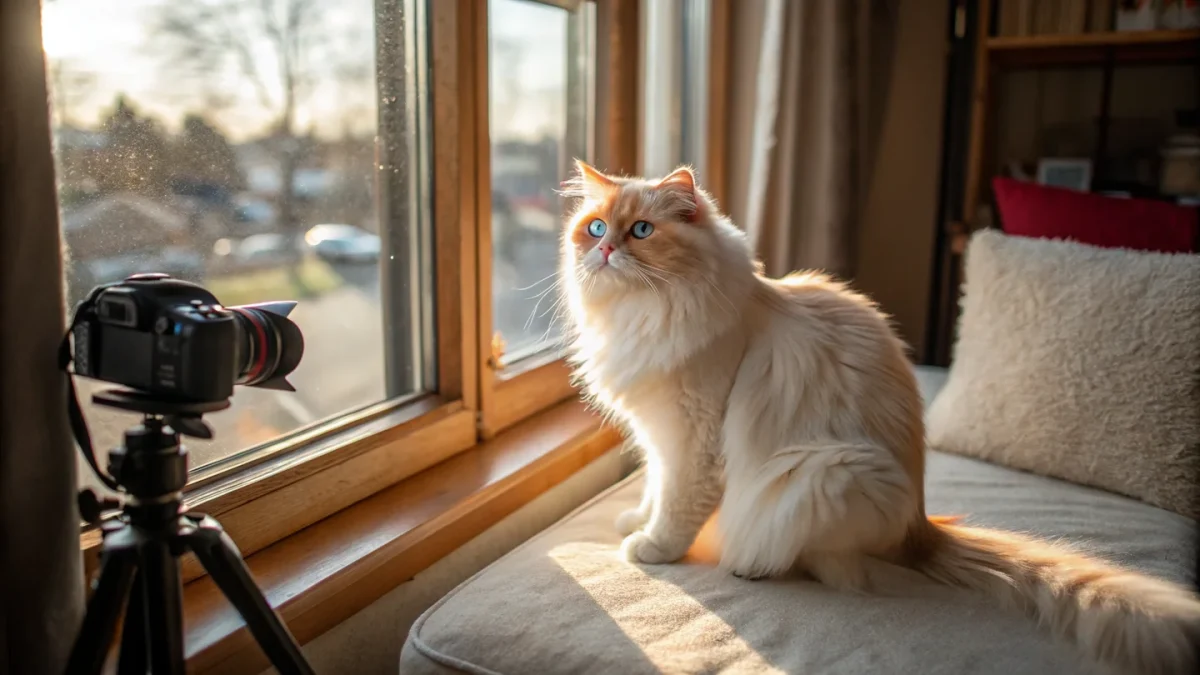
The Persian cat has sometimes been described as furniture that breathes — a criticism lodged by owners who wanted something more interactive. The Himalayan's Siamese ancestry changed that equation. What you get with a Himalayan is the Persian's serenity plus a genuine desire for human company that the pure Persian doesn't always reliably provide.
It's a subtle distinction to non-cat-people, but owners notice it immediately: the Himalayan doesn't just tolerate your presence. It follows you.
For the full background on the breed's history and the complexity of its breed status, the Himalayan cat breed guide has the full context.
The Persian Foundation: Calm as a Starting Point
The Persian's behavioral profile is built around stillness and contentment — the Persian temperament that forms the Himalayan's behavioral foundation is worth understanding in full before acquiring a Himalayan. Persians are not anxious cats; they're not reactive cats; they're not cats that need a great deal of external stimulation to feel settled. They have a quality of repose that many owners find genuinely relaxing to live with.
The Himalayan inherits this. In a calm, stable household, a Himalayan is one of the most relaxed domestic cats available. They don't need to patrol the territory. They don't need to investigate every change. They find a comfortable position and are content to remain there for hours.
This means a well-situated Himalayan generates very little disruption in a household. They don't knock things over out of boredom. They don't vocalize for entertainment. They occupy space with a beautiful quietness that owners who've experienced anxious or high-drive breeds genuinely appreciate.
The Siamese Warmth: What's Different from a Persian
Here's where Himalayans diverge from pure Persians in ways that matter. The Siamese contribution isn't dramatic — it doesn't override the Persian foundation — but it consistently shows up in two ways: the quality of the bond with their people, and the expressiveness of their communication.
Bonding: Himalayans choose their people more actively than Persians tend to. Where a Persian may appreciate being in the household generally, a Himalayan typically develops clear attachments to specific individuals — following them, positioning near them, and showing visible engagement with their activities. Owners often describe the feeling of being "chosen" by a Himalayan in a way that feels distinct from a Persian's more democratic acceptance of whoever is nearby.
Expression: The Himalayan's eyes and voice are slightly livelier than a typical Persian's. They communicate — with gaze, with body language, with occasional vocal commentary — in a way that makes them feel more present than an aloof Persian might. They're not Siamese-vocal by any stretch, but they're not mute either.
Day-to-Day Personality
Living with a Himalayan day-to-day is defined more by what they aren't than what they are. They aren't demanding. They aren't loud. They aren't destructive. They aren't competitive for resources or territory.
What they are: present, quietly affectionate, and consistent. Himalayan owners frequently describe the breed as having an almost meditative quality — a cat that brings calmness into a room rather than energy.
Play is part of their life, particularly in kittenhood and early adulthood. Himalayans will engage with interactive toys, chase feather wands, and bat at moving objects with genuine enjoyment. The play sessions are shorter and lower-intensity than with active breeds, and they don't demand them as often. But they're real.
As they age — and Himalayans are typically calmer with each passing year — the resting and proximity behaviors become more dominant.
Sensitivity to Environment
The single most important thing to understand about Himalayan temperament is how strongly it depends on environment. These cats are not resilient to stress in the way that more adaptable breeds are.
Noise: Loud households are hard on Himalayans. Persistent noise, unpredictable sounds (slamming doors, shouting), and chaotic activity patterns create sustained low-level stress that shows up as hiding, reduced appetite, or changes in coat condition.
Change: Himalayans adjust slowly to changes — new people moving in, furniture rearranged, schedule shifts. They're not impossible to adjust; they just need more time and should be given quiet, familiar spaces to retreat to during transitions.
Other pets: Himalayans can coexist well with other calm cats. Energetic, dominant, or aggressive cats stress them. High-energy dogs that treat cats as entertainment create the same problem.
A Himalayan placed in the right environment is among the most reliably tranquil cats to own. A Himalayan placed in the wrong environment shows you, slowly, just how sensitive that tranquility is.
With Children
The Himalayan's tolerance for handling makes it functional in households with children who have been taught appropriate cat interaction. They're not as bounce-back tolerant as a Ragamuffin — they will retreat if handled roughly rather than indefinitely tolerating it — but they're not easily provoked either.
The better description is that Himalayans do well with children who have the maturity and training to be gentle. With very young children who can't yet control their grip or their noise levels, the Himalayan's stress sensitivity is a relevant factor. Many Himalayan owners with toddlers describe the cat spending the peak-chaos years in elevated safe spaces, returning to warmth once the household quiets.
Independence vs. Attachment
Himalayans occupy an interesting middle ground on the independence spectrum. They're not the clingy breed that follows you into the bathroom demanding commentary. But they're also not the cat that disappears for eight hours and reappears only at meal times.
The typical pattern is oriented proximity: a Himalayan will position near you, often within visual range, and be content to simply be present. The contact doesn't need to be physical constantly — having you in the same room is often enough. They'll occasionally seek active petting or settle into a lap, but they don't demand it.
This makes them workable for people with somewhat busy schedules, as long as the household isn't completely empty for very long stretches. They're less demanding of constant interaction than a Tonkinese or a Siamese; more attached than a true loner breed.
The Honest Summary
The Himalayan is a magnificent companion for a specific type of owner in a specific type of household. They reward gentleness, calm, and consistency with a warmth and loyalty that genuine Himalayan enthusiasts describe as one of the breed's most underappreciated qualities.
Push them into chaos, neglect the grooming, ignore the health needs that come with the flat face, and you have a stressed, uncomfortable cat whose beauty becomes a burden.
Get it right, and a Himalayan adds something genuinely lovely to a home — a cat that is beautiful, affectionate, and quietly devoted in a way that the more performatively expressive breeds never quite manage.