

The first successful Siamese-Persian hybrid kittens were born in 1935 at Harvard Medical School — not at a cattery, but in a genetics laboratory. Dr. Clyde Keeler and Virginia Cobb were studying color inheritance in cats, and the kittens they produced with Persian body type and Siamese coloring were a proof of concept for a specific genetic theory, not a deliberate attempt to create a breed.
They called their experiment a success, wrote their paper, and moved on. Other breeders looked at those kittens and saw something else entirely: one of the most beautiful cats imaginable.
What Is a Himalayan Cat?
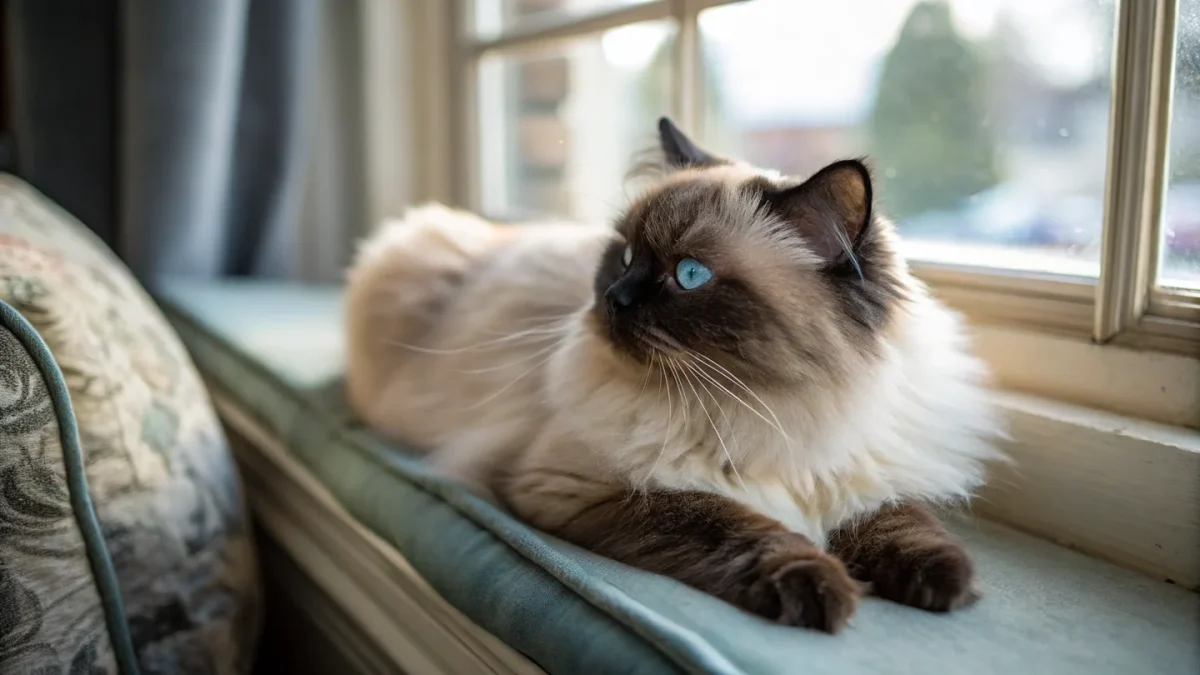
The Himalayan is a cat with the structure and coat of a Persian combined with the colorpoint pattern of a Siamese. The result is a longhaired, flat-faced cat with luxuriant pale fur and dramatically dark points — face, ears, paws, and tail — in colors ranging from seal to lilac to flame.
Here's where the breed status question gets genuinely complicated, and it's worth addressing directly: the Cat Fanciers' Association (CFA) classifies the Himalayan as a color division of the Persian breed, not a separate breed. The International Cat Association (TICA) recognizes the Himalayan as a distinct breed. Other registries take their own positions.
This isn't a trivial difference in paperwork. It affects how Himalayans are judged at shows, how breeding records are kept, and how breeders describe their cats. The practical reality for pet owners is simpler: what you're getting is a Persian with point coloring, regardless of how the registry files it.
The Breed's Development
After Keeler and Cobb's laboratory work, American breeder Marguerita Goforth spent years developing the Himalayan as a true breeding cat. British breeders worked on the same cross independently. The CFA recognized the Himalayan as a separate breed in 1957, then reversed course and merged it back into the Persian division in 1984 — a decision that remains controversial among dedicated Himalayan breeders to this day.
The name "Himalayan" was chosen to evoke the pointed color pattern of the Himalayan rabbit and Siamese cat, not because the breed has any connection to the Himalayan mountain range.
Physical Characteristics
The Himalayan carries the full Persian conformation — for the full detail on that body type and its associated health considerations, see the Persian's conformation and health profile. The structure is a cobby, broad-chested body, short sturdy legs, a large rounded head with a flat (brachycephalic) face, and small rounded ears. The flat face is the defining structural feature — and also the most medically significant one.
The coat is the breed's most spectacular visual attribute: long, dense, and fine-textured, standing away from the body rather than lying flat. A fully coated Himalayan in peak condition is an imposing sight, the fur creating a mane around the neck and a plumed tail. It is also, as any Himalayan owner will tell you, everywhere.
The colorpoint pattern puts darker pigment on the extremities — the "points" — while the body remains pale. Point colors include:
- Seal (dark brown-black points, pale fawn body)
- Blue (gray-blue points, bluish-white body)
- Chocolate (warm milk-chocolate points, ivory body)
- Lilac (pinkish-gray points, magnolia body)
- Red/Flame (orange-red points, pale body)
- Cream (pale cream points, white body)
- Tortie and lynx (tabby-striped) variations on the above
All Himalayans have blue eyes — the colorpoint gene that creates the point pattern is linked to blue eye pigmentation.
Himalayan Temperament
Himalayans inherit the Persian's calm, placid disposition with some variability introduced by the Siamese ancestry. They are quiet, sweet-natured cats that prefer stability and gentleness.
Calmness: Himalayans are among the most serene domestic cats. They don't typically engage in the intense activity bursts that characterize breeds like Abyssinians or Bengals. They play, but at their own pace, and they are genuinely content spending long stretches resting in comfortable spots.
Affection: The Siamese ancestry shows up here. Himalayans tend to be warmer and more interactive than a classic Persian. They seek out their preferred people, often positioning themselves nearby without necessarily demanding physical contact — a gentle, persistent presence rather than a demanding one.
Voice: Quieter than a Siamese, but more communicative than many Persians. Himalayans have a soft, pleasant voice and use it selectively.
Environment sensitivity: These cats do best in calm households. Loud environments, frequent disruption, or very active children who don't know how to interact gently with animals will stress a Himalayan. They adapt slowly to change and prefer predictable routines.
What Most People Get Wrong About Himalayans
The single biggest misconception is treating the Himalayan as an exotic, rare, or particularly unusual cat to own. In terms of temperament and care requirements, the Himalayan is essentially a Persian — and that means the same health considerations, the same grooming demands, and the same environmental preferences as a Persian.
People who haven't owned a brachycephalic cat before are often underprepared for the respiratory sounds and the eye discharge. The flat face — while beautiful in photographs — has real functional consequences. Daily eye cleaning is not optional; it's a routine health maintenance task. Breathing sounds that would worry owners of other breeds are normal for Himalayans, and owners need to know what sounds are normal versus what requires veterinary attention.
Third: many people assume the Himalayan is quiet and undemanding because it doesn't vocalize constantly or charge around the house. These cats are not undemanding — they require substantial daily grooming, regular veterinary attention for face-related health issues, and a calm environment. Their demands are in maintenance, not behavior.
Grooming: The Full Reality
Owning a Himalayan without a genuine commitment to daily grooming is not a good idea for the cat. The long, fine coat mats quickly — especially in the areas under the "armpits," between the back legs, and at the neck. A mat left too long becomes a painful tangle that may require professional or veterinary removal.
Daily combing (not just brushing) is the standard recommendation for Himalayans. A steel wide-tooth comb reaches through the coat more effectively than a brush and is better at finding developing tangles before they become mats.
Eye care: The flat face causes tears to overflow onto the face rather than draining properly. This creates reddish-brown staining around the eyes, and the damp environment can encourage skin fold irritation. Daily gentle cleaning with a damp cloth removes discharge and keeps the skin folds dry and comfortable.
Bathing: More frequent bathing than most longhaired cats — many Himalayan owners bathe monthly or more often, partly because the long coat traps debris and body oils, and partly because a clean coat mats less readily.
Dental care: Brachycephalic cats often have dental crowding because the shortened jaw compresses the tooth arrangement. Regular dental care — ideally teeth brushing — is important.
Health Considerations
The Himalayan's health profile follows the Persian closely.
Brachycephalic obstructive airway syndrome (BOAS): The flat face can cause narrowed nostrils, elongated soft palate, and other structural issues that compromise breathing. Severity varies between individuals; some Himalayans breathe nearly silently, others snore loudly. Owners should monitor for labored breathing, exercise intolerance, or blue-tinged gums and consult a veterinarian. Surgical correction is available for severe cases.
Polycystic kidney disease (PKD): Persian-origin cats have a well-documented hereditary form of PKD caused by an autosomal dominant mutation. A DNA test for this mutation exists and should be part of responsible Himalayan breeding. Responsible breeders test their breeding animals. Ask about PKD test results when acquiring a kitten.
Hypertrophic cardiomyopathy (HCM): As with many breeds, HCM occurs in Himalayans. Cardiac screening of breeding animals is recommended.
Eye conditions: The facial structure increases susceptibility to corneal sequestrum (a pigmented lesion on the cornea) and entropion (inward-rolling eyelids). Regular eye examinations are worthwhile.
Is a Himalayan Right for You?
The Himalayan is a magnificent companion for the right person in the right household. That person is patient with grooming, comfortable with daily eye maintenance, unbothered by respiratory sounds that take some getting used to, and able to provide a calm, stable environment.
They suit apartment living well, provided the space has comfortable resting spots and isn't chaotic. They suit people who want a beautiful, affectionate presence that doesn't demand constant entertainment. They suit experienced cat owners who understand brachycephalic health needs.
They are not suitable for people who underestimate the grooming commitment, who expect a low-maintenance cat, or who want an active, adventurous companion.
Get the grooming right, give them the calm environment they need, monitor the health concerns that come with the facial structure, and a Himalayan can be a deeply rewarding companion for fifteen years or more.
Frequently Asked Questions
Is a Himalayan cat the same as a Persian?
In CFA's classification, yes — the Himalayan is a color division of the Persian, not a separate breed. In TICA's classification, it is a distinct breed. Biologically and in terms of care, the Himalayan is a Persian with colorpoint coloring: same body type, same coat, same health considerations. The distinction is mainly administrative and affects how cats are shown and registered.
Are Himalayan cats hypoallergenic?
No. Himalayans produce Fel d 1, the primary cat allergen, like all domestic cats. The long coat also collects more dander than shorthaired breeds, which can make allergic reactions worse for sensitive individuals. Claiming any cat breed is truly hypoallergenic is not accurate.
How long does it take to groom a Himalayan?
Daily combing of a fully coated adult Himalayan takes roughly 5–15 minutes depending on coat condition. A cat that is combed daily stays mat-free and combs quickly; a neglected coat takes much longer and may require professional attention. Add daily eye cleaning (2–3 minutes) and occasional bathing (several hours including drying time) to get the full picture.
Do Himalayan cats get along with other pets?
Himalayans are not territorial or aggressive, which makes introductions generally manageable. However, their preference for calm means a boisterous dog or a very active cat can cause ongoing stress. Best companions are other quiet cats or calm, low-energy dogs. The pace of the household matters more than the specific other animal.
What is the lifespan of a Himalayan cat?
With good care, including attention to the brachycephalic health issues, Himalayans typically live 10–15 years. A 2019 study in Scientific Reports that tracked Persian-group cats under UK veterinary care put median longevity at 13.5 years — and since Himalayans share the Persian's genetic base, that number is the closest solid data point available for them too. PKD-free lines, cardiac monitoring, and diligent grooming all contribute to longer, healthier lives.