

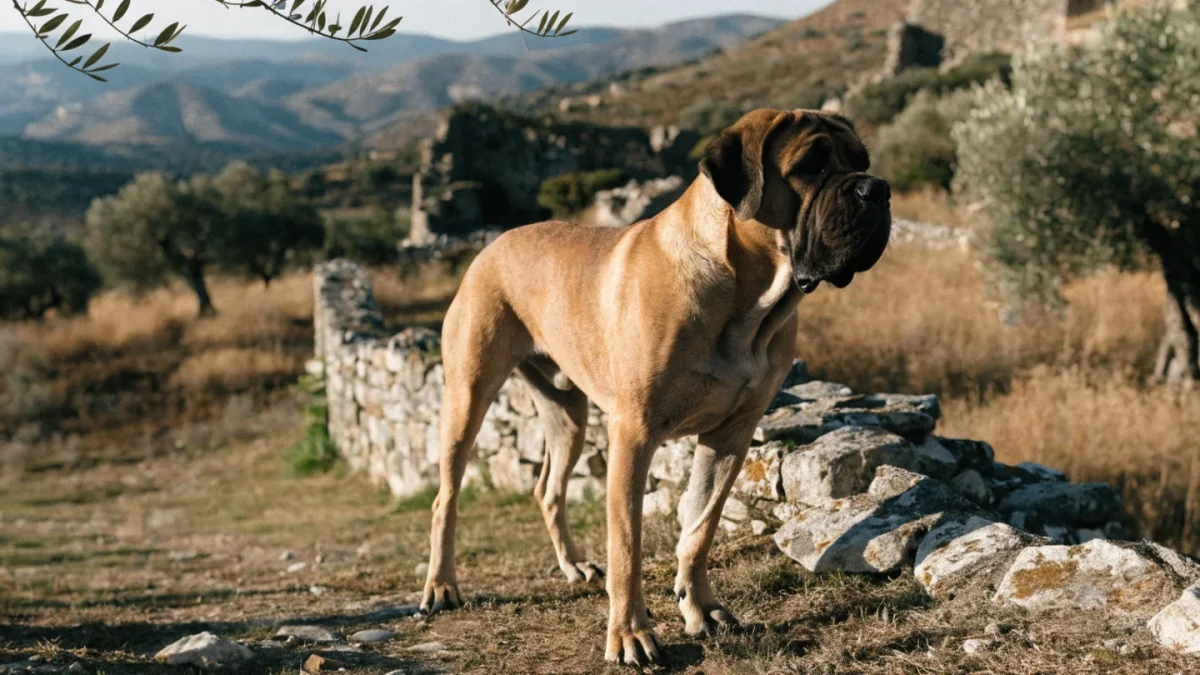
When Alexander the Great marched his armies through Persia in 331 BC, his forces traveled with war dogs that contemporary accounts describe as massive, broad-headed, and fierce enough to confront lions. Those dogs were almost certainly Molossers — the same broad type that the Molossi people of Epirus in northwestern Greece had been breeding for centuries as livestock guardians and war dogs. The Roman Empire later adopted these dogs for arena combat, military operations, and estate guarding, spreading the type across every territory Rome controlled. Nearly every modern mastiff-type breed traces its lineage, directly or through crosses, to that ancient Molosser foundation.
The Molosser family is the oldest continuously bred guardian dog lineage in the Western world. Unlike Spitz breeds, which are defined by geography and climate adaptation, Molossers are defined by function: they were bred to be intimidating, physically powerful, and unflinchingly protective.
The Molosser Body Plan
Molosser breeds share a physical template that reflects their guardian heritage:
Massive head with broad skull. The wide cranium and powerful jaw structure are the family's most recognizable features. This head shape provides the bite force that was essential for confronting predators or adversaries — and it's the feature that most clearly distinguishes Molossers from other large breed families.
Heavy, muscular build. Molossers are built for power rather than speed. Thick bone, substantial muscle mass, and a broad chest create a physical presence that serves the guardian function even without aggression — the dog's appearance alone is a deterrent.
Loose skin and dewlap. Many Molosser breeds carry excess skin, particularly around the neck and face. This served a practical function in combat with predators: loose skin is harder for an attacker to grip effectively, and bites to loose skin cause less damage to underlying tissue than bites to tight skin.
Short to medium coat. Most Molossers have relatively short, dense coats — practical for dogs that work outdoors in temperate climates but don't need the extreme insulation of northern breeds.
The Family Tree
The Molosser family branches across continents, with each regional line adapted to local conditions and functions:
European mastiffs — English Mastiff, Neapolitan Mastiff, Spanish Mastiff — represent the closest living relatives of the original Mediterranean guardian dogs, with English Mastiff males regularly exceeding 90 kg.
Bulldogs and bull-type breeds — English Bulldog, Bullmastiff, Dogue de Bordeaux — descend from Molosser stock developed for bull-baiting and later refined into companion or guarding roles.
Mountain guardians — Saint Bernard, Bernese Mountain Dog, Greater Swiss Mountain Dog — are Molossers adapted to alpine environments for protecting livestock from predators.
Modern guardian breeds — Cane Corso, Rottweiler, Dogo Argentino, Boerboel — represent more recent refinements. The Cane Corso was resurrected from near-extinction in southern Italy during the 1970s.
The Guardian Temperament
Molosser temperament follows a consistent pattern shaped by millennia of selection for protective behavior:
Calm confidence. A well-bred Molosser projects steady, watchful calm — assessing situations before reacting. This makes them surprisingly easy to live with indoors despite their size.
Territorial awareness. Molossers instinctively know their territory boundaries and who belongs there. Extensive socialization is essential so the dog learns to accept welcome visitors.
Bond intensity. They form deep, devoted bonds with family while remaining reserved with strangers. This duality — family-devoted, stranger-cautious — is the Molosser personality in its purest form.
Health Considerations
Molosser breeds face health challenges that scale with their body size and physical conformation:
Shortened lifespan is universal across the larger Molosser breeds. English Mastiffs, Neapolitan Mastiffs, and Dogue de Bordeaux typically live 7 to 10 years. The Dogue de Bordeaux has one of the shortest median lifespans of any breed — often cited at approximately 5 to 8 years.
Joint disease — hip dysplasia, elbow dysplasia, cruciate ligament tears — is nearly universal in large Molossers. The combination of rapid growth, heavy body weight, and genetic predisposition creates cumulative joint stress.
Bloat (GDV) is a life-threatening risk in deep-chested Molosser breeds, particularly Mastiffs and Great Danes (often classified with Molossers despite also having sighthound ancestry).
Brachycephalic concerns affect the Bulldog branches of the family — English Bulldogs, French Bulldogs, and to a lesser degree Boxers and Dogue de Bordeaux.
The health profile of Molosser breeds is inseparable from their physical type. For an understanding of how these breeds fit within the formal classification system, most Molossers sit in the Working Group, with Bulldogs in Non-Sporting and some breeds varying by registry. A broader view across all breed groups provides context for where guardian breeds fit relative to other functional types.
Frequently Asked Questions
Are Molosser breeds aggressive?
Protective, not aggressive — there's a difference. A well-socialized Molosser is calm and non-reactive. Problems arise from poor socialization, deliberate aggression training, or inexperienced owners. Their size means behavioral problems carry higher stakes, which is why experience and socialization matter more with Molossers than with most breed families.
What's the difference between a Mastiff and a Molosser?
All Mastiffs are Molossers, but not all Molossers are Mastiffs. "Molosser" refers to the broader family of heavy, broad-headed guardian-type dogs. "Mastiff" typically refers to specific breeds within that family — English Mastiff, Neapolitan Mastiff, Tibetan Mastiff. Bulldogs, Rottweilers, and Cane Corsos are also Molossers but aren't typically called "Mastiffs," even though they share the family heritage. Think of "Molosser" as the family name and individual breed names as the given names.
Do Molosser breeds need a lot of exercise?
Less than most people expect. Many Molosser breeds — particularly the heavier mastiff types — are moderate-energy dogs that do well with two to three moderate daily walks and don't require the intense exercise that sporting or herding breeds demand. Their guardian heritage involves long periods of watchful rest punctuated by brief activity — a pattern that translates well to domestic life. That said, puppies and adolescents are more active, and breeds like the Cane Corso and Rottweiler have higher exercise requirements than the English Mastiff or Neapolitan Mastiff.