

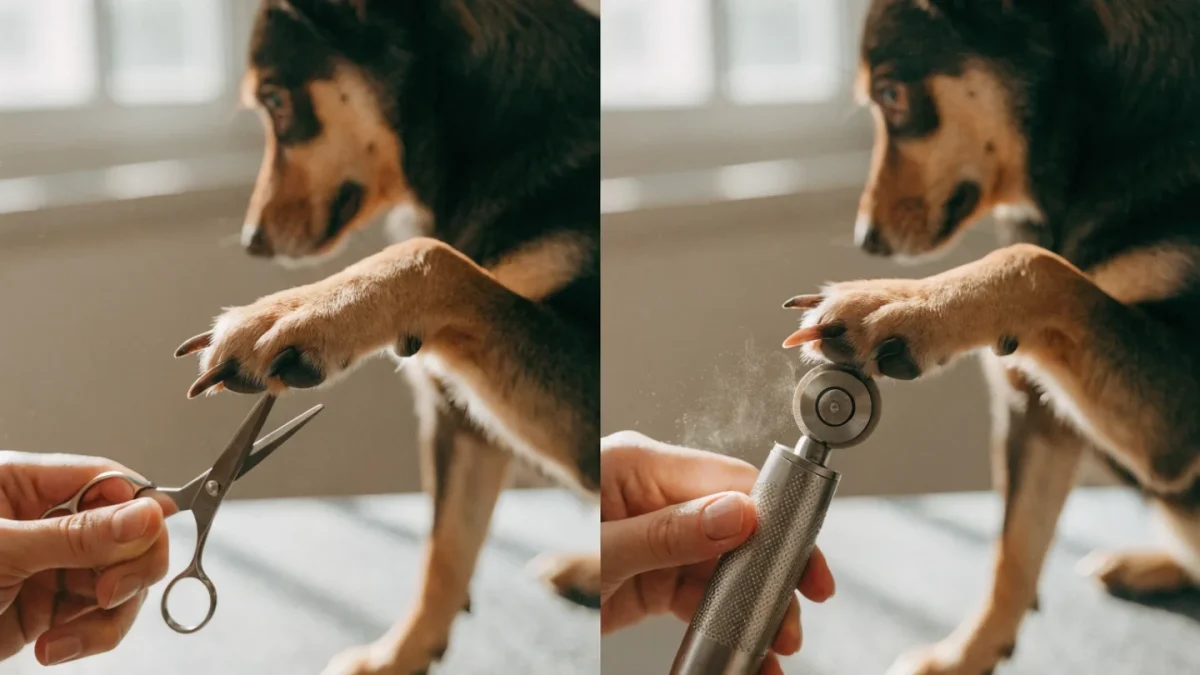
The nail grinder versus clipper debate is one of the genuinely contested questions in dog grooming — where both sides have legitimate arguments and the right answer actually depends on the specific dog in front of you. I've used both extensively, and I'll tell you upfront: I keep grinders and clippers in my kit and choose based on the individual. For the complete nail trimming process from start to finish, see the complete guide to trimming pet nails.
Here's the actual difference.
The Case for Clippers
Clippers are fast. A cooperative dog, sharp clippers, proper technique: all four paws in under five minutes. That speed matters — the less time spent on something a dog tolerates rather than enjoys, the better the overall experience.
They're quiet during the actual cutting moment (though the mechanical click of the spring and the snipping sound can startle dogs). No vibration. No heat. For dogs who are new to nail trimming, clippers may feel more natural and less alarming than a buzzing tool pressed against their nails.
Clippers work on soft or thin nails very cleanly — puppies, small dogs, cats, most adult dogs. They're the obvious choice for a first-time trimmer learning the process, because the cause-and-effect is direct: you squeeze, the nail is cut, you see the result.
The limitations: cutting angle creates a slight edge rather than a smooth finish, meaning the cut nail has a sharper tip that may scratch people and furniture until it naturally smooths over. For very thick nails — Rottweilers, Great Danes, large sporting dogs — even heavy-duty clippers sometimes require two cuts and more effort than a grinder. And dull clippers are actively bad: they crush the nail instead of cutting it, which cracks the nail, compresses the quick, and is genuinely painful.
The Case for Grinders
Grinders (whether dedicated pet nail grinders or standard Dremel-style rotary tools with a sanding attachment) sand the nail down gradually rather than removing material all at once. This gives you substantially more control.
For dark nails specifically — where the quick is invisible until you're right at it — that control is the key advantage. You can remove a fraction of a millimeter at a time, check the surface texture and color change that signals you're approaching the quick, and stop well before any discomfort. Compare that to clippers, where each cut removes several millimeters and misjudging by one snip means a cut quick.
Grinders also produce a naturally smooth, rounded finish. No sharp edges, no microscopic cracks in the nail surface. For large or giant breeds with thick nails, the grinding action is more effective than clippers — you're not asking the tool to shear through dense keratin, you're slowly removing it.
The limitations are real though. Time. A full grind of all four paws takes three to four times as long as clipping. For a dog that merely tolerates nail trims, longer is worse, not better.
Noise and vibration. This is the biggest issue. The buzzing sound of a grinder is alarming to many dogs. The vibration sensation on the nail travels into the paw. Dogs who have been habituated to grinders from puppyhood often accept it easily — but introducing a grinder to an adult dog that's never seen one takes significant desensitization work, more than introducing clippers.
Heat buildup. Grinding generates friction heat in the nail. Grinding too long in one spot without pausing — even for just three to four seconds — creates a burning sensation the dog will respond to unhappily. The technique requires regular pauses to let the nail cool.
Nail dust. The grinding process produces fine nail powder. Not hazardous but not pleasant, and requires cleanup.
Choosing for Specific Dogs
New puppy, first-time owner: Start with clippers. Simple, fast, establishes the routine. Transition to grinders later if it seems beneficial.
Dog with black nails and an owner nervous about the quick: The grinder is your friend. The visual feedback from the cut surface change is clearer and you have more margin for error.
Large breed with very thick nails: Grinder wins. Heavy-duty clippers work but require real effort; a grinder handles dense nail comfortably.
Anxious or sensitive dog: Depends on the specific anxiety. If the dog is scared of noise and vibration, clippers are less alarming. If the dog has had painful clipper experiences (cut quicks), a grinder with its incremental control may actually be better once the sound is habituated.
Dog with nail-splitting problem: Grinder. Clippers can sometimes catch a splitting nail and worsen the tear; grinding avoids the shearing force entirely.
Cats: Clippers, essentially always. The fine control needed for thin cat nails, combined with how little nail actually needs to be removed, makes clippers the right tool. The noise and vibration of grinders is particularly alarming to cats.
Technique for Clippers
Position the clipper perpendicular to the nail — straight across. Cutting at a severe downward angle toward the quick reduces your safety margin.
Squeeze in a single confident motion. A slow, progressive squeeze is harder on the nail than a decisive cut.
For dark nails: make small cuts, 1–2mm at a time. After each cut, examine the cut surface. The nail's center will show a chalky white interior when you're in safe territory; a small darker circle or oval appearing in the center signals you're within a millimeter of the quick. Stop.
Technique for Grinders
Safety first: Keep the dog's fur away from the spinning drum. Long-coated dogs need loose hair secured before grinding — the drum catches fur and wraps it painfully. This is a genuine risk and the reason some groomers are cautious with grinders on long-coated breeds.
Grit choice: Most pet nail grinders come with medium-grit drums. This is appropriate for regular maintenance. Coarser drums remove material faster but give less control. Fine grit is for smoothing final edges.
Movement: Keep the grinder moving across the nail surface — don't hold it stationary on one spot. Three to four seconds maximum on any one point before moving. This prevents heat buildup.
Approach angle: Hold the grinder so the sanding drum contacts the front or top of the nail, working toward the tip. Avoid holding it at an angle that points the drum into the paw pad.
Pauses: After each nail, let the tool rest off the paw for five seconds before moving to the next. Dogs can feel heat accumulation even when you can't see it.
Combination Approach
Many professional groomers use both: clippers to remove the bulk of excess nail quickly, then a grinder to smooth the edges and refine the final length. This gets the speed advantage of clipping with the smooth finish advantage of grinding.
For owners doing home grooming: this is a legitimate approach for dogs comfortable with both tools, but it extends session time. Worth considering once both tools feel familiar.
Frequently Asked Questions
My dog is terrified of the grinder sound. Is there any way to habituate him?
Yes, but it takes time. Start with the grinder turned on in another room while you feed treats. Move it progressively closer over several sessions. Touch the running grinder to a fingernail near the dog before touching the dog's nail. This desensitization process takes two to four weeks of daily sessions before most dogs accept it comfortably.
Can I use a regular hardware-store Dremel?
Yes — with a sanding drum attachment designed for pet nails. The variable speed feature on most Dremels is helpful; use the lowest effective speed to minimize vibration and heat.
My dog's nails are extremely hard. Clippers keep cracking them. What should I do?
Grinder, or soaking the paws in warm water for five to ten minutes before clipping to soften the nail. Hard nails that crack during clipping often indicate dull clippers as much as nail density — check your blade sharpness first.
How do I know when nails are short enough after grinding?
The same benchmark as clipping: standing on a flat surface, no contact between nail and floor. The smooth, rounded tip a grinder leaves makes the final length slightly harder to judge than the flat cut surface of clippers — check by feel (run a finger across the tip) and by the flat-surface test.