

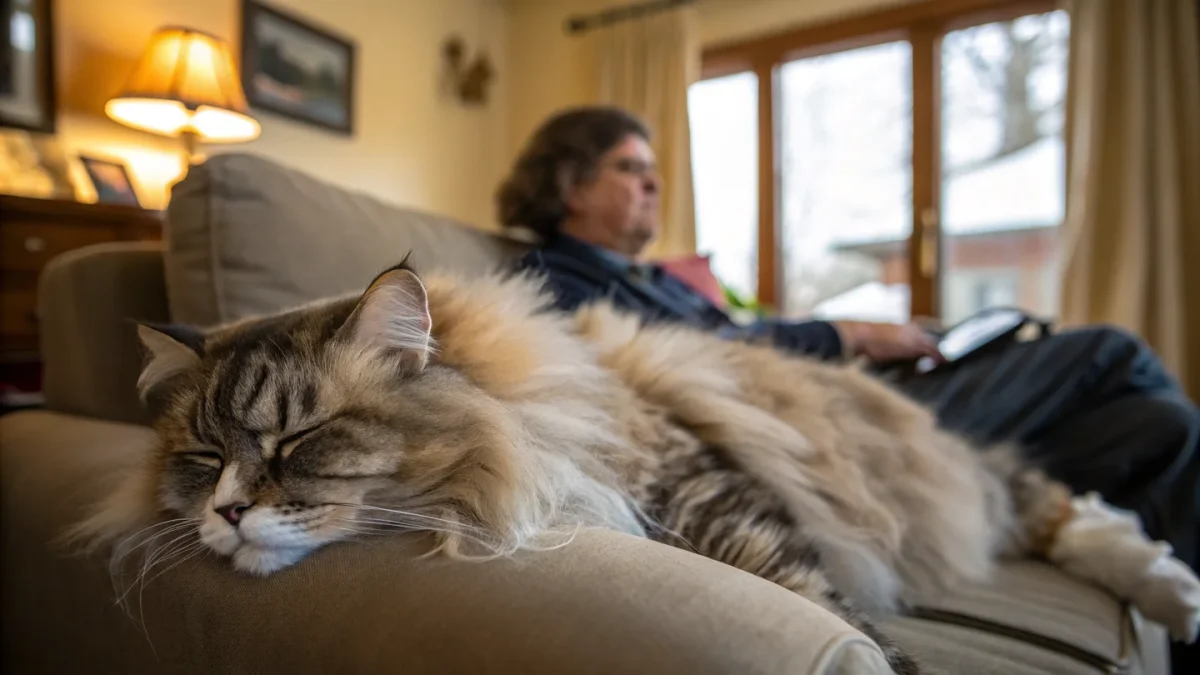
The comparison that circulates most often about Ragamuffins is to a ragdoll — lowercase, the toy, not the breed. Pick one up and the analogy becomes immediately obvious: the cat yields completely to your grip, limbs relaxed, body conforming to your hold with a total absence of resistance. The sensation is remarkable enough that people who've owned other cats for years will describe it as surprising.
But "floppy lap cat" is a reductive description of a temperament that has more texture than that. The Ragamuffin's docility is one of several characteristics, not the sum total of the breed. For background on the breed's origins and how the temperament was developed, the Ragamuffin breed guide covers the full context.
The Foundation of the Breed's Disposition
The Ragamuffin's temperament isn't accidental. The breed descends from cats selected over generations for relaxed stress responses to human handling — the same foundation as the Ragdoll's closely related temperament, then extended through outcrossing that introduced additional temperament influences from Persians and Himalayans.
Both the Persian and the Himalayan are calm, people-oriented breeds. Combining those influences with Ragdoll genetics produced a cat whose entire behavioral profile is oriented toward comfort with and affection for humans. This isn't training, socialization, or individual variation — it's breed-level selection that has been reinforced consistently enough to produce reliable results.
The Floppy Response: What's Actually Happening
When a Ragamuffin goes limp in your arms, it's displaying an extremely relaxed autonomic response — the cat's nervous system isn't triggered into alert or defensive posture by being held and restrained. This is the opposite of what most prey animals (and most cats) experience when suddenly lifted.
It means the cat doesn't perceive being held as a threat. But "doesn't perceive as threat" and "enjoys indefinitely" aren't identical. Ragamuffins will signal when they've had enough — typically a shift of weight, a slight stiffening, or a quiet turn of the head toward an exit. The floppy response means the beginning of being held is relaxed; the end is still up to the cat.
Understanding this prevents a common mistake: assuming that because a Ragamuffin tolerates handling, it wants unlimited handling. These cats prefer company and closeness, but they still communicate preferences. Respecting those cues keeps the relationship genuinely comfortable for both parties.
How Ragamuffins Show Affection
The Ragamuffin's affection is active rather than passive. These cats pursue proximity — they follow family members, position themselves in whatever room is occupied, and orient toward human activity with clear interest. It's not just that they tolerate being picked up; they often seek to be picked up.
Physical contact is a primary language: headbutts, slow blinks, settling into laps with obvious deliberateness. Many Ragamuffin owners describe the breed as seeking a level of closeness that feels more mutual than typical cat ownership — less "my cat is near me" and more "my cat wants to be with me."
They greet people at the door, including visitors, with a friendly curiosity that owners of more reserved breeds find disarming. The Ragamuffin's social accessibility makes it one of the better cat options for households that receive guests regularly.
With Children
The combination of large size, tolerance for handling, and non-reactive temperament makes the Ragamuffin genuinely appropriate for households with children — with the usual caveats about very young children who haven't yet learned how to interact with animals.
Ragamuffins rarely scratch or bite in response to annoying handling in the way more reactive breeds might. This doesn't make them bottomless wells of patience — it means their threshold for objecting is higher, and their objection when it comes is usually withdrawal rather than aggression. Supervising young children around any cat remains good practice; the Ragamuffin simply requires less anxious management than most.
Older children who've been taught appropriate handling find Ragamuffins excellent companions. The breed's willingness to engage in gentle play, sit still for dress-up (within limits), and be carried around suits children who want a genuinely interactive animal.
Energy Level and Play
Adult Ragamuffins are moderate-energy cats. They play enthusiastically when invited and tire appropriately; they don't require the constant interactive stimulation that high-drive breeds need. After a play session, a Ragamuffin is genuinely content to settle.
The kitten and adolescent phase is a different matter. Ragamuffin kittens up to two years old are noticeably more active — curious, playful, occasionally mischievous. Owners expecting an immediately placid companion from kitten age sometimes find the early months require more cat-proofing and engagement than they anticipated.
The docility of the adult breed develops gradually. By three to four years old — when the Ragamuffin has reached physical and behavioral maturity — the famous laid-back personality is fully established.
Vocalization and Communication
Ragamuffins have soft, quiet voices that they use selectively. They're not demanding or relentless in the way Siamese can be — there's no cat equivalent of "yelling for attention" in the Ragamuffin behavioral toolkit.
When they want something — food, attention, the door opened — they'll typically position themselves near the relevant source and wait. If waiting doesn't work, the request becomes slightly more insistent, but through physical closeness rather than noise.
This makes Ragamuffins well-suited to apartment living and households where noise is a concern. They participate in household life without narrating it.
With Other Pets
The Ragamuffin's even temperament extends to other animals. They are not territorial and rarely initiate conflict. Introductions to other cats typically go smoothly, especially if the other cat is also non-aggressive or similarly mellow.
With dogs, the usual rules of slow introduction and reading both animals' responses apply. A Ragamuffin paired with a gentle, low-prey-drive dog usually adapts well. A dog that treats cats as targets for high-energy chasing is a different situation — not because the Ragamuffin becomes aggressive, but because sustained stress is bad for any cat.
What the Temperament Requires from Owners
The Ragamuffin's affectionate temperament isn't self-sustaining in isolation. These cats are social animals that need human interaction as a genuine need, not a nice-to-have. A Ragamuffin in an empty apartment for ten or twelve hours a day, every day, is not thriving — it's managing, and managing wears on them over time.
The practical implication: if your lifestyle involves frequent extended absences, a second companion cat (ideally another calm breed) significantly improves a Ragamuffin's quality of life. Two Ragamuffins together are a particularly contented pair.
The breed's gentleness also means it doesn't compete well with aggressive cats in multi-cat households. If you have an existing resident cat with dominant or bully tendencies, introducing a Ragamuffin requires careful management.
For the owner who can provide consistent presence, regular interaction, and a calm household — the Ragamuffin gives back more than most breeds. The relationship has a particular quality: not a cat that happens to live with you, but a cat that has decided your company is the best thing available, and acts accordingly.