

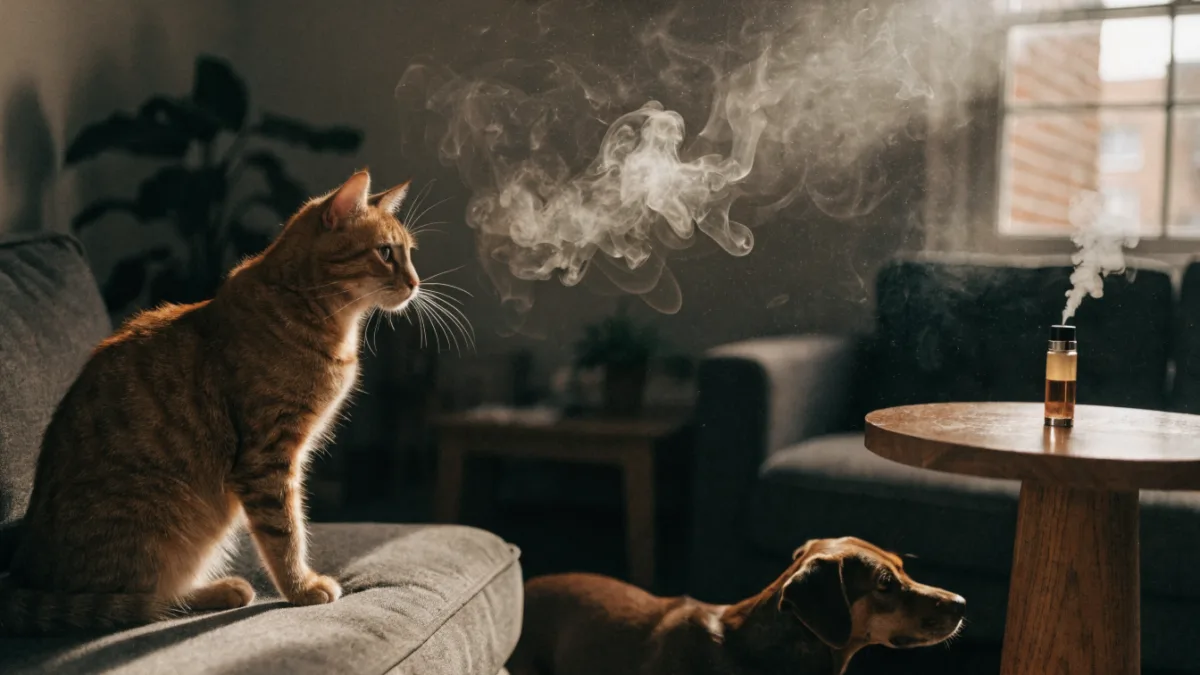
When Marigold, a seven-year-old Siamese cat, started coughing last spring, her owner Lisa thought it was a hairball. But the coughing didn’t stop. By the time Lisa brought Marigold into my clinic, the cat was wheezing with every breath, her sides heaving from the effort. I diagnosed her with feline asthma — a chronic inflammatory condition where the airways narrow and make breathing difficult. Lisa was devastated and confused. “But she’s an indoor cat,” she kept saying. “She’s never been around anything dangerous.” Then she mentioned, almost as an afterthought, that she and her partner vaped in the living room every evening. That was the missing piece.
I see variations of Marigold’s story play out more often than most people would guess. Pets are breathing the same air we breathe, and when that air carries tobacco smoke or e-cigarette aerosol, their bodies absorb it. Sometimes they show the effects long before the humans in the household notice anything wrong.
The Canary in Your Living Room
Researchers use the term sentinel species to describe animals that act as early warning systems for environmental hazards. Dogs and cats fit this description almost perfectly when it comes to household air quality. They have smaller bodies than we do, they spend more time close to the ground where heavier pollutants settle, and they generally spend more total hours indoors than their owners.
What surprises many of my clients is that their pets actually accumulate measurable levels of nicotine metabolites — the chemical leftovers your body produces when it breaks down nicotine — from secondhand exposure. A [1] confirmed that both dogs and cats living with smokers absorb and process significant amounts of these compounds. Their livers and kidneys work overtime to clear these toxins, and over time, that takes a toll.
The concept is simple but powerful: if the air in your home is polluted enough to sicken your pet, it’s probably affecting you too. Your dog or cat may simply be the first to show symptoms.
How Dogs Process Smoke Differently
Dogs aren’t tiny humans when it comes to smoke exposure. Their nasal anatomy plays a huge role in how toxins enter their bodies, and this is where breed differences become medically significant.
The Long-Nose Problem
Long-nosed breeds — think Collies, Greyhounds, Dachshunds, and Borzois — have an extensive network of nasal turbinates. These are delicate, scroll-shaped bones inside the nose that warm and filter incoming air. They’re wonderful for a dog’s sense of smell, but they also act like a trap for airborne carcinogens. Smoke particles get caught in that long nasal passage rather than reaching the lungs.
This sounds protective, and in a way it is — long-nosed dogs have lower rates of lung cancer than short-nosed breeds. But there’s a trade-off. Because those carcinogenic particles linger in the nasal cavity, [2] than other breeds. Nasal cancer in dogs is aggressive and difficult to treat. I remember treating a nine-year-old Greyhound named Emerson whose owner had smoked indoors for years. By the time the nasal tumor was found, it had already invaded the surrounding bone.
Short-Nosed Breeds and Lung Risk
Short-nosed (brachycephalic) breeds like Pugs, Bulldogs, and Boston Terriers have the opposite problem. Their compressed nasal passages don’t filter air effectively, which means more smoke particles reach deep into the lungs. These breeds already struggle with breathing due to their anatomy — adding smoke exposure compounds the problem considerably.
Beyond cancer risk, I regularly see dogs from smoking households present with chronic eye infections, worsened allergies, and persistent coughing. The smoke irritates the mucous membranes lining their respiratory tract and eyes, creating inflammation that never fully resolves as long as the exposure continues.
Why Cats Are Even More Vulnerable
If dogs are the canary in the coal mine, cats are the canary with an extra burden. Their grooming behavior creates a unique pathway for toxin ingestion that dogs simply don’t share.
The Licking Problem
Cats groom themselves meticulously. When smoke particles settle on their fur — what researchers call thirdhand smoke residue — cats lick those particles off while cleaning themselves. This means they’re not just inhaling toxins; they’re eating them. Over months and years, this oral exposure dramatically increases a cat’s risk of oral cancer and lymphoma, a cancer of the lymphatic system.
I treated a twelve-year-old tabby named Pepper a few years ago whose owner smoked on the couch every evening with Pepper in her lap. Pepper developed a squamous cell carcinoma — an aggressive oral tumor — on the underside of her tongue. The connection between thirdhand smoke exposure through grooming and this specific cancer type has been documented in multiple veterinary studies.
Feline Asthma on the Rise
Feline asthma is an inflammatory airway disease where the small passageways in the lungs constrict, making it difficult to breathe. Affected cats cough, wheeze, and sometimes struggle to catch their breath. While asthma can have multiple triggers, secondhand smoke is one of the most significant and preventable environmental factors.
Cats are also more sensitive to airborne particulates in general because their respiratory systems are smaller and more reactive than those of dogs. A cat breathing in a smoke-filled room is, proportionally, inhaling a much larger dose of toxins per pound of body weight than a human in the same room.
The Vaping Myth
When e-cigarettes became popular, I noticed a shift in my practice. Clients who would never light up a cigarette indoors felt completely comfortable vaping next to their pets. “It’s just water vapor,” they’d tell me. “There’s no smoke, so it’s safe.”
I understand the logic. Vaping produces a visible cloud that looks harmless compared to cigarette smoke. But the truth is that what you’re exhaling is not water vapor at all. It’s an aerosol — a suspension of tiny liquid particles in gas — and those particles contain nicotine, propylene glycol, flavoring chemicals, and sometimes heavy metals.
The [1] and related research have pushed back hard against the “safe alternative” narrative. Their findings confirmed that dogs exposed to e-cigarette aerosols absorb nicotine metabolites at levels comparable to those exposed to traditional tobacco smoke. The delivery method has changed, but the chemical exposure hasn’t.
I’ll admit I initially thought vaping was probably less harmful to pets than traditional smoking. The early marketing was persuasive, and the absence of that acrid smoke smell made it feel safer. But the research that has emerged over the past several years changed my mind. Nicotine is nicotine, regardless of whether it arrives via combustion or aerosol.
Does Smoking Outside Actually Help?
Many pet owners do the right thing by stepping outside to smoke or vape. This is genuinely better than smoking indoors — it dramatically reduces the concentration of airborne particles your pet breathes. But it doesn’t eliminate exposure entirely.
Thirdhand smoke — the toxic residue that clings to your skin, hair, and clothing — follows you back inside. When your cat curls up in your lap or your dog nuzzles against your shirt, they’re coming into contact with those residual chemicals. For highly sensitive pets, especially cats with asthma or compromised immune systems, even this secondary exposure can trigger symptoms.
Washing your hands after smoking, changing into clean clothes before cuddling your pet, and smoking as far from the house as possible all help reduce the risk. It’s not a perfect solution, but it’s a meaningful improvement over indoor smoking.
The [3] has been instrumental in raising awareness about these connections. What I appreciate about this campaign is that it doesn’t shame pet owners — it simply provides clear, actionable information and encourages small changes that add up to meaningful protection.
If you smoke or vape, you don’t have to choose between your habit and your pet’s health. You just need to be thoughtful about how, where, and when you do it. Step outside. Wash your hands. Keep your vaping supplies sealed and out of reach — nicotine liquid is highly toxic if ingested directly, and curious pets have been poisoned by chewing on cartridges. And if your pet starts coughing, wheezing, or showing any respiratory changes, mention your household smoking situation to your veterinarian. That context matters more than you might realize.
Your pet shares your home, your furniture, and your air. Making that air as clean as possible isn’t just good medicine — it’s part of what it means to care for another living being who depends entirely on the choices you make.
Sources
- recent study published in PMC — pmc.ncbi.nlm.nih.gov
- long-nosed dogs develop nasal cancer at significantly higher rates — petmd.com
- American Lung Association's "Don't Puff Around Pets" campaign — lung.org