

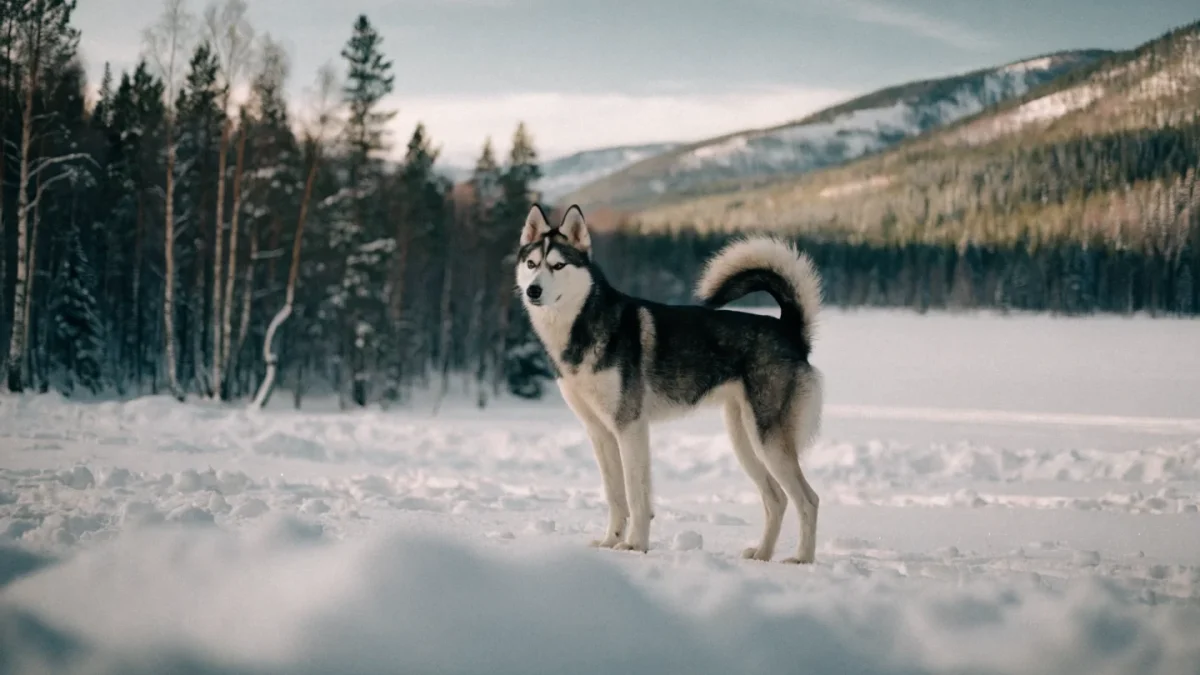
Most domestic dogs have had their ancient behaviors selected out of them. The herding breeds have it channeled into something useful; the retrievers have it redirected toward cooperation; the toy breeds have been buffered from it through generations of companion selection. The Spitz breeds largely kept theirs.
The howl instead of a bark. The independence that looks like stubbornness but is actually a dog that learned to make decisions without waiting for human confirmation — because on Arctic sea ice, waiting for the musher to tell you the ice is safe could kill the whole team. The self-reliance that makes recall training an ongoing negotiation. The prey drive that stays live even in dogs that have been family pets for three generations. These aren't training failures. They're what selective pressure looks like when thousands of years of functional work leave deeper marks than a few decades of suburban living.
Spitz breeds are not a formal kennel club group — you'll find Huskies in the Working Group, Shiba Inus in Non-Sporting, Finnish Spitz in the Sporting Group depending on which registry you consult. But they are a biological family, connected by genetic heritage, physical architecture, and behavioral tendencies that predate any human classification system. Understanding what they share explains a lot about why they behave the way they do.
Defining the Spitz Type
Spitz breeds share a constellation of physical features that are immediately recognizable:
Erect, triangular ears — standing upright, often small relative to head size, sometimes heavily furred. These ears are efficient in cold environments, minimizing heat loss compared to floppy ears.
Dense double coat — a thick, insulating undercoat beneath a harsher guard coat. This combination provides remarkable cold tolerance. Samoyed coats are so effective that indigenous Nenets people historically spun shed Samoyed fur into yarn for knitting.
Curled or sickle tail — carried up and over the back, often resting against the flank. The tail wraps around the nose during sleep, providing insulation for the face in extreme cold. This is not a decorative trait — it's a survival adaptation.
Wedge-shaped head — a proportionate skull with a defined but not extreme stop, creating the characteristic "foxy" or "wolfish" facial profile.
Compact, balanced build — designed for efficiency in movement across snow or rough terrain, with well-padded feet that function like snowshoes.
The Northern Origins
Spitz breeds emerged across the Northern Hemisphere — from Scandinavia and Russia to Japan, China, and the Arctic regions of North America. Their original functions varied by region:
Arctic sled and freight dogs — Siberian Huskies, Alaskan Malamutes, Samoyeds — were bred by indigenous peoples for hauling loads and transportation across frozen terrain. The Chukchi people of northeastern Siberia developed the Siberian Husky over thousands of years as a lightweight endurance sled dog. The Mahlemuit people of Alaska bred the Malamute for heavier freight work.
Hunting Spitz — the Finnish Spitz hunts grouse by barking at treed birds to distract them. The Norwegian Elkhound tracked moose across Scandinavian forests. The Karelian Bear Dog was bred to hunt large game including bears.
Herding and farm Spitz — the Icelandic Sheepdog, Swedish Vallhund, and Norwegian Buhund served as general-purpose farm dogs in Scandinavian agricultural communities.
Companion Spitz — the Pomeranian (miniaturized from larger sled Spitz) and Japanese Spitz were refined for companionship, though they retain many behavioral traits of their working ancestors.
Guardian Spitz — the Akita and Chow Chow served guard and protection roles in Japan and China respectively, producing dogs with more territorial and reserved temperaments than the typically sociable Arctic breeds.
Behavioral Threads
Despite enormous variation in size and specific function, Spitz breeds share behavioral patterns:
Independence. Spitz breeds think for themselves. A lead sled dog that blindly followed a handler's command to cross unsafe ice would kill the entire team. That autonomy manifests as selective obedience and a tendency to evaluate commands before deciding whether to comply.
Vocal communication. Huskies are famously vocal, producing howls, yodels, and conversational sounds. Samoyeds, Shiba Inus, and Malamutes all communicate vocally well beyond simple barking.
Prey drive. Most Spitz breeds retain significant prey drive. Huskies and Malamutes can be dangerous to small animals including cats.
Escape artistry and cold tolerance. Intelligence plus prey drive makes many Spitz breeds legendary escape artists. Their magnificent double coat provides cold comfort but also makes them vulnerable to overheating in warm climates.
Spitz breeds have exploded in popularity, but the gap between the Spitz aesthetic and reality fills shelters with surrendered Huskies and Malamutes. For those prepared for the independence and grooming commitment, these breeds offer a connection to an ancient partnership between humans and wolves. See the breed group guide for where Spitz breeds fall in the formal classification system.
Frequently Asked Questions
Are Spitz breeds good for first-time owners?
Generally, no. Most Spitz breeds require experienced handling due to their independent temperament, high prey drive, escape tendencies, and grooming demands. Exceptions exist at the smaller end: well-bred Pomeranians and Japanese Spitz can be manageable for dedicated first-time owners willing to commit to training and grooming. But Huskies, Malamutes, and Akitas are consistently among the breeds most commonly surrendered by first-time owners who underestimated the commitment.
Can you shave a Spitz breed's coat in summer?
No. Shaving a double-coated Spitz breed removes both the insulating undercoat and the protective guard coat. Contrary to popular belief, the double coat actually helps regulate temperature in heat as well as cold — the insulating layer works in both directions. Shaving also exposes the skin to sunburn and can cause permanent coat damage (the undercoat may grow back faster than the guard coat, resulting in a cottony, matted texture). Instead, keep the coat well-brushed, remove loose undercoat regularly, provide shade and water, and exercise during cooler parts of the day.
Why do Huskies talk instead of bark?
Huskies were bred in a social pack structure where nuanced vocal communication helped coordinate group behavior over long distances. Barking is an alarm signal — effective but limited in information. The howls, yodels, and conversational vocalizations Huskies produce carry more tonal variation and can communicate different messages over greater distances. Wolves use similar vocal ranges for pack coordination, and Huskies retain this ancestral communication style more than most domestic breeds.