

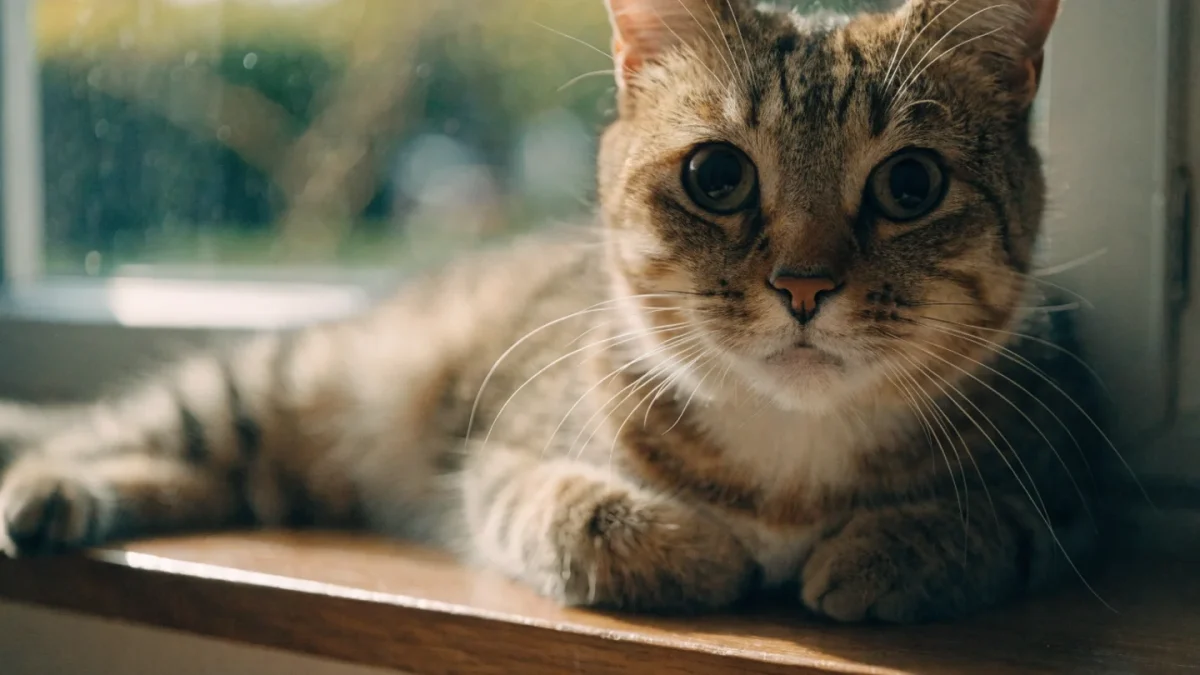
Here's what's actually going on when your cat stares at you across the room: they're talking. Not in a metaphorical "all animals communicate" way — in a very specific, readable way that tells you exactly what they're thinking, if you know what to look for.
Cat eye signals are one of the clearest windows into feline mood and intent. Understanding them is part of your cat's body language as a whole, but the eyes deserve their own deep dive because they shift so fast and carry so much meaning. My cat Mochi can go from "I love you" eyes to "I will ruin you" eyes in about two seconds, and honestly, once I learned to read the difference, our whole relationship changed.
Pupil Size: The Most Immediate Signal
Pupils are involuntary. Your cat isn't consciously choosing to dilate or contract them, which makes pupil size one of the most honest signals you'll ever get from a cat.
Fully dilated (large, round black pupils) can mean several different things — context is everything here. In low light, dilation is just physics. But in normal lighting, big round pupils usually signal one of three states: high arousal (excitement, playfulness, the zoomies incoming), fear, or overstimulation. If Mochi's pupils blow up while I'm petting her and her tail starts twitching, that's my cue to stop before the situation escalates.
Fully constricted (narrow vertical slit pupils) in bright light is normal. In dim or indoor lighting, tight slits typically mean your cat is calm, confident, and content. It can also signal focused aggression — a cat about to pounce or warning another animal. You'll know which one it is from the rest of the body: a relaxed cat with slits looks melted into the couch; an aggressive cat with slits looks tense, still, and deliberate.
Mid-dilation is the sweet spot. A cat with medium-sized, slightly oval pupils and a relaxed body is a comfortable, alert cat. This is your cat just existing happily in the world.
One thing worth knowing: pupil size can be affected by certain medical conditions and medications. If you notice persistent asymmetrical pupils (one much larger than the other) and it's not a lighting issue, that warrants a vet conversation.
The Slow Blink: Your Cat's "I Love You"
If you've ever caught your cat gazing at you and then slowly closing their eyes — not falling asleep, just a long, lazy blink — they're doing something meaningful. Slow blinks are widely understood by feline behavior researchers to be a cat's way of signaling trust and relaxation. Researchers at the University of Sussex found that cats are more likely to approach and slow-blink at humans who slow-blink at them first, suggesting this gesture is a genuine form of cross-species communication.
The thing I find genuinely charming about this is that it works both ways. If you slowly blink back at your cat, many cats will blink in return, or even approach you. It's the closest thing to a smile cats have, and it's not something they do when they're stressed, alert, or uncertain. You only get slow blinks from a cat who feels safe. What I cover in cat tail positions and what they mean maps onto this almost perfectly.
Honestly, this one small behavior shift — actually blinking back at my cats instead of just staring at them — made a noticeable difference in how quickly my more anxious cat, Figaro, would settle in a new environment.
The Unblinking Stare: Not What It Looks Like on Dogs
In humans and dogs, prolonged eye contact can signal affection or attentiveness. In cats, a hard, unblinking stare directed at another cat is a dominance display or a threat. It means: I'm watching you, and I'm not backing down.
This doesn't always mean aggression toward you. When your cat stares unblinking at you, it's more likely they're tracking you, trying to figure out what you're doing, or — with a very confident, bonded cat — just giving you a territorial acknowledgment. The body tells you which one: a cat who's relaxed and staring is curious; a cat who's stiff, low, and staring is communicating something more charged.
With other cats in the household, unblinking stares are a serious signal. If you see two of your cats locked in a hard stare, that standoff isn't friendly. The best thing you can do is interrupt it calmly — move between them or create a noise that breaks the visual contact — before it escalates.
Half-Closed Eyes and the "Almost Asleep" Look
A cat with heavy, drooping eyelids and a soft, unfocused gaze is about as relaxed as a cat can get. This is the feline equivalent of sighing contentedly. They're not actually tired — or they might be, but that expression during waking hours is pure comfort. You'll usually see this paired with slow, even breathing and a loose, sprawled or tucked body.
The real question with half-closed eyes is whether you're seeing comfort or glazed-over overstimulation. The difference: a comfortable cat with droopy eyes is still responsive and soft. An overstimulated cat (often mid-petting) has eyes that look slightly glazed, the body gets stiff, and the tail usually starts its warning flick. Same eyes, completely different message — which is why I always say you can't read just the eyes in isolation.
Wide Eyes, Whiskers Forward: High Alert
Fully open, wide eyes with whiskers pushed forward and ears upright means your cat has spotted something interesting. This is the "what was that" face — that snap of attention when a sound or movement registers. It's neither fearful nor aggressive by default; it's pure focus.
If the ears go sideways or back from this position, the vibe shifts to threat assessment or defensiveness. If the ears stay forward and the cat's whole body orients toward whatever they saw, it's curiosity or predatory interest. Watch where the paws go: a cat who crouches and goes low is in hunting mode; a cat who stands tall and moves toward the object is just investigating.
Eyes in the Context of the Whole Face
One thing that takes a while to learn is that individual eye signals don't exist in isolation. A slow blink from a cat who's also growling is not relaxed; something is off and they're conflicted. Dilated pupils from a cat who's playing look completely different from dilated pupils on a cat who's cornered.
The whiskers, ears, and overall posture always go together with the eyes. Over time, you start reading the whole package at once — it becomes the same kind of fast, instinctive reading you do with human facial expressions. But in the beginning, it helps to check each piece consciously until the pattern clicks.
Mochi once sat on my lap with a slow blink face AND subtly flattened ears. Looked like relaxation, felt like a warning. Sure enough, the neighboring dog had walked past the window. Eyes said chill, ears said don't push it. I put her down and gave her space. No drama.
Frequently Asked Questions
Why do my cat's pupils get huge when we're playing?
During play, cats shift into a predatory arousal state — the same one they'd use hunting. Dilated pupils help maximize light intake and improve motion detection, which is useful when tracking a toy or prey. It's completely normal and it means they're genuinely engaged, not just tolerating the feather wand.
Is it okay to stare back at my cat?
Soft eye contact with slow blinking is fine and actually positive — it's how cats signal trust to each other and to you. Hard, unblinking stares are more confrontational in cat communication, so if your cat looks tense, break eye contact first. With a relaxed, bonded cat, brief eye contact won't be an issue.
What does it mean when my cat's pupils are two different sizes?
Anisocoria (unequal pupils) not explained by different lighting conditions on each eye should be mentioned to your vet. It can sometimes be associated with certain neurological or eye health issues, including Horner's syndrome, oculomotor nerve dysfunction, or uveitis. Note that this is beyond lifestyle advice — it's a health observation, so professional input matters.
Why does my cat stare at me while I sleep?
Cats are crepuscular and often more active when you're winding down. A cat watching you sleep is most likely guarding you (a bonded cat behavior) or waiting to see if you're about to get up and do something interesting, like feed them. Unblinking stares at sleeping humans are rarely hostile — they're usually monitoring.
Can cats tell what I'm feeling from my eyes?
There's emerging research suggesting cats read human facial expressions to some degree, including eye region cues, and that they respond differently to owners who look happy versus distressed. A couple of actual studies back this up: researchers at Oakland University found cats respond differently to happy versus angry facial and postural cues from their owners, spending more time in contact when owners appeared happy, and a University of Bari study found cats can cross-modally recognize human emotional expressions at all. Neither found a huge effect — cats are subtler about this than dogs — but the signal is there. Anecdotally — ask anyone with a cat who seems to appear specifically when you cry — the connection feels very real.