

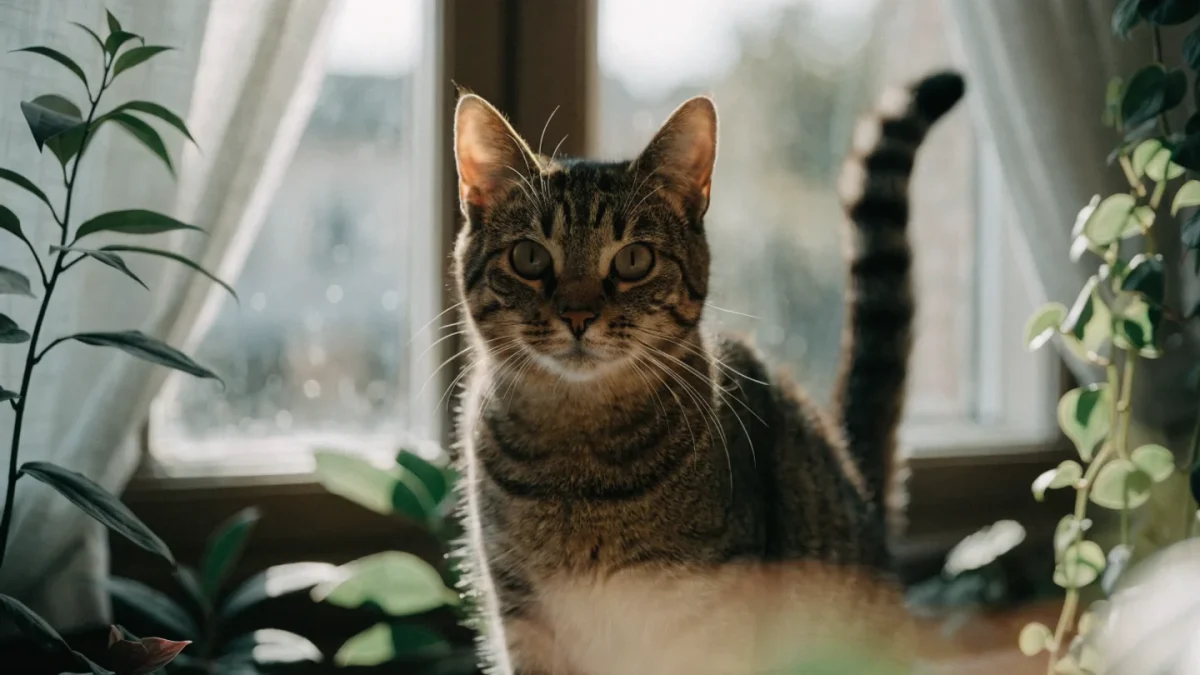
Here's what's actually going on when your cat walks in, tail held high like a little flag: they're telling you something. Cats can't talk, obviously, but they are constantly communicating — and the tail is one of the loudest channels they have.
A cat's tail position, speed of movement, and whether the fur is smooth or puffed up all carry specific meaning. Once you know the vocabulary, reading your cat gets a lot easier. If you want the full picture, the complete guide to reading your cat's body language covers ears, eyes, and posture too — but the tail alone will take you surprisingly far.
My own cat, Mochi, spent the first six months of her life giving me signals I completely misread. Turns out a lot of what I thought was attitude was actually anxiety. Knowing the difference changed how I responded to her, and our relationship shifted noticeably.
The Upright Tail: Confidence and Friendliness
When a cat approaches with their tail pointing straight up — or even with a little curl at the very tip — that's a good sign. This is the feline equivalent of a cheerful wave. It typically means:
- They feel safe and comfortable in their environment
- They're in a social mood and open to interaction
- They trust you enough to approach without wariness
Kittens do this automatically when greeting their mothers. Adult cats carry the same behavior forward with humans and other cats they like. If Mochi walks into the room and her tail goes up when she spots me, I take it as a genuine compliment.
The little hook or curl at the tip adds a note of excitement or playfulness. Think of it as a question mark at the end of a sentence — they're happy to see you, and maybe a little curious about what you're doing.
The Low or Tucked Tail: Fear and Submission
A tail tucked down between the legs — or held very low and rigid against the belly — is a sign of anxiety, fear, or submission. This is the opposite end of the emotional spectrum from the upright greeting tail.
Cats in a new environment often walk with a low tail for the first few days. It doesn't mean something is wrong with them; it means they haven't yet decided whether this place is safe. That's a reasonable position to take, honestly.
If your cat suddenly starts carrying their tail low around the house when they didn't before, that's worth paying attention to. Something in their environment has shifted and made them feel less secure. Common triggers include a new pet, rearranged furniture, a stranger in the house, or a change in routine they didn't ask for.
The Puffed-Up Tail: Fear, Threat, or Aggression
A puffed-up tail — where all the fur stands on end, making the tail look two or three times its normal size — is the cat version of looking bigger than you are. It's a defensive response.
The puffed tail almost always comes with other signals: arched back, fur raised along the spine, ears flattened or turned sideways, and a body posture turned slightly sideways to maximize apparent size. When you see this combination, your cat is either scared and trying to warn something off, or they've decided a confrontation might be coming and they're getting ready. If you're noticing a pattern here, eyes are telling you reinforces it from another angle.
The real question here is: what triggered it? A puffed tail in response to seeing another cat through the window is different from a puffed tail directed at you or another pet in the household. Context is everything. If this happens regularly inside your home, that's stress you probably want to address.
The Slowly Swaying or Lashing Tail: Focus, Frustration, or Aggression
This one trips people up the most, because dogs wag their tails when they're happy — and cats absolutely do not follow the same rules.
A slow, deliberate swaying tail while your cat watches something (a bird outside, a toy, another animal) usually signals deep focus. They're locked in. This is hunting mode, and the tail movement is involuntary, a byproduct of concentration.
But when the tail starts lashing — rapid, wide, forceful side-to-side movement — that's a different message. Lashing almost always signals frustration, irritation, or escalating aggression. If you're petting your cat and their tail starts going from a slow wave to an active lash, take your hand away. They've been politely telling you to stop, and a scratch or bite is the next step.
Mochi does a mid-speed tail flick when she's deciding whether she wants attention. It's neither slow nor fast — sort of a contemplative movement. I've learned to wait and see rather than reach for her in that moment.
The Wrapped or Tucked Tail While Sitting: Contentment or Chill
A cat sitting quietly with their tail wrapped neatly around their paws is usually a cat at rest. It's a neutral, calm position that signals they're comfortable and not particularly engaged with anything.
If the tail is tucked tightly to the body while they're sitting (versus just wrapped), and especially if combined with a hunched posture, that can lean toward discomfort or mild stress. But a relaxed cat with paws tucked under their body (the "loaf" position) and tail draped alongside? That's a content cat.
The Quivering Tail: Excitement and Intense Affection
Sometimes you'll see a cat hold their tail upright and let it vibrate rapidly — a sort of quiver or trembling at the very tip or along the whole length. This is usually an expression of intense excitement or greeting.
Cats sometimes do this when they're about to spray-mark a surface, which is worth knowing. But in a neutered cat who doesn't spray, a quivering tail aimed at you when they walk up is generally a very enthusiastic hello. Mochi does this when I come home after being out all day. I'll take it.
The Tail Twined Around You: Bonding
When a cat wraps their tail around your leg, your arm, or another cat, that's affection. It's the cat equivalent of a hug — relaxed, deliberate, and something they only do with individuals they trust.
You'll see this most often between bonded cats who sleep together, or between a cat and a person they've decided is truly their person. It's a quiet signal, easy to miss if you're not looking for it, but one of the nicer ones to notice.
Reading the Tail as Part of the Whole Picture
No single signal tells the whole story. A tail position always makes more sense when you factor in the ears, eyes, posture, and context. A cat with an upright tail but flattened ears is giving you mixed signals that need decoding together.
That said, the tail is often the most visible and immediate indicator of how your cat is feeling in any given moment. Once you start paying attention to it, you'll find yourself reading them faster and more accurately than you expected. Cats aren't cryptic — they're just using a language most people haven't learned yet.
Frequently Asked Questions
Why does my cat's tail puff up around other cats but not around me?
A cat that puffs up around other cats but stays relaxed with you has simply decided that the other cat poses a potential threat while you don't. It's a compliment to you, and a sign that the cats still need more time and space to get comfortable around each other. Puffing is a defensive response — it means the perceived threat is the other animal, not you.
What does it mean when a cat holds their tail to the side?
A tail held low and angled slightly to the side can signal mild discomfort, wariness, or appeasement. It often appears during interactions where a cat is unsure whether the situation is friendly or not — such as approaching a new person or another animal they're not sure about yet. It's different from the full-tuck, which signals fear, but it's worth reading alongside the rest of their body language.
Is a wagging cat tail the same as a wagging dog tail?
No — and this confusion causes a lot of scratches. A dog wags their tail when excited and happy. A cat that lashes their tail rapidly is typically irritated, frustrated, or escalating toward aggression. A slow, methodical wave can mean focused concentration rather than contentment. When in doubt, give a lashing-tailed cat some space.
Can a cat's tail position change quickly?
Yes, and this is worth knowing. A cat can go from relaxed to alert to defensive in seconds if something startles them or shifts the situation. The tail usually tracks their emotional state almost in real time. Watching the tail give you a running update on how your cat is processing what's happening around them.
My cat's tail is always low — should I be worried?
A consistently low tail in a cat that never shows confidence signals is worth discussing with a vet to rule out any physical discomfort — researchers and clinicians have documented that pain can alter a cat's posture and tail carriage, according to expert consensus published in peer-reviewed veterinary literature (including a 2015 study in PLOS ONE on behavioural signs of pain in cats). If the vet gives them a clean bill of health, the low tail likely reflects a more anxious temperament. Some cats are simply more cautious than others, and creating a calm, predictable environment goes a long way.