

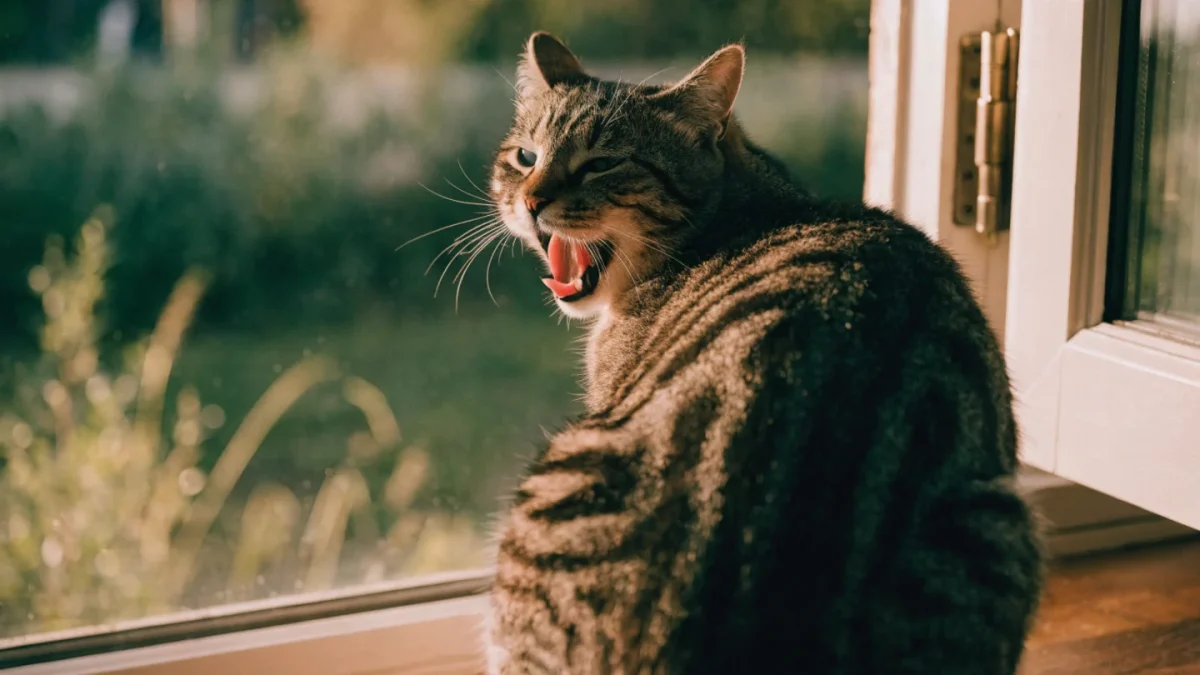
Here's what's actually going on when your cat won't stop meowing: they're trying to tell you something, and the communication is a lot more specific than it sounds. I break down cat vocalizations explained separately, and it really helps this make sense.
Cats are one of the few animals that meow almost exclusively at humans. They don't really do it with each other as adults — it's a behavior they developed with us, which means when your cat is being relentlessly vocal, it's a deliberate choice to get your attention. Whether that's helpful or exhausting depends entirely on what they're trying to say.
Cat meowing excessively is almost always rooted in one of a handful of causes. Some are simple. Some need attention. And a few warrant an actual vet visit. Here's how to tell them apart.
Hunger (The Obvious One, But Also the Sneaky One)
Look, hunger is the most common driver of excessive meowing — and it's not just about empty bowls. Cats are opportunistic feeders who learned very quickly that meowing produces food. If your cat has ever cried at the bowl and you fed them, congratulations, you trained a behavior.
The pattern to watch for: meowing that intensifies around typical meal times, or a cat that follows you to the kitchen, makes eye contact, and yells. My cat Mochi does this roughly forty-five minutes before her scheduled dinner, every single day, with escalating drama.
If you free-feed (leave dry food out all day), this is rarely the issue. But if you're on a meal schedule and your cat is meowing between meals, they might genuinely be underfed — especially if they're young, active, or have recently lost weight. A conversation with your vet about portion size is worth having before you assume it's just manipulation. (Adult cats typically need around 45-50 calories per pound of body weight daily, according to the American Animal Hospital Association's nutritional guidelines.)
Solutions that actually work:
- Move to automatic feeders with set portion sizes and times. The machine becomes the "feeder," not you, which can actually reduce food-related meowing directed at you.
- If they're meowing before a scheduled meal, do not feed early. Feed on the clock. Every time you give in early, you move the "mealtime" earlier in your cat's mental model.
- Rule out medical causes if the hunger seems insatiable — hyperthyroidism in older cats is a common driver of sudden, voracious appetite. (It's one of the most frequently diagnosed endocrine disorders in cats over 10 years, affecting roughly 10% of senior cats according to the Cornell University College of Veterinary Medicine.)
Attention and Boredom
This one gets underestimated. Cats have a reputation for being solitary, but many of them — especially indoor-only cats — are genuinely understimulated. A cat who meows the moment you sit down to work, or who ramps up in the evenings when you're home, is often bored.
The real question here isn't "how do I get them to stop?" It's "am I giving them enough to do?" For a lot of cats, the answer is no.
Attention-seeking meowing usually has a conversational quality to it — the cat will meow, pause, meow again when you respond (even just by looking up), and keep the loop going. It's different from the flat, repetitive meowing of a cat in distress.
What actually helps:
- Two dedicated play sessions a day, even 10 minutes each, can significantly reduce attention-seeking meowing. Wand toys, laser pointers, anything that activates predator mode. The goal is to get them to a full "hunt–catch–kill–eat–groom–sleep" cycle.
- Environmental enrichment matters more than most people expect. A bird feeder outside a window, a tall cat tree by natural light, even a cardboard box — these things give cats something to think about that isn't you.
- Honestly, if you have a social cat who's alone all day, a second cat is sometimes the best solution. That's a big commitment, obviously, but the meowing improvement in multi-cat households where the cats genuinely get along can be dramatic.
Stress, Change, and Anxiety
Cats are creatures of pattern, and they do not love disruption. A new baby, a new pet, a move, a change in your schedule, even rearranging the furniture — all of these can trigger a period of increased vocalization. Purring actually mean? it's not always happiness is connected to this in ways that surprised me at first.
Stress meowing tends to look different from hunger or boredom meowing. It often sounds more urgent or plaintive. You might notice it paired with other stress signals: hiding, overgrooming, changes in litter box behavior, or reduced appetite.
If something changed in your household recently and your cat's meowing ramped up around the same time, that's almost certainly the connection.
The approach here is less about stopping the meowing and more about reducing the underlying stress. Give them access to a safe space that's theirs alone. Maintain feeding and playtime schedules as consistently as possible. If a new pet is involved, a slow, structured introduction — weeks, not days — makes a big difference.
Pheromone diffusers (the ones that mimic calming cat facial pheromones) get mixed reviews, but some cats do respond well to them. Worth trying before anything more involved. (Clinical studies published in the Journal of Veterinary Behavior show synthetic pheromones can reduce stress-related behaviors in some cats, though response varies considerably between individuals.)
Age-Related Changes
Older cats meow more, and there are two distinct reasons for it.
The first is cognitive: cats can develop a syndrome similar to dementia in humans, often showing up as disorientation, confusion, and nighttime vocalization. A senior cat who wanders the house meowing at 2 a.m. — particularly if they seem lost or don't respond normally to their name — may be experiencing cognitive decline. Your vet can help assess this and discuss management options.
The second is sensory: hearing loss is common in older cats. A deaf or hard-of-hearing cat often meows more loudly, simply because they can no longer self-regulate their volume. They can't hear themselves. It's not distress — they're just turned up to eleven.
Neither of these is something you can train away, and honestly, trying to punish or ignore the meowing of a cognitively impaired senior cat is pointless and unkind. The focus shifts to comfort and management.
Pain or Medical Issues
This is the one that can't get skipped. A sudden change in a cat's vocalization — especially if they weren't particularly vocal before — can sometimes indicate pain or illness.
Cats who are in discomfort sometimes meow more, and they're not great at showing pain in obvious ways. The meowing might sound different: more low-pitched, more urgent, more persistent. You might notice it paired with changes in posture, reluctance to jump, changes in bathroom habits, or loss of interest in food.
If your cat's meowing increased suddenly with no clear behavioral cause, and especially if they're older than 8, a vet visit is worth doing. Hyperthyroidism, hypertension, kidney disease, and urinary issues are all known to increase vocalization. (The Cornell University College of Veterinary Medicine lists excessive vocalization as a key clinical sign of these conditions, particularly in senior cats where the onset is often gradual enough that owners miss the pattern until other symptoms appear.)
You know your cat. If it feels different, take it seriously.
When It's Just Who They Are
Some cats are talkers. Siamese are famously vocal. Maine Coons hold full conversations. Some mixed-breed cats just turned out chatty, and there's no pathology, no unmet need — they just have a lot to say.
If your cat has always been this way, is healthy, well-fed, and stimulated, and the meowing has been consistent over time without a sudden change, this is probably just personality. The solutions in this case are about management: responding selectively (not every meow needs acknowledgment), maintaining routines, and honestly — accepting that you have a vocal cat.
It's not a problem to fix. It's a cat being a cat.
FAQ
Why does my cat meow so much at night?
Nighttime meowing is one of the most common complaints, and the causes are usually hunger (if their last meal was early in the day), boredom (cats are crepuscular — most active at dawn and dusk), or age-related cognitive changes in senior cats. A later feeding time, an interactive toy before bed, and a scheduled play session in the evening can help a lot for younger cats. For seniors, nighttime vocalization paired with apparent confusion is worth discussing with a vet.
Should I ignore my cat when they meow for attention?
Mostly yes — but timing is everything. If you respond to meowing with attention, you reinforce it. The key is to wait for a moment of quiet, however brief, and reward that instead. Over time, this teaches the cat that quiet gets attention, not noise. It takes consistency and a few days of feeling like a terrible cat parent, but it works.
Is excessive meowing always a sign something is wrong?
Not always. Some cats are naturally vocal, and chatty behavior that's been consistent your cat's whole life usually isn't a red flag. What warrants attention is a sudden change — a previously quiet cat who starts meowing constantly, or meowing that's paired with other behavioral or physical changes. That pattern is worth a vet call.
Can you train a cat to meow less?
You can reduce learned meowing behaviors — the food-demanding, attention-seeking varieties — through consistent non-reinforcement. What you can't train away is meowing that's driven by pain, cognitive changes, or genuine unmet needs. The first step is always figuring out which type you're dealing with.
At what point should I take excessive meowing to a vet?
Take it to a vet if: the meowing started suddenly with no clear trigger, your cat is over 8 years old and this is a change from their baseline, the meowing is paired with any other physical or behavioral changes (appetite, litter box habits, mobility), or your gut tells you something's off. Cats don't complain loudly — when they do, it's worth paying attention.