

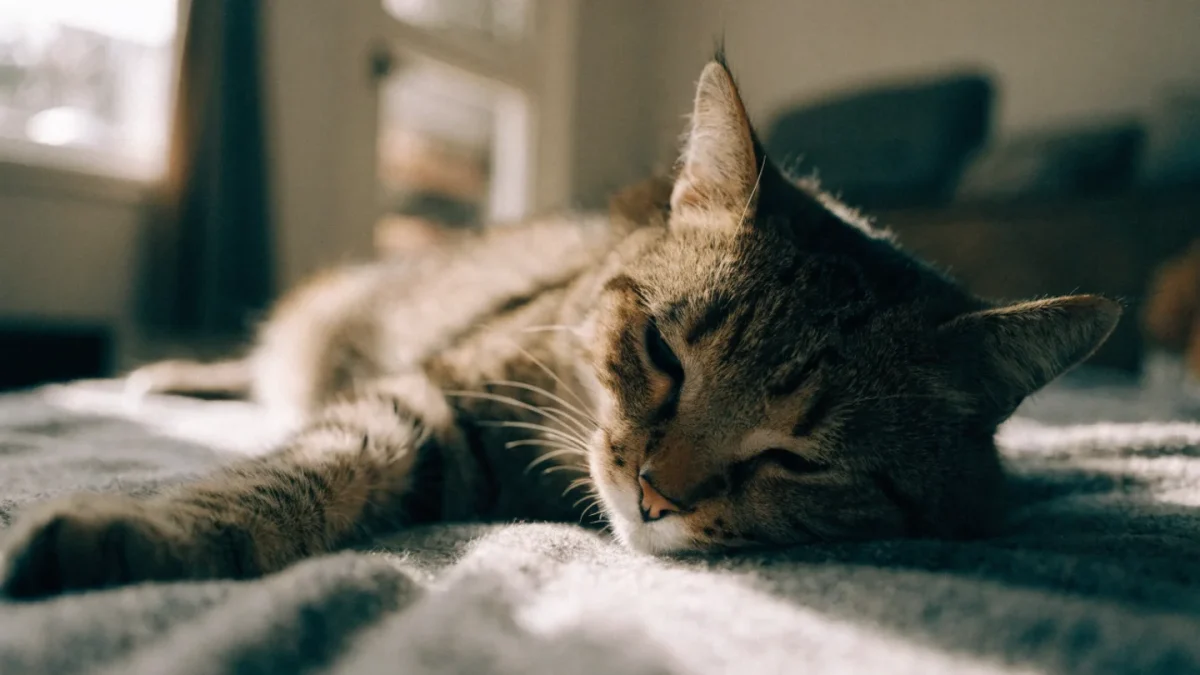
Here's what's actually going on when your cat starts vibrating like a little motor: it might mean she's blissfully happy, or it might mean she's terrified, sick, or trying to tell you something is wrong. The sound is the same. The meaning is not. All of this connects back to cat vocalizations explained, which is worth reading alongside this piece.
Cat purring meaning depends almost entirely on context. A purring cat isn't automatically a content cat — and once you understand the full range of what purring communicates, you'll start reading your cat very differently.
Purring Is a Communication Tool, Not Just an Emotion
Most people grow up assuming purring = happiness. Understandable. A cat curled up in your lap, rumbling away while you pet her — that's joy, right?
Sometimes, yes. But the vibration mechanism itself is more neutral than that. Cats produce purring through a rapid movement of the laryngeal muscles in the throat, which dilates and constricts the glottis — the space around the vocal cords — during both inhalation and exhalation. That's why purring sounds continuous and works in both directions of breathing, unlike most vocalizations. Veterinary research has confirmed this unique laryngeal mechanism using electromyography, showing that cats purr through intermittent nerve signaling to these muscles rather than continuous contraction.
What matters is that this mechanism can be triggered by multiple emotional and physiological states. Happiness is one of them. It's just not the only one.
The Contentment Purr (Yes, This One Is Real)
Start with the obvious: cats absolutely purr when they're happy, comfortable, and safe. My cat Mochi does a low, rolling purr whenever she settles into my lap that's practically meditative. She's relaxed, her body is loose, she's slowly blinking. Everything in her posture says she's at peace.
This kind of purring tends to be soft and rhythmically even. The cat's whole body reflects the mood — slow tail movement or stillness, soft eyes, relaxed ears facing forward. The purr is almost incidental, a background hum to a creature who has no complaints about the world right now.
If your cat is seeking you out, settling in, and purring after a good meal or a petting session, you can be pretty confident that's contentment. But that same sound in a different situation tells a different story entirely.
Purring Under Stress and Anxiety
This is where a lot of cat owners get confused — and where misreading the signal can actually cause problems.
Cats purr when they're anxious, overstimulated, or in an unfamiliar environment. A cat at the vet. A cat being held when she'd rather not be. A cat in a carrier who's been in the car for an hour. They're purring, so they must be okay, right?
Not necessarily. This is often called a self-soothing purr, and it's roughly analogous to a person humming quietly to themselves when they're nervous. The act of purring releases neurochemicals that have a calming effect. The cat is literally using the vibration to manage her own stress response.
The tell is the body language. A stress-purred cat will often have flattened or sideways ears, a tucked tail, wide pupils, or a tense, still posture. She might be avoiding eye contact or trying to make herself smaller. Reading her body language alongside the sound is the only way to actually know which kind of purr you're dealing with — and cat body language has a lot more signals than most people realize.
Purring When Sick or in Pain
Honestly, this is the one that surprises people the most, and it's worth taking seriously.
Cats don't just purr under emotional stress. They purr in physical distress too. A cat who is ill, injured, recovering from surgery, or in chronic pain may purr continuously — not because she's fine, but because the vibration itself appears to have physiological benefits. Research published in the Journal of the Acoustical Society of America has confirmed that the frequency range of a cat's purr (roughly 25–150 Hz) falls within ranges associated with bone density maintenance and tissue healing in other therapeutic contexts, though the extent to which cats consciously use this is still being studied.
What this means practically: if your cat is purring but seems off — less active than usual, not eating normally, hiding more, or reacting to being touched in certain areas — don't let the purring reassure you. It might be the opposite of reassurance.
This is one of those situations where the sound tells you nothing useful without everything else that's happening around it.
The "Feed Me" Purr
There's a more specific purr worth knowing about, sometimes called the solicitation purr or embedded cry purr. Some cats embed a higher-frequency cry within their purr when they want something — usually food. The result is a purr with an urgency to it, almost uncomfortable to hear. If you want the specifics, meow so much? reasons and solutions digs into this further.
Research published in Current Biology has found that humans, including non-cat-owners, rate this type of purr as more urgent and less pleasant than a regular purr. It seems to tap into something instinctive — the cry frequency mimics the frequency range of an infant's cry, which humans are biologically wired to respond to.
Mochi has this purr. It starts the moment I walk anywhere near the kitchen and it does not stop until I produce food. It's manipulative and it absolutely works.
Not every cat uses this vocalization, but if yours does, you'll recognize it once you know to listen for it. The pitch variation gives it away — it's not the smooth, even vibration of a contentment purr.
How to Read the Whole Picture
The real question isn't "is my cat purring?" — it's "what else is my cat doing?"
A purring cat who is:
- Approaching you, making eye contact, slow-blinking, or kneading → almost certainly content
- Pressed flat, ears back, avoiding touch, hiding → likely stressed or in pain
- Suddenly purring more than usual during a period of illness or recovery → possible pain response
- Escalating the pitch or intensity around meal times → solicitation purr, she wants something
Context clues that help distinguish: time of day, what just happened, whether anything has changed in the home recently, and whether the purring is accompanied by other vocalizations like chirping, trilling, or low growls.
Look, cats are rarely broadcasting one single clear signal. Most of the time they're layering multiple cues at once — the purr, the body posture, the tail, the ears, the eyes. The purr is just one frequency in a much more complex transmission.
When to Pay Attention to Unusual Purring
If your cat's purring behavior has changed noticeably — more frequent, more intense, or happening in contexts where it didn't before — that's worth paying attention to. Persistent purring during rest, combined with other changes in behavior or appetite, is a reason to have a vet check things out. Don't let a purring cat lull you into assuming everything is fine.
The cats who have gotten consistently misread aren't the ones who yowl or hiss — those signals are obvious. It's the quietly purring cats who were trying to tell someone something, and everyone assumed they were just happy.
FAQ
Why do cats purr when they're not happy?
Purring is a self-regulation tool, not just an expression of joy. Cats purr to calm themselves down when anxious or scared, and they also purr in physical pain or illness — the vibration appears to have a physiological calming and potentially healing function. The same sound gets used across very different emotional states.
Can a cat purring mean they're in pain?
Yes. This catches a lot of people off guard, but cats absolutely purr when they're hurting. If a cat is purring but also showing signs of withdrawal, reduced appetite, sensitivity to touch, or decreased activity, the purring isn't reassurance — it may actually indicate the opposite. A vet check is warranted.
What's the difference between a happy purr and a stressed purr?
The sound alone is hard to distinguish without context. The difference shows up in body language: a content cat is loose, soft-eyed, and seeking contact; a stressed cat will be tense, with flattened or sideways ears, avoidant gaze, and a tucked tail. The purr sounds similar — the body tells the rest of the story.
What is the solicitation purr?
Some cats embed a higher-pitched cry within their regular purr when they want food or attention. It sounds more urgent than a normal purr and has been shown in research to feel more demanding even to people who don't own cats. Not all cats use it, but those who do use it very effectively.