

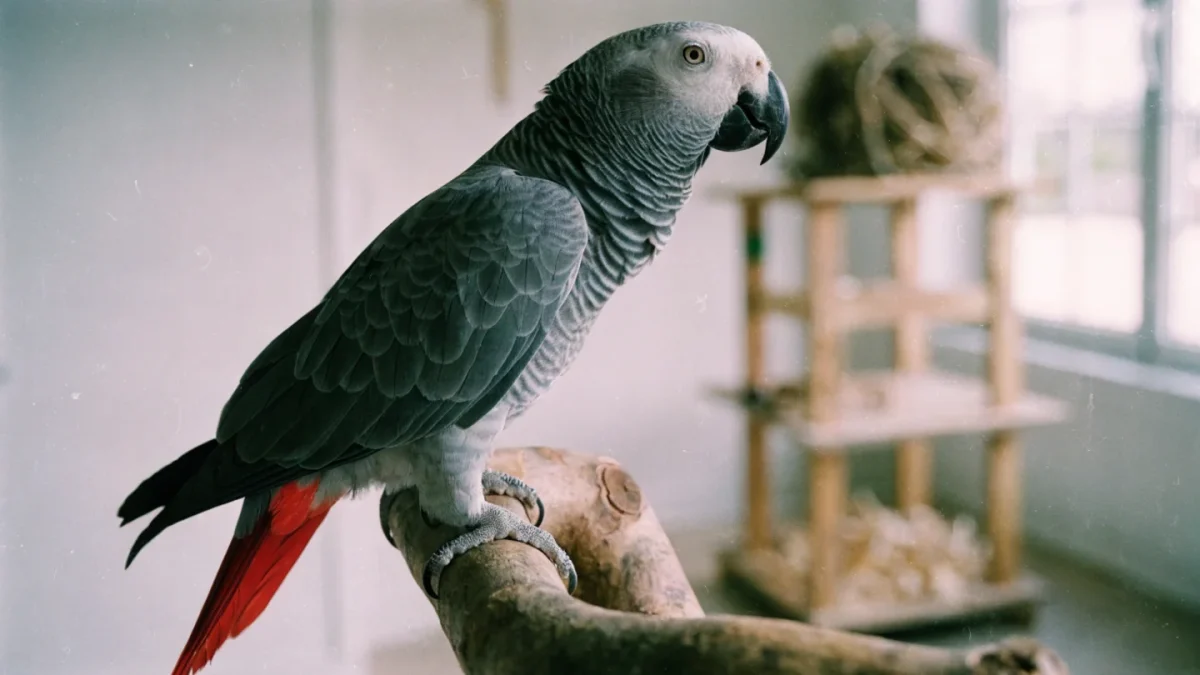
I got my first African Grey twelve years ago from a woman who was moving overseas and couldn't take the bird. He was nine, barely handled, and spent the first three weeks in my home refusing to step up, refusing treats, and staring at me with one eye tilted in what I can only describe as deep suspicion. On day twenty-two, he said "come here" in the woman's voice. Clear as a phone call. Then went back to ignoring me.
African Grey parrots (Psittacus erithacus) require a diet centered on high-quality pellets with calcium-rich vegetable supplements, a predictable daily routine, and meaningful mental stimulation — puzzle toys, training sessions, and social engagement — for several hours every day. Their intelligence is both their most remarkable trait and the primary reason they end up in rescues: owners aren't prepared for a bird that gets bored, anxious, or depressed when its cognitive needs go unmet.
The Intelligence Factor
Greys don't just mimic. They associate.
I'm not romanticizing this. The research from Dr. Irene Pepperberg with Alex the African Grey demonstrated that these birds can understand concepts like color, shape, quantity, and even absence — "none" was part of Alex's functional vocabulary. As documented in Pepperberg's The Alex Studies (Harvard University Press, 1999), that level of conceptual understanding was previously associated primarily with great apes and cetaceans.
What this means in your living room is a bird that learns your schedule, recognizes your moods, and uses words in context. My Grey says "want grape" when he sees me near the fridge. Not randomly. When I'm near the fridge. He also says "good night" when I turn off the living room light, and "what's that?" when he hears an unfamiliar sound. These aren't party tricks — they're functional communication.
The flip side is that intelligent animals suffer more acutely from boredom and isolation. A Grey left alone for ten hours with nothing but a mirror and a seed cup isn't just unhappy. It's the cognitive equivalent of solitary confinement for an animal that evolved to live in flock groups of dozens.
Diet and the Calcium Problem
African Greys are more prone to hypocalcemia than any other commonly kept parrot species. Low blood calcium leads to seizures, weakness, and eventually death. I've had two emergency vet visits with rescue Greys presenting with calcium crashes — both were on all-seed diets.
Build the diet around pellets: 60-70% of daily intake. Supplement with calcium-dense vegetables — broccoli, kale, collard greens, bok choy — and offer cuttlebone or a calcium block as a passive supplement. Some avian vets prescribe liquid calcium for birds with documented deficiency.
Nuts are fine in moderation. Almonds are a good choice — lower in fat than sunflower seeds and a decent calcium source. Walnuts, a few times a week. Brazil nuts sparingly because of selenium content. Skip peanuts in the shell unless you're confident they're aflatoxin-free.
Fresh fruits — berries, papaya, melon — work as training treats and foraging rewards. But fruit shouldn't make up more than 10-15% of the diet. The sugar content isn't ideal for a bird that's already predisposed to obesity in a captive setting.
I do a morning "chop" for my Grey: a mix of finely diced peppers, snap peas, shredded carrots, a bit of cooked sweet potato, and whatever leafy greens I have. He picks through it, throwing about half of it on the floor. That's normal. Greys are opinionated eaters.
Enrichment That Actually Works
Forget the plastic toy with the bell inside. Greys want to destroy things.
Foraging is the backbone of Grey enrichment. In the wild, these birds spend hours finding and processing food. In captivity, we hand them a bowl. The gap between those two experiences is where behavior problems breed. Wrap pellets in paper. Hide nuts inside cardboard tubes. Thread vegetables onto skewers. Use puzzle feeders that require manipulation to access the food inside.
Rotate toys weekly. A Grey that's stared at the same three hanging toys for a month has stopped seeing them. Introduce one new item, remove one old item. Novelty matters — though some Greys are deeply suspicious of new objects and need the new toy placed near (not inside) the cage for a few days before they'll interact with it.
Training sessions are enrichment gold. Greys respond well to target training, and you can build from there to retrieve, color identification, and simple puzzle-solving. Keep sessions under fifteen minutes. End on a success. Use a specific treat that only appears during training — this creates a clear signal that training time is happening.
My Grey learned to sort colored rings onto matching pegs in about three weeks. It took me longer to figure out how to teach it than it took him to learn it. That ratio is pretty standard with these birds.
Emotional Needs and Behavioral Red Flags
This is where African Grey care diverges from most other parrot species. Greys bond intensely — often to a single person — and can become genuinely distressed when that person's schedule changes, when the household dynamic shifts, or when the environment becomes unpredictable.
Signs of stress in a Grey: feather plucking (especially chest and back feathers), increased aggression, phobic behavior (sudden terror of familiar objects), excessive screaming, and appetite changes. I watched a rescue Grey pull out every feather on its chest in a single afternoon after being moved to its third home in two months. The bird looked like it was wearing a vest of bare skin.
Routine matters more for Greys than for macaws or cockatoos. Feed at the same times. Maintain a consistent sleep schedule — 10-12 hours of dark, quiet rest. Introduce changes gradually. If you're rearranging furniture, move one piece at a time and let the bird observe from a distance.
One thing that surprises new Grey owners: these birds often prefer calm, quiet interaction over the boisterous play that macaws enjoy. A Grey might be perfectly content sitting on your shoulder while you read, occasionally preening your hair or muttering quietly. Forcing high-energy interaction with a bird that wants proximity, not performance, creates tension.
If you've read about large parrot care fundamentals, you'll know the social demands are significant across all large species. But Greys express those needs more quietly, which means they're easier to ignore — and that's dangerous.
Who Should (and Shouldn't) Keep a Grey
African Greys are a poor fit for first-time parrot owners, despite what pet store employees might say. They're a poor fit for households with unpredictable schedules, frequent moves, or lots of noise and chaos. They're a poor fit for people who want a cuddly bird — some Greys tolerate petting, many don't, and pushing physical contact on a Grey that doesn't want it erodes trust fast.
They're a great fit for patient, observant people who find intelligence fascinating and are willing to build a relationship over months and years. People who enjoy routines. People who can provide a quiet, stable home and don't mind a bird that may never enjoy being held but will learn fifty words and use them appropriately.
If you're comparing a Grey to macaw ownership, the biggest difference isn't size or noise — it's temperament. Macaws are extroverts. Greys are introverts with a gift for language. Choose accordingly.
FAQ
How many words can an African Grey learn?
There's no fixed ceiling. Some documented Greys have functional vocabularies exceeding 200 words, with contextual usage that goes beyond mimicry. My Grey uses around 80-90 phrases, and he still picks up new ones — usually phrases I didn't intend to teach. Not every Grey will be a prolific talker. Some are quieter, some prefer whistles and sound effects. Don't buy a Grey expecting a conversation partner; buy one prepared for the possibility.
Do African Greys get along with other parrots?
Sometimes. Greys can coexist with other parrots if given separate cages and supervised interaction, but they rarely form close bonds with other species. Two Greys can work, though same-sex pairs may clash. I housed my Grey near a cockatiel for years and they developed a mutual tolerance that occasionally resembled friendship — mostly expressed through the Grey perfectly imitating the cockatiel's flock call at inappropriate moments.
Why does my African Grey bite more now than when I first got it?
Greys go through a "bluffing" phase, usually between 1-3 years of age, where biting increases dramatically. It's developmental, not a personality shift. Respond by not reacting (no yelling, no dropping the bird) and using step-up commands to redirect. If the biting started suddenly in an adult Grey, look at environmental changes: new people, schedule disruptions, illness, or pain. A vet visit is warranted if the change is abrupt.
What temperature should I keep my African Grey's room at?
Standard household temperatures — 18-27°C (65-80°F) — work fine. Avoid drafts, especially from air conditioning vents aimed near the cage. Greys are more sensitive to sudden temperature drops than to a specific range. If the room gets cold at night, a ceramic heat emitter placed safely outside the cage can help, but most homes don't need supplemental heating for these birds.