

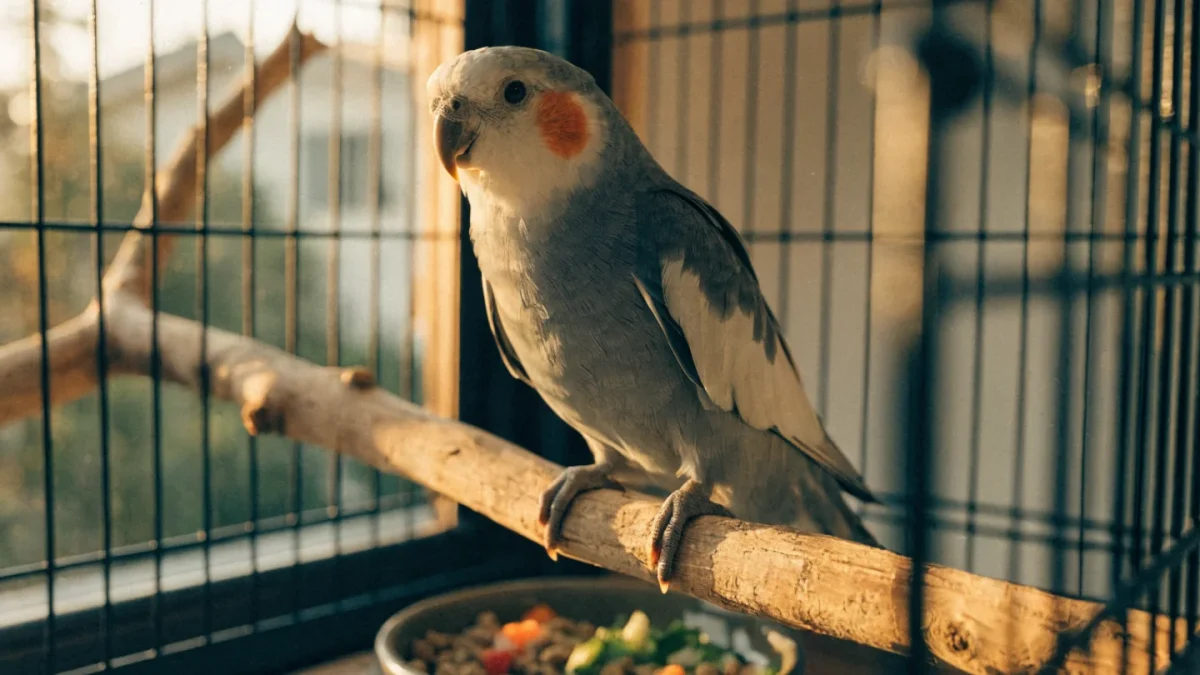
The first cockatiel I ever kept was a hand-raised grey pearl female I got at fourteen. She lasted twenty-three years. Twenty-three. I had her through high school, college, three apartment moves, and most of my professional career. Most people don't realize they're signing up for that kind of timeline when they bring home a thirty-dollar bird from a pet store.
Cockatiels (Nymphicus hollandicus) need a spacious cage, a diet built around pellets and fresh vegetables rather than just seeds, 10-12 hours of darkness for sleep, and meaningful daily interaction outside the cage. They're social, emotionally complex birds that will develop feather-destructive behavior, excessive screaming, or outright aggression when their needs go unmet. And those needs aren't complicated — they just require consistency over a very long stretch of time.
Why Cockatiels Are Different From What You'd Expect
People treat cockatiels like they're a step up from a goldfish. Small bird, small cage, throw in some seeds, done. But cockatiels are parrots. Small parrots, sure — the smallest member of the cockatoo family, technically — but parrots all the same. They form pair bonds. They vocalize to communicate. They need problem-solving opportunities to stay mentally healthy.
I've worked with dozens of cockatiel owners who got frustrated because their bird "suddenly" started biting or screaming after a year of being perfectly calm. Almost every time, the root cause was the same: nothing changed in the bird's environment. That's the problem. Cockatiels need novelty. Rotate perches, introduce foraging toys, rearrange the cage layout every few weeks. A static environment is a boring environment, and a bored cockatiel is a loud cockatiel.
They're also dust machines. Cockatiels produce powder down — a fine white dust from specialized feathers — that coats everything within a few feet of the cage. If you have asthma or allergies, this is a deal-breaker, not a minor inconvenience.
Cockatiel Care Guide: Setting Up the Right Cage
Minimum cage size for a single cockatiel: 24 inches long by 18 inches wide by 24 inches tall. But honestly, bigger is always better, and flight cages that are 36 inches or longer let the bird actually move the way it needs to.
Bar spacing matters more than people think. Half-inch spacing is the maximum — anything wider and a cockatiel can wedge its head between bars, which can be fatal. I saw it happen once at a rescue intake. The previous owner had used a cage meant for a larger parrot. The bird survived, but it had neck injuries that took weeks to heal.
Horizontal bars on at least two sides of the cage. Cockatiels are climbers, and vertical-only bars leave them no way to move laterally across the cage walls. Natural wood perches of varying diameters — not the smooth dowel rods that come with most cages. Those uniform surfaces contribute to pressure sores on the feet over time.
Place the cage against a wall rather than in the center of a room. A wall on one or two sides gives the bird a sense of security. Avoid the kitchen entirely — nonstick cookware fumes (PTFE/polytetrafluoroethylene) are lethal to birds at temperatures that seem perfectly normal for cooking.
Diet: Beyond the Seed Cup
Seeds are not a complete cockatiel diet. Full stop. A cockatiel on an all-seed diet is eating the nutritional equivalent of a human living on french fries — calories, sure, but desperately lacking in vitamins A and D, calcium, and most amino acids.
The base of a cockatiel's diet should be a formulated pellet — roughly 60-70% of daily intake. Pellets are designed to deliver balanced nutrition in every bite, which matters because cockatiels are expert food-sorters. Give them a mix and they'll pick out the sunflower seeds and ignore everything else.
Fresh vegetables daily: dark leafy greens (kale, Swiss chard, dandelion greens), shredded carrots, broccoli florets, sweet potato. Some cockatiels take to vegetables immediately; others need weeks of patient introduction. I've had success with clipping leafy greens to cage bars so the bird can shred them during play — it taps into their natural foraging behavior and bypasses the suspicion they have about things in their food bowl.
Fruit in small amounts — maybe two or three times a week. Berries, apple slices (no seeds), melon. Too much fruit means too much sugar.
Seeds as treats, not staples. A pinch of millet spray as a training reward. That's the right context for seeds.
Fresh water daily, obviously. I use open ceramic crocks rather than tube waterers because they're easier to clean thoroughly, and bacterial buildup in those tubes is something a lot of owners don't notice until the bird gets sick.
If you want the full breakdown on transitioning from seeds to pellets and which fresh foods work best, I've put together a separate guide on that — it's a process that takes patience, and some birds resist the change for weeks.
Bonding and Socialization
Cockatiels are flock animals. In the wild, they live in groups, sometimes numbering in the hundreds. Your single pet cockatiel has exactly one flock member: you. If you're not spending time with the bird outside the cage every day — an hour minimum — you're leaving it socially isolated.
Start with hand-taming if the bird isn't already tame. Sit near the cage and talk quietly. Offer millet through the cage bars. Then open the door and let the bird come out on its own terms. Forcing a cockatiel out of its cage destroys trust in about five seconds and takes weeks to rebuild.
Once the bird is comfortable stepping onto your hand, build from there. Shoulder sitting during calm activities (reading, watching something on a screen), supervised time on a play stand, target training with a chopstick. Cockatiels can learn to follow a target stick remarkably fast — most get it within two or three sessions.
I had a cockatiel client once — a normal grey male named Dexter — whose owner traveled for work three weeks a month. Dexter had started pulling out his chest feathers. The owner thought it was a medical problem, but the avian vet couldn't find anything wrong. It was loneliness, plain and simple. They ended up getting a second cockatiel, and Dexter's feathering came back within two months.
That said, a second bird is not a substitute for human interaction. Two cockatiels will bond with each other and potentially become less interested in you. If your goal is a tame, interactive companion, a single bird with lots of your time is the better path.
Health Signals You Shouldn't Ignore
A healthy cockatiel is alert, active, has smooth feathers, clear eyes, and produces firm droppings with a distinct white urate portion. Learn what your bird's normal droppings look like — it's the earliest health indicator you have.
Warning signs that need an avian vet — not a regular vet, an avian specialist:
Fluffed up and sitting on the cage floor. This is a bird that's too sick to perch. By the time a cockatiel shows this kind of obvious illness, things are already serious. Birds hide weakness instinctively because showing illness in a flock makes them a predator target.
Discharge from the nares (nostrils) or eyes. Sneezing with wet discharge. Tail-bobbing while breathing — that rhythmic up-and-down movement of the tail feathers synchronized with each breath. Any respiratory sign in a bird demands same-day veterinary attention.
Changes in droppings: watery, discolored (especially black or bright green without matching food intake), or a sudden decrease in volume. Also watch for undigested seeds in droppings, which suggests the bird isn't processing food properly.
Weight loss. You can't eyeball this with a bird because feathers disguise body condition. Get a small gram scale and weigh your cockatiel weekly. A healthy adult cockatiel weighs between 80 and 120 grams depending on the individual. A drop of more than 10% body weight is an emergency.
Singing, Whistling, and Noise
Males are the showoffs vocally. A male cockatiel in good spirits will whistle, mimic tunes, and create elaborate little songs that he performs repeatedly — especially when he sees his own reflection or when you come home. Females vocalize too, but they lean more toward contact calls (the high-pitched "flock call" that means "where are you?") than sustained melodies.
The noise level is moderate compared to larger parrots. You won't need earplugs. But the flock call — that sharp, repetitive whistle a cockatiel makes when it can hear you but can't see you — carries. It's designed to travel across open Australian grassland, and it will travel across your apartment with no trouble at all.
If the screaming becomes excessive, it's almost always a communication issue, not a behavioral defect. The bird wants attention, or it's startled, or its schedule has been disrupted. Yelling back at a screaming cockatiel reinforces the behavior — they got what they wanted, which was a response from their flock.
Whistle training is one of the most rewarding parts of cockatiel ownership. Pick a short, simple tune and whistle it to your bird repeatedly, every day. Male cockatiels especially will pick it up within a few weeks and perform it back. I had one that learned the opening bars of a TV theme song and would belt it out every time someone walked past his cage.
Sleep, Light, and Routine
Cockatiels need 10-12 hours of uninterrupted, quiet darkness for sleep. Not "the TV is on but the lights are dim." Actual darkness. Cover the cage with a breathable cover or move the bird to a quiet, dark room.
Light matters too. Birds perceive a much wider spectrum than we do, and artificial lighting with flicker (which most fluorescent and some LED bulbs produce at frequencies invisible to humans but very visible to birds) can cause chronic stress. Full-spectrum lighting designed for avian use, run on a timer to match a natural day-night cycle, is the gold standard.
Night frights are a cockatiel-specific concern. Something startles the bird in the dark — a shadow, a car headlight sweeping across the ceiling, even a noise — and it panics, thrashing around the cage. This can result in broken blood feathers, bruised wings, or worse. A dim night light near the cage reduces night fright incidents dramatically.
Routine matters more than most owners realize. Cockatiels thrive on predictability: wake time, feeding time, out-of-cage time, bedtime. Disrupted routines cause stress, and stressed cockatiels get louder and more nippy.
The Twenty-Year Question
A well-cared-for cockatiel can live 20-25 years. Some hit 30. That's not a pet you're getting for your kid who'll be off to college in four years — it's a commitment that spans decades.
Think about that. Where will you be living in fifteen years? Will your future roommate, partner, or landlord accept a bird? Can you afford annual avian vet checkups for twenty years? What's your plan when you travel?
I've taken in cockatiels from owners who moved overseas and couldn't bring them. From people who developed bird allergies after a decade. From college students who got the bird at eighteen and at twenty-two discovered that their first apartment didn't allow pets. Planning ahead isn't pessimism. It's responsible ownership.
If you've compared this to budgie care, you'll notice budgies are smaller and shorter-lived, but cockatiels are calmer and form deeper one-on-one bonds. The right choice depends on what you want from the relationship.
FAQ
Do cockatiels need to be kept in pairs?
No. A single cockatiel with sufficient daily human interaction will thrive. Pairs are great if you can't provide several hours of social time daily, but paired birds often bond with each other and become less handleable. It's a trade-off, not a rule.
Can cockatiels live with budgies or other small birds?
I've seen mixed-species aviaries where cockatiels and budgies coexist, but I don't recommend it in a standard cage. Budgies are more aggressive for their size than people expect, and cockatiels are surprisingly passive. The budgie usually dominates food access and preferred perching spots. If you try it, the enclosure needs to be large enough that both species can maintain separate areas.
How often should I take my cockatiel to the vet?
Annual wellness exams with an avian-certified vet. Not a dog-and-cat vet who "also sees birds." Avian medicine is a specialty, and a general practitioner may miss subtle signs. The exam should include a physical, a gram weight comparison to previous visits, and discussion of diet and behavior changes. Budget for blood work every year or two once the bird is past ten.
Why does my cockatiel hiss at me?
Hissing is a warning — the bird feels threatened or cornered. It's not aggression in the way people think. Back off, give the bird space, and figure out what triggered it. Common culprits: approaching too fast, reaching directly into the cage from above (raptor silhouette), or disturbing the bird during rest. Hissing is communication, and the correct response is to listen to it.